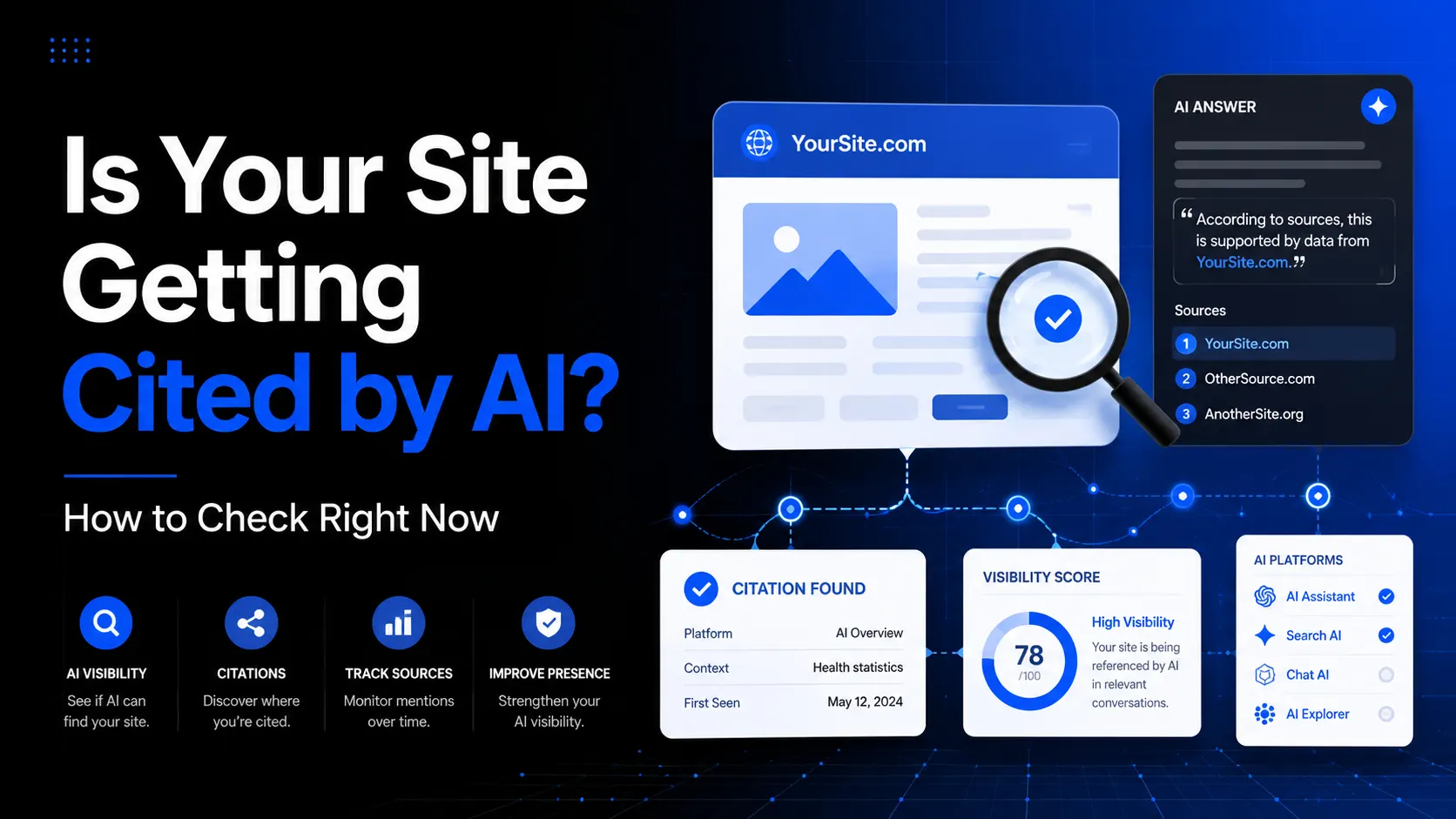
Is Your Site Getting Cited by AI? How to Check Right Now
Key Takeaways
- You can check whether your content is being cited by ChatGPT, Perplexity, and Google AI Overviews right now. Most site owners have never done this and are surprised by what they find.
- AI citation and Google ranking are two different things. A page can rank #1 for a keyword and never appear in an AI-generated answer for the same query.
- Each AI platform pulls from different sources with different selection logic. Checking one platform tells you nothing about the others.
- The sites that do appear in AI citations share specific structural patterns: direct answers to specific questions, FAQ schema, clean HTML, and original data that models can’t synthesize on their own.
How to Check if AI Search Is Citing Your Content
AI citation visibility is something most businesses have never measured. They track Google rankings, monitor organic traffic, and watch Search Console data. But they have no idea whether ChatGPT, Perplexity, or Google AI Overviews are referencing their content when users ask questions about their industry.
That blind spot is a problem. AI search usage doubled in 2025, and the users asking questions through these platforms are high-intent. They’re researching, comparing, and making decisions. If an AI tool recommends your competitor when someone asks about your product category, that’s a lost opportunity you never knew about.
Here’s how to check each platform.
Checking ChatGPT Citations
Open ChatGPT with web browsing enabled. Type a question that your target customer would ask about your product, service, or industry. Don’t use your brand name. Use the same language a prospect would use.
For example, if you sell project management software, ask: “What are the best project management tools for remote teams under 50 people?”
Look at the response. Does ChatGPT mention your brand? Does it link to your site in the citations at the bottom? If it links to a competitor’s comparison page or a review site instead of your own content, that’s your gap.
Run this test with 8-10 different questions that map to your key topics. Record which queries cite your content, which cite competitors, and which cite third-party sources like review sites or publications. That gives you a baseline citation map.
We covered the mechanics of how ChatGPT selects which sources to cite in a separate piece if you want the full breakdown of the selection logic.
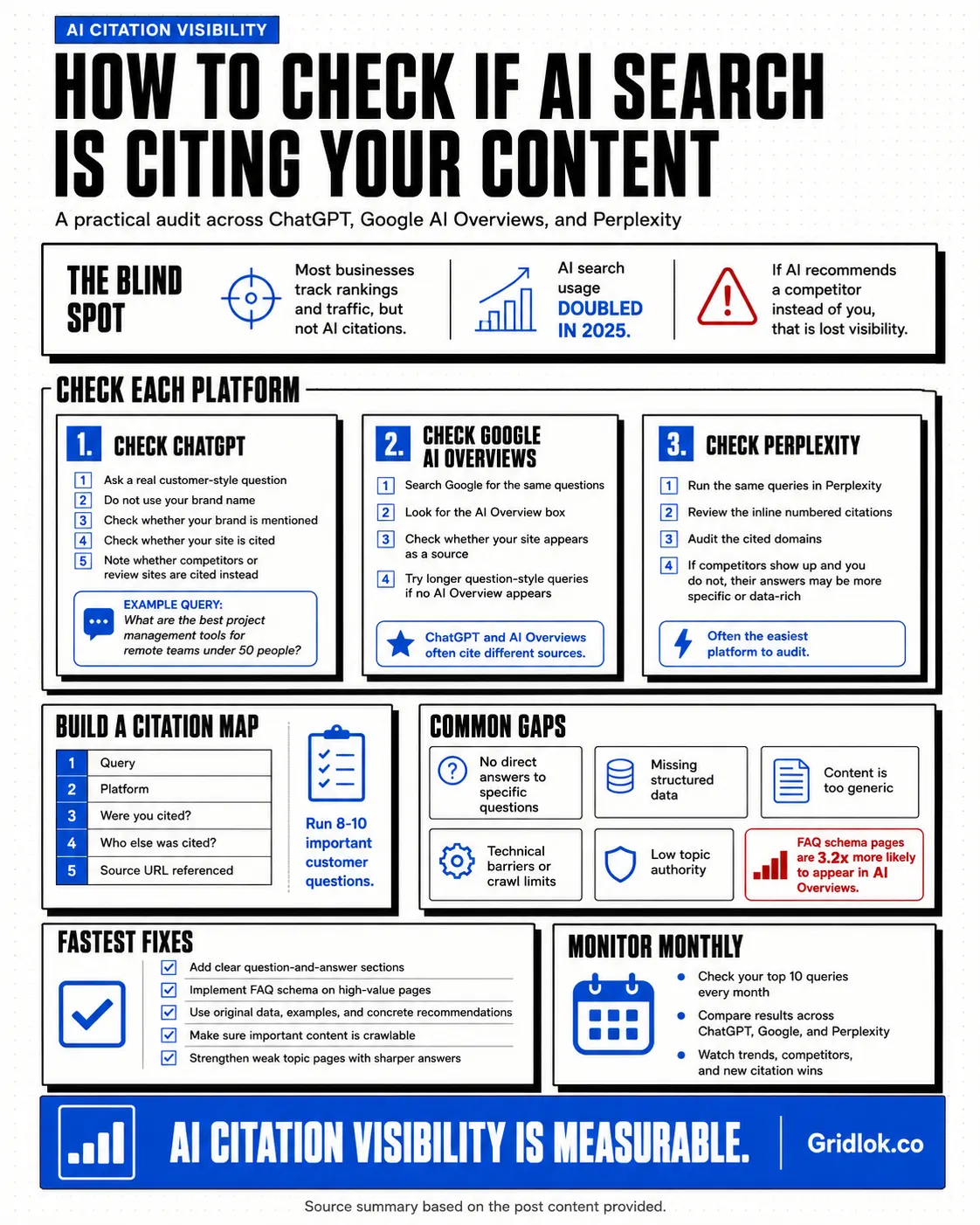
Share this infographic anywhere you want. Embedding it on your site? A link back to Gridlok is appreciated.
Embed Code — Copy and Paste
<a href="https://gridlok.co/blog/is-your-site-getting-cited-by-ai/">
  <img src="https://gridlok.co/wp-content/uploads/2026/05/Getting-cited-by-ai-convertcompress.webp"
       alt="Is Your Site Getting Cited by AI? How to Check Right Now"
       style="max-width:100%;height:auto;border:0;" />
</a>
<p>Infographic by <a href="https://gridlok.co">Gridlok</a></p>
Checking Google AI Overviews
Search Google for the same questions you used in ChatGPT. Look for the AI Overview box at the top of the results page. If one appears, check whether your site is listed as a source.
AI Overviews don’t appear for every query. They’re more common for informational and comparison queries. If you’re not seeing AI Overviews for your target keywords, try longer, more question-style queries.
One thing to watch: Google AI Overviews and ChatGPT cite completely different sources for the same topics. A page that gets cited by ChatGPT might be invisible to AI Overviews, and vice versa. You need to check both.
Checking Perplexity
Go to perplexity.ai and run the same queries. Perplexity is the most transparent about its sources, showing numbered citations inline with the response text. This makes it the easiest platform to audit.
Pay attention to the source domains. Perplexity tends to favor authoritative, data-rich pages. If your competitors show up here and you don’t, it’s usually because their content provides more specific, structured answers to the query.
What to Do When You’re Not Getting Cited
If you ran these checks and found your content missing from AI citations, that’s actually useful information. It means there’s a specific, fixable gap between your content and what AI systems are looking for.
The most common reasons content gets passed over:
No direct answers to specific questions. Your page talks about the topic in general terms but doesn’t provide a clear, quotable answer to a specific question. AI systems need extractable statements they can synthesize into responses.
Missing structured data. Pages with FAQ schema are 3.2x more likely to appear in AI Overviews. If your competitors have schema markup and you don’t, that’s a structural disadvantage.
Content is too generic. AI systems prefer content with original data, specific examples, and concrete recommendations over pages that restate what’s already widely available. If your page could have been written by anyone in your industry, it won’t stand out to a model that has access to everything in your industry.
Technical barriers. Your FAQ content might exist but sit below the 2 MB crawl limit cutoff. Or your robots.txt might be blocking specific AI crawlers without you realizing it.
Low domain authority for the topic. Citation selection factors in domain credibility. A newer site needs stronger structural optimization to compete with established domains for the same citations.
How to Track Citation Visibility Over Time
This isn’t a one-time check. AI citation results change as models update, as your content changes, and as competitors optimize. Set up a monthly cadence.
Pick your 10 most important topic queries. Run them through ChatGPT, Google (for AI Overviews), and Perplexity. Record the results in a spreadsheet: query, platform, whether you were cited, which competitors were cited, and the source URL that was referenced.
Over time, this gives you a citation trend line. You’ll see which optimizations are working, which competitors are gaining ground, and which queries represent unclaimed citation territory.
Don’t want to do this manually every month? Let me handle it. I run cross-platform citation audits and deliver monthly visibility reports so you know exactly where you stand across every major AI search platform.
Frequently Asked Questions
Can I see AI citation data in Google Search Console?
Not directly. Search Console tracks impressions and clicks from traditional search results and AI Overviews, but it doesn’t break out which pages were cited within AI Overview responses specifically. Manual testing across platforms is currently the most reliable method for measuring citation visibility.
How often do AI citation results change?
Frequently. ChatGPT’s web browsing results can change daily based on what it finds during real-time searches. Google AI Overviews update as the index changes. Monthly monitoring is the minimum cadence for tracking meaningful trends. Reach out if you want ongoing citation tracking set up for your brand.
Does ranking #1 on Google mean I’ll be cited by AI Overviews?
No. AI Overviews pull from indexed content based on different selection criteria than traditional ranking. A page at position #4 with clear FAQ schema and direct answers can be cited over the #1 result if the #1 page is a general guide without structured, extractable answers.
What’s the fastest way to start getting cited?
Add FAQ schema to your highest-traffic pages with clear, specific answers to questions your audience is asking. That single change, combined with making sure your FAQ content isn’t being truncated by crawl limits, is the highest-impact quick win. For a full strategy, check out our AEO services or get in touch.
See what ChatGPT is really searching
SubSeed captures the hidden Google queries ChatGPT runs behind every answer and enriches them with search volume, CPC, and keyword difficulty.