The Website Features We Killed, Then Brought Back
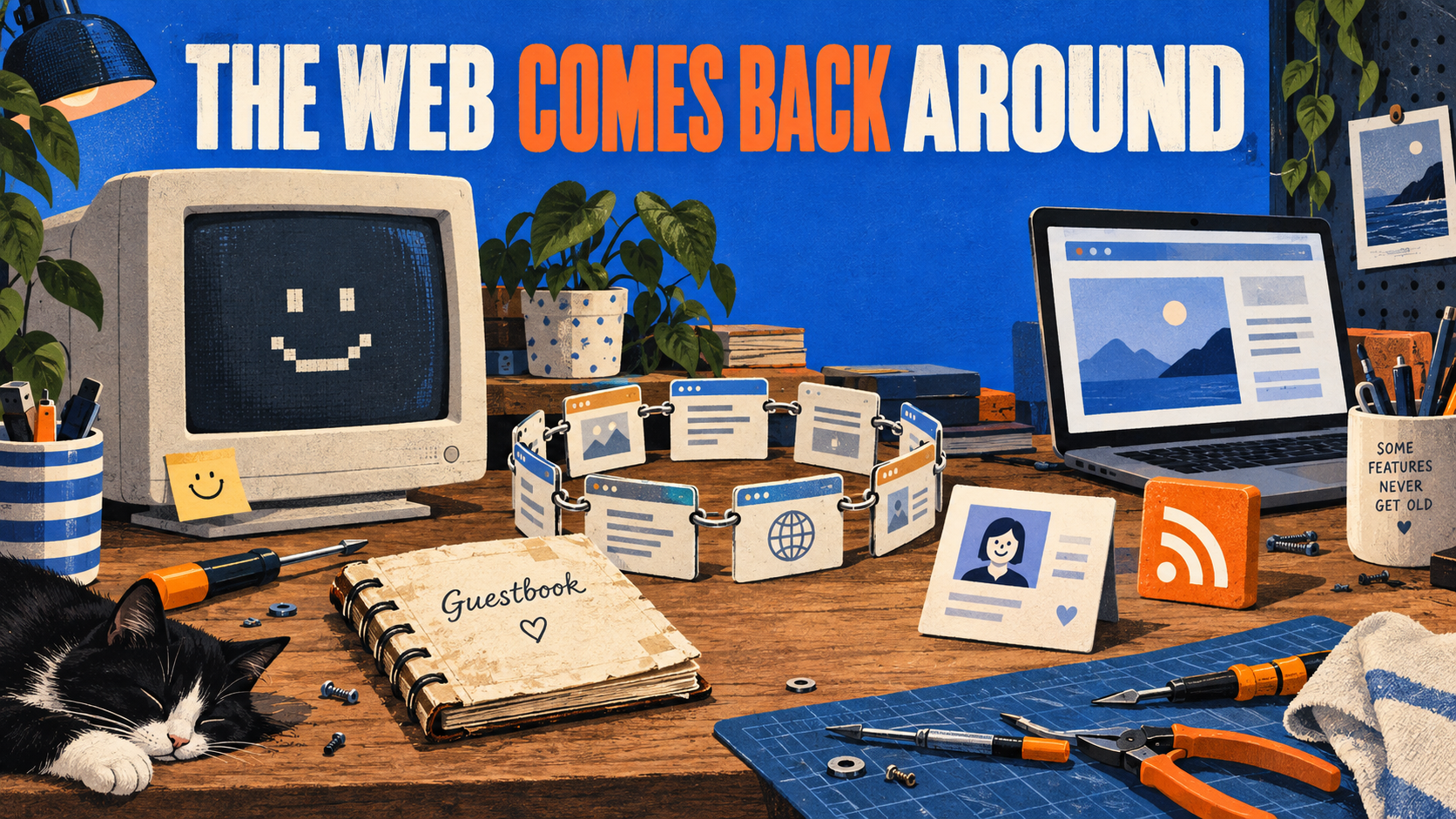
A guestbook asks you to leave a message. A links page sends you somewhere the owner likes. A feed tells you when that owner has written something new.
These are small website features with unusually clear jobs. They can look old-fashioned because we recognize them from personal pages, but the need behind each one is still easy to explain.
The comeback is visible in specific projects: personal-site hosts, small-web directories, and people publishing their own pages. Look at what those projects actually offer before declaring that the entire internet has changed its mind.
The personal website gives its owner more decisions
Neocities offers static HTML hosting and describes itself as a place for personal websites. Its examples include portfolios, fan sites, project notes, and community archives. Neocities, project description and history.
That freedom changes the shape of a page. A person can make an entire section for a niche interest, decide how its navigation works, and keep a record that does not have to fit a standard post format.
The benefit comes with responsibility. Somebody chooses the filenames, fixes broken links, and decides what the site is for. A neglected personal site can be charming; a neglected support page can leave a player stuck.
For a studio, a small site can still express a point of view through its screenshots, writing, project notes, and recommendations. It does not need a complicated application to do those things.
| Feature | Visitor benefit | Owner’s ongoing task |
|---|---|---|
| Personal homepage | A stable introduction to a person or project | Keep the description and main links current. |
| Links page | Recommendations from a named curator | Check destinations and explain why they belong. |
| Guestbook | A public place to leave a greeting | Moderate submissions and handle spam. |
| Feed | A way to follow new entries | Publish consistent dates and item links. |
| Web ring or directory | A route through related independent sites | Maintain membership and navigation. |
A links page is an editorial choice
A good links page tells the visitor more than which URLs the owner collected. It explains what each destination is good for and why the owner thinks it deserves attention.
Kagi’s September 2023 Small Web announcement describes an initiative for surfacing independent web content. Its published website list is available through the project’s linked repository. Kagi, Small Web launch, September 2023.
Readers can see who chose the sites and decide whether they trust the selection. A short explanation beside each link gives them a reason to follow it.
A game studio could keep a short page of modding resources, community tools, accessibility references, or supported fan projects. Add a description and a review date. Keep official support clearly identified so a community recommendation is not mistaken for a promise from the developer.
What will the visitor find?
Describe the destination in a sentence. A clever site name may tell a new visitor almost nothing.
Why is it on this list?
State the useful quality or relationship. Keep paid placements and other material connections clearly identified.
Does the destination still match?
Check that the URL loads and still serves the described purpose. A working redirect can lead somewhere unrelated.
Who looks after the list?
Assign a reviewer and a repeatable schedule. A short maintained list is easier to trust than a large abandoned collection.
RSS lost a browser feature and kept a useful job
Mozilla removed feed previews and Live Bookmarks in Firefox 64 in December 2018. Its support article points readers to replacement feed readers and explains how to export existing bookmarks. Mozilla Support, Firefox feed-reader changes.
That is a change in a browser interface. The underlying job remains straightforward: a reader follows a feed and receives new items without visiting each site separately.
The RSS 2.0 specification describes a channel containing items, with fields such as titles, links, and descriptions. A publishing system can use that structure to distribute updates. RSS Advisory Board, RSS 2.0 specification.
For a game studio, a development-log or patch-note feed can serve players, journalists, and community maintainers. Give each entry a permanent page and a clear date. A feed becomes frustrating when every item is called “Update” and the destination keeps changing.
| Field or behavior | Good example | Check |
|---|---|---|
| Title | Game name, version, and update topic | Can readers distinguish entries in a list? |
| Item link | The permanent update page | Does it open the entry rather than the homepage? |
| Description | A short account of what changed | Does it help a reader decide whether to open it? |
| Date | The entry’s publication or update date | Is the ordering consistent? |
Ask Jim about adding a maintained resource page or update feed.
A guestbook comes with a chair for the moderator
A public message box looks simple until people use it. A studio needs to decide whether the space is for greetings, support, feedback, or conversation. Those are different commitments.
If it accepts support requests, someone needs to respond and move private details out of public view. If it is for greetings, say so and provide a separate support route.
Build the moderation process before inviting submissions. Decide what is displayed, whether entries are reviewed first, and how someone requests removal. A friendly feature should not surprise its visitor with public exposure.
The old web offers plenty of inspiration without requiring every feature to return. Choose the one your team can look after.
Which feature earns a place on your site?
Add or surface a feed for dated posts. Check item titles, permanent links, and the update schedule.
Help people follow updates
Add or surface a feed for dated posts. Check item titles, permanent links, and the update schedule.
Recommend useful resources
Build a short links page with an explanation beside each destination. Give it a named owner and review date.
Give the studio a recognizable voice
Publish a readable about page and occasional project notes. Connect the writing to the games and people behind them.
Invite public greetings
Use a moderated guestbook with a clear purpose. Explain what becomes public and provide a separate route for support.
Connect independent creators
Consider a small directory or web ring with clear membership rules. Keep each destination current and easy to leave or replace.
Add one feature and see whether people use it
Place the feature where it supports an existing task. A patch-note feed belongs near updates. A list of community tools belongs beside the relevant game or modding information.
Keep the main website structure ordinary enough to use. Descriptive titles, headings, and links help a new visitor understand the page before they appreciate its personality.
Set a review date after launch. Look for actual use: feed requests, clicks to recommended resources, useful submissions, or fewer repeated questions. Choose a measure that matches the feature’s job.
Preservation projects show how much personality personal pages can contain. A maintained small feature can give your own site some of that character while doing something useful for the next visitor.
Sources and calculations
Project dates come from Neocities, Kagi, and Mozilla. Feature comparisons and the picker are Gridlok’s recommendations. The examples document particular projects and functions.
Want visitors to have a reason to return?
Send Jim the feature you are considering and who would maintain it. We can plan a useful resource page, update feed, or community feature.
Talk to Jim about a useful site featureFrequently asked questions
The projects here show continuing interest in independent and personal websites. A broad adoption claim would need a defined measurement of sites over time.
Yes. Feed readers can consume published feeds. Firefox’s removal of its built-in features changed one way of accessing them.
It can, when the selection is relevant, explained, and maintained. A list of unexplained or outdated URLs is much less useful.
A dated update feed or a concise resource page often has a clear purpose. Choose according to the player task and the team member who will maintain it.
Keep reading
References
See what ChatGPT is really searching
SubSeed captures the hidden Google queries ChatGPT runs behind every answer and enriches them with search volume, CPC, and keyword difficulty.
Related Posts
Read this post with an assistant
This is the whole prompt each button sends. Nothing hidden in it.
Read https://gridlok.co/blog/website-features-comeback/ and give me the main points in a few sentences.
Make Gridlok a Preferred Source on Google
See Gridlok surfaced more often in your Top Stories, AI Overviews, and AI Mode. One click, applied across Google Search.