Search Queries Are Getting Longer: What the 2025 Data Means for Content Strategy
Key Takeaways
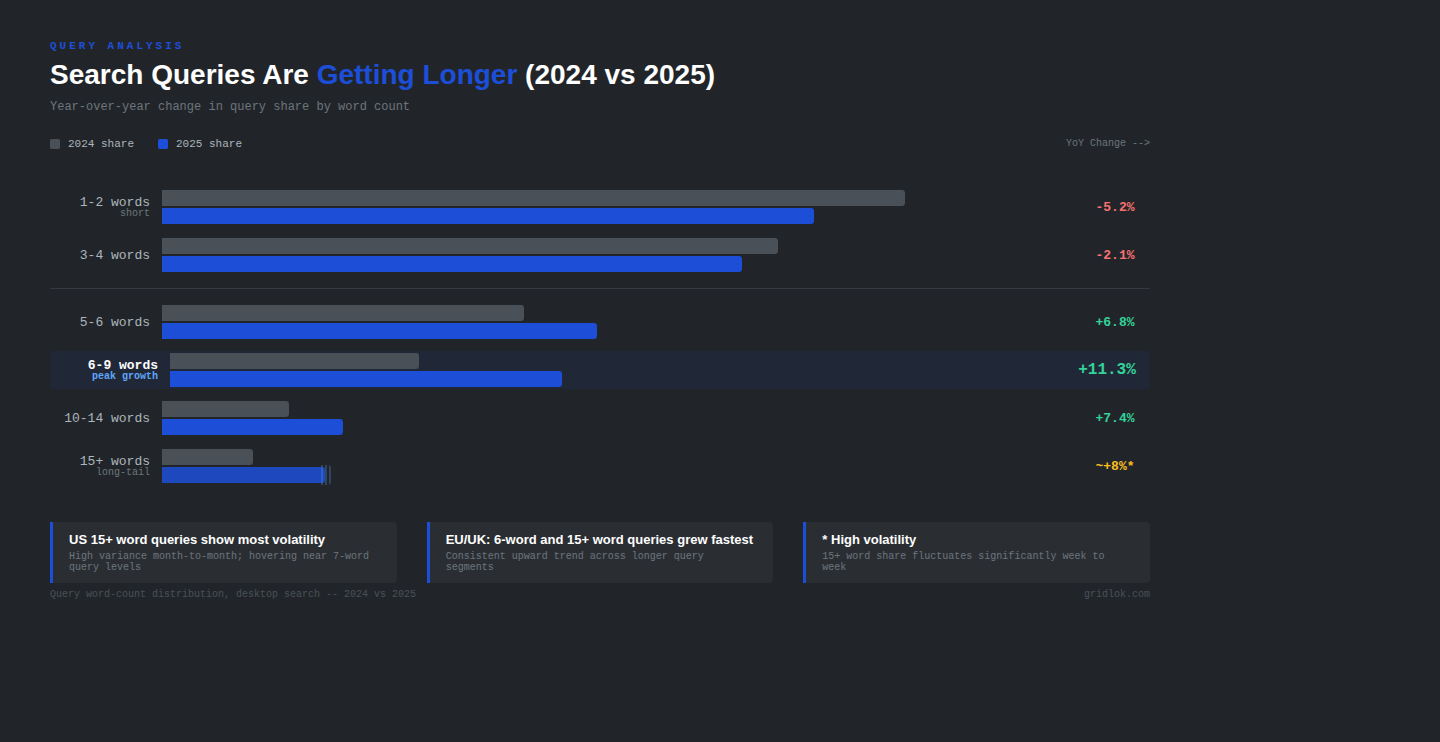
- Mid-length queries (6-9 words) showed the most growth in 2025. Users are moving away from short keyword-style searches toward more explicit, multi-term phrasing.
- In the US, 15+ word queries are volatile but hover near the same levels as 7-word queries. In the EU, 6-word and 15+ word queries both grew faster than average.
- This shift has direct implications for content strategy. Pages built around short head terms are losing ground to content that matches how people actually phrase complex questions.
- Longer queries correlate with higher intent and more specific needs. The content that ranks for these queries needs to match that specificity.
Search Query Length Is Shifting Toward Longer, More Specific Phrasing
The Datos/Semrush State of Search Q4 2025 report tracked search query length distribution for the first time, covering 15 months of desktop data across the US, EU, and UK. The results show a consistent shift: users are typing longer, more detailed queries into search engines.
In the US, the fastest growth appeared in mid-length queries, particularly 6-9 word searches. But the 15+ word category was the most interesting. Those ultra-long queries showed high volatility month to month but hovered at levels comparable to 7-word queries, meaning a meaningful chunk of users are now typing full sentences or questions into Google.
The EU Is Moving Faster on Query Length
In the EU and UK, the shift was even more pronounced. The fastest relative growth hit both ends of the “longer query” spectrum: 6-word queries and 15+ word queries grew fastest.
The combined share of longer queries appears to be increasing slightly faster in Europe than in the US. Rand Fishkin noted in his commentary on the report: “Americans experimenting so much more aggressively with very long queries is fun to see in the data. I’ll be watching to see if other countries and languages eventually make this change as well.”
Why Queries Are Getting Longer
Two factors are driving this.
First, AI search tools have trained users to ask questions in natural language. If you spend time talking to ChatGPT or using Google AI Mode, you get comfortable typing full sentences. That behavior carries over to traditional search. When users switch back to Google, they bring that conversational phrasing with them.
Second, users who have been searching for years are getting more sophisticated. They’ve learned that a short query like “email marketing” returns generic results, while “best email marketing platform for small e-commerce stores under 10k subscribers” returns something useful. The specificity is learned behavior.
What Longer Search Queries Mean for Content Strategy
If users are typing longer, more specific queries, then content needs to match that specificity. A page targeting “email marketing” is competing against every other generic guide on the internet. A page targeting the exact question a user typed has far less competition and far higher relevance.
This connects directly to how AI systems select content for citation. Models looking for answers to specific questions prefer content that directly addresses those questions with concrete, specific information. Pages built around vague head terms get passed over in favor of pages that answer the actual query.
For anyone building content around AI Overview and ChatGPT citation strategies, this data reinforces the approach: build content around specific questions, not broad topics.
Practical Changes to Make Right Now
Audit your keyword targets. If your content strategy is still centered on 2-3 word head terms, you’re optimizing for the shrinking segment of search behavior. Pull your Google Search Console data and look at the query lengths driving your actual impressions and clicks. You’ll likely find that your best-performing content already matches longer, more specific queries.
Build content around full questions. Use the exact phrasing people type. Tools like Search Console’s query report, AnswerThePublic, and People Also Ask data give you real user language to work with. Structure your content so each section directly answers a specific question.
Use FAQ sections strategically. Longer queries often map to FAQ-style content. But be aware of where that FAQ content sits in your HTML. If your page is heavy enough to hit the 2 MB crawl limit, your FAQ section might get truncated before Google ever sees it.
Think in terms of query intent, not just keywords. A 7-word query signals a user who knows exactly what they need. The content that wins that click needs to deliver on that specificity within the first few paragraphs.
Need help restructuring your content for this shift? Get in touch and I’ll review your current keyword strategy against the query length data.
Query Length Shift: 2024 vs 2025 Data
| Word Count | US YoY Change | EU/UK YoY Change | Trend |
|---|---|---|---|
| 1-2 words | -5.2% | -4.1% | Declining |
| 3-4 words | -2.1% | -1.8% | Declining |
| 5-6 words | +6.8% | +8.2% | Growing |
| 6-9 words | +11.3% | +12.1% | Peak Growth |
| 10-14 words | +7.4% | +6.9% | Growing |
| 15+ words | ~+8%* | +9.4% | Volatile |
* High month-to-month volatility in US 15+ word queries. Click headers to sort. Source: Datos/Semrush Q4 2025.
Is Your Content Strategy Built for Longer Queries?
1. What does your typical target keyword look like?
2. Do your pages directly answer specific questions in the first 2 paragraphs?
3. How often do you check Search Console for the actual queries driving your traffic?
4. Do you have content specifically targeting “People Also Ask” and conversational queries?
Frequently Asked Questions
How much longer are search queries getting?
The biggest growth is in the 6-9 word range. In the US, 15+ word queries also showed significant activity, hovering near 7-word query levels. The shortest query formats (1-2 words) are declining as a share of total searches. The shift is gradual but consistent across both the US and EU.
Is this trend driven by AI tools?
Partially. Users who interact with ChatGPT, Gemini, and other conversational AI tools get accustomed to typing full questions. That habit carries over to traditional search. But it’s also a natural evolution. Experienced searchers learn that more specific queries return better results.
Should I stop targeting short keywords?
No. Short head terms still drive massive volume. But your content strategy should expand to cover the longer, more specific queries that are growing fastest. Think of short keywords as your traffic foundation and longer queries as your conversion and citation opportunity. Run an audit to see which query lengths are actually driving your traffic.
Where does this data come from?
The Datos/Semrush State of Search Q4 2025 report, which tracks anonymized desktop clickstream data from tens of millions of users across the US, EU, and UK. The query length analysis covers 15 months of data from October 2024 through December 2025.
See what ChatGPT is really searching
SubSeed captures the hidden Google queries ChatGPT runs behind every answer and enriches them with search volume, CPC, and keyword difficulty.