AI Searchers Visit Different Websites Than Google Searchers. The Data Proves It.
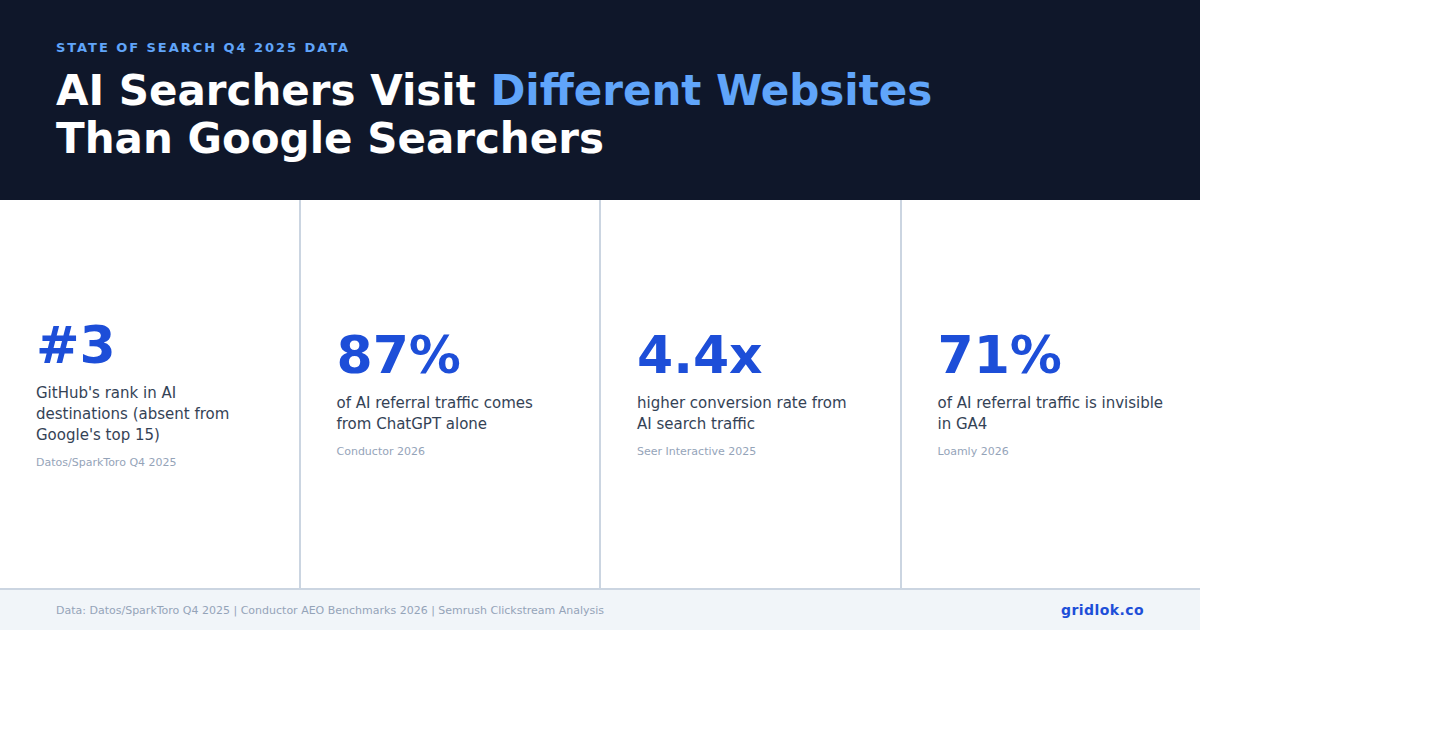
- → GitHub, NIH, Canva, and Anthropic appear in the AI destination top 15 but not in Google’s traditional search top 15 (Datos/SparkToro Q4 2025)
- → ChatGPT drives 87.4% of all AI referral traffic across 10 major industries (Conductor AEO/GEO Benchmarks 2026)
- → AI platform visits grew 28.6% YoY, but referral traffic to external websites peaked and then declined (Digiday, 2025)
- → 70.6% of AI referral traffic is misclassified as “direct” in GA4, making it invisible to most analytics setups (Loamly State of AI Traffic 2026)
AI search destination domains tell a different story than most marketers expect. When someone uses ChatGPT or Gemini and then opens a new tab, they don’t visit the same websites that Google searchers do. The Datos/SparkToro Q4 2025 clickstream data, which tracks browsing behavior across tens of millions of desktop users, reveals two distinct webs emerging from two distinct search experiences.
For business owners, this raises a direct question: is AI search sending people to websites like yours, or is it funneling users toward a narrow set of technical platforms?
AI vs Traditional Search: Two Different Destination Maps
The Datos Q4 2025 report tracks “destination domains,” defined as the next website a user visits after interacting with a search tool. This is clickstream behavior from millions of real desktop users, not referral data from analytics platforms.
When you compare the top destinations after AI search against where users go after traditional Google search, the overlap is only partial. The top two are the same (Google and YouTube). After that, the lists diverge sharply.
| Rank | After AI Search (US) | After Traditional Google Search (US) | Overlap? |
|---|---|---|---|
| 1 | YouTube | Both in top 5 | |
| 2 | YouTube | Both in top 5 | |
| 3 | GitHub ↑ | Amazon | AI only |
| 4 | Microsoft | Wikipedia | Google only |
| 5 | Amazon | Google only | |
| 6 | ChatGPT ↑↑ | ChatGPT | Both lists |
| 7-10 | NIH, Reddit, Gemini | eBay, LinkedIn, Instagram | Mostly different |
| 11-15 | Canva, Anthropic | Pinterest, Apple, Target | AI only |
AI search destinations skew toward tools, technical resources, and research platforms. Traditional search destinations skew toward social media, e-commerce, and general reference. Wikipedia tops the traditional list at #4 but doesn’t crack the AI top 15. Facebook sits at #5 for Google searchers but is absent from AI destinations entirely.
What the AI Destination List Reveals About AI Users
The destination differences aren’t random. They map to distinct user profiles driving AI search adoption, according to SparkToro CEO Rand Fishkin’s analysis of the Q4 data.
Fishkin summarized it: “The most interesting domains on this list are those that don’t appear in the ‘top search destinations’ list… NIH, Canva, Anthropic, Github, and Gemini. Those illuminate the difference in intent between AI ‘searchers’ and traditional search users, showing that many of these AI users are trying to accomplish specific solutions around health, content creation, and programming.”
The Referral Traffic Paradox: More AI Usage, Flat Clicks
Here’s the uncomfortable reality behind the AI search destination domains data. AI tools doubled their share of desktop activity over 2025, growing from 0.42% to 0.77% of total events. More people used AI tools more often throughout the year.
But the clicks those platforms sent to external websites didn’t keep pace. According to Digiday, AI referral traffic peaked mid-2025 and then declined, even as platform visits grew 28.6% year over year.
This creates a two-layer challenge for businesses. Getting cited by AI tools is one piece. Getting users to actually click through from an AI citation to your site is another. The data says that second step is getting harder, not easier.
| Metric | Value | Source |
|---|---|---|
| AI referral traffic as share of total website traffic | 1.08% | Conductor, 2026 |
| ChatGPT’s share of all AI referral traffic | 87.4% | Conductor, 2026 |
| AI traffic conversion rate vs organic search | 4.4x higher | Seer Interactive, 2025 |
| AI referral traffic invisible in GA4 (misclassified as direct) | 70.6% | Loamly, 2026 |
| Domains receiving 64% of all ChatGPT referral clicks | 120 | Semrush, 2025 |
| ChatGPT external links clicked per user visit | 1.4 | Momentic, 2025 |
US vs Europe: Regional Differences in AI Search Destination Domains
The Datos report breaks AI search destination domains out by region. The broad patterns mirror each other: Google and YouTube top both lists, GitHub appears prominently in both, and ChatGPT rose from #14 to #6 in both the US and EU/UK year over year.
Two regional differences stand out.
| Difference | US | EU/UK | What It Signals |
|---|---|---|---|
| Microsoft ranking | Stable position | Dropped 5 places | European users shifting away from Microsoft ecosystem after AI search |
| Not in top 15 | In top 15 | EU AI users share findings via WhatsApp, reflecting regional messaging preferences | |
| Climbed into top 10 | Climbed into top 10 | Community-driven content holds value across both AI search experiences globally |
What This Means for Your Website
The AI search destination domains data carries practical implications depending on what kind of site you run.
If your site provides general informational content, the data is a warning. AI tools are replacing the browse-to-learn behavior that used to drive traffic to reference sites. Wikipedia’s absence from AI destinations is the clearest example. You need to offer something AI can’t synthesize: original research, proprietary data, or expert commentary with a named author.
If your site is a tool or platform, the data is encouraging. GitHub, Canva, and NIH thrive as AI destinations because users need to visit them to accomplish a task. If your product requires hands-on interaction, AI search is pushing users toward you.
If you’re a service business, the opportunity sits between these two poles. AI tools won’t replace a consultation or a custom proposal. But they will replace the “learn about this topic” content that used to bring people to your site. The content that survives needs to demonstrate expertise a chatbot can’t replicate: case studies with real outcomes, benchmarks from actual client work, opinions backed by experience. Each AI platform needs a different citation strategy, so a one-size approach won’t work.
Methodology
This analysis synthesizes data from 8 sources directly cited and 14 sources consulted. The primary dataset is the Datos/SparkToro Q4 2025 State of Search Report, which draws on clickstream data from tens of millions of anonymized desktop users across the US, EU, and UK, covering October through December 2025.
Supporting data: Conductor AEO/GEO Benchmarks 2026, Semrush 80M clickstream analysis (H2 2024), Digiday AI referral traffic analysis (2025), Seer Interactive conversion study (2025), Loamly State of AI Traffic 2026
Limitations: All clickstream data covers desktop only. Mobile behavior may differ. “Destination domains” measures the next site visited, not referral attribution. Conductor data covers 10 industries and may not represent all verticals.
Research date: April 2, 2026
Update schedule: Updated quarterly when new Datos/SparkToro reports publish
FAQ
Sources & References
- Datos/SparkToro (2025). “State of Search Q4 2025: Behaviors, Trends, and Clicks Across the US & Europe.” https://datos.live
- Conductor (2026). “The 2026 AEO/GEO Benchmarks Report.” https://www.conductor.com/academy/aeo-geo-benchmarks-report/
- Semrush (2025). “Investigating ChatGPT Search: Insights from 80 Million Clickstream Records.” https://www.semrush.com/blog/chatgpt-search-insights/
- Digiday (2025). “In Graphic Detail: The State of AI Referral Traffic in 2025.” https://digiday.com/media/in-graphic-detail-the-state-of-ai-referral-traffic-in-2025/
- Search Engine Land (2025). “AI sends 1% of website traffic, and most of it is from ChatGPT.” https://searchengineland.com/ai-1-traffic-mostly-chatgpt-464653
- Seer Interactive (2025). “Case Study: 6 Learnings, 1 Site, How Traffic from ChatGPT Converts.” https://www.seerinteractive.com/insights/case-study-6-learnings-about-how-traffic-from-chatgpt-converts
- Loamly (2026). “State of AI Traffic 2026: Industry Benchmark Report.” https://www.loamly.ai/blog/state-of-ai-traffic-2026-benchmark-report
- Momentic Marketing (2025). “What the Data Says: Google vs. ChatGPT + the State of SEO.” https://momenticmarketing.com/blog/google-reach-chatgpt-click-throughs
Data source: Datos/SparkToro State of Search Q4 2025 Report, covering October-December 2025 desktop user behavior across the US, EU, and UK.
See what ChatGPT is really searching
SubSeed captures the hidden Google queries ChatGPT runs behind every answer and enriches them with search volume, CPC, and keyword difficulty.
Related Posts
Read this post with an assistant
This is the whole prompt each button sends. Nothing hidden in it.
Read https://gridlok.co/blog/ai-search-destination-domains-vs-google/ and give me the main points in a few sentences.
Make Gridlok a Preferred Source on Google
See Gridlok surfaced more often in your Top Stories, AI Overviews, and AI Mode. One click, applied across Google Search.