Google Searches Per User Dropped 20% in the US: The Most Underreported Stat of 2025
Key Takeaways
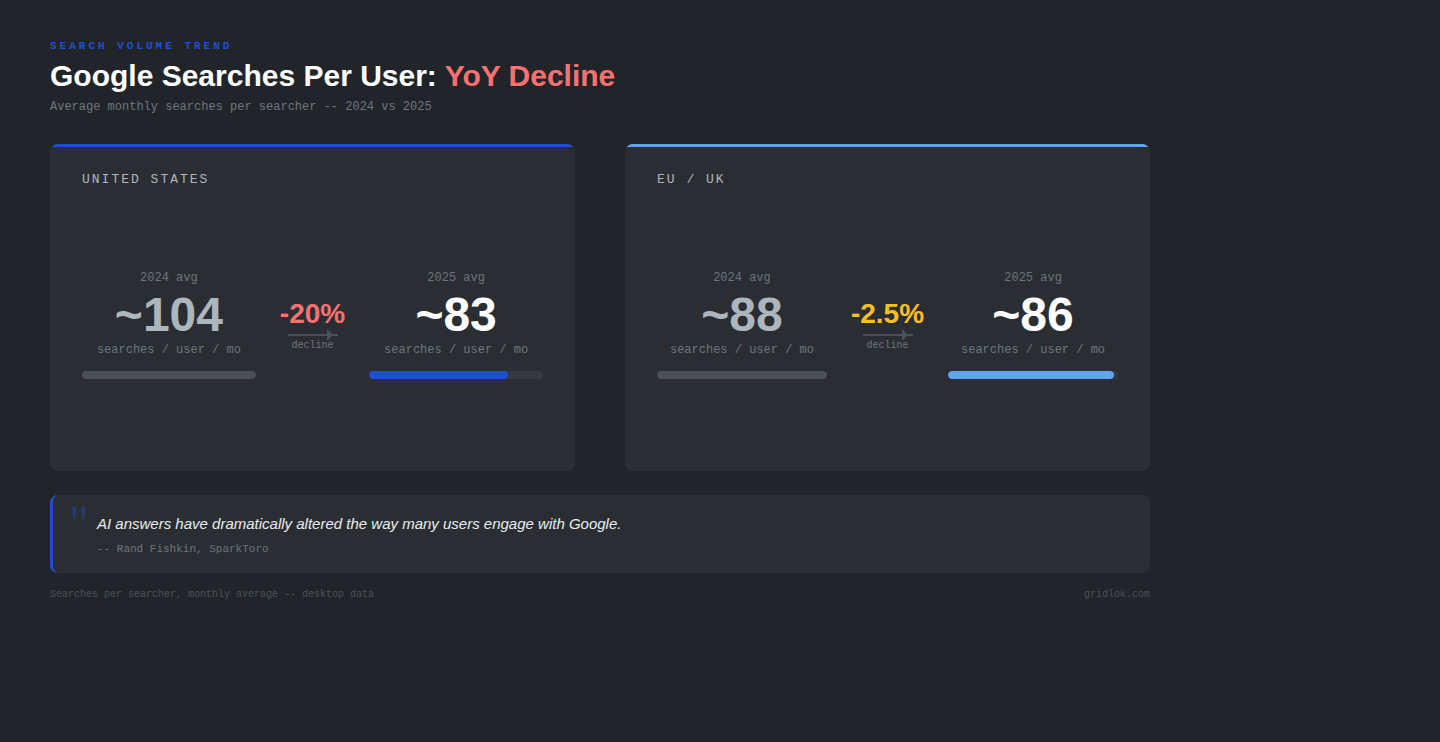
- Google searches per user dropped nearly 20% year over year in the US, falling from roughly 104 searches per month to around 92. In the EU/UK, the decline was only 2-3%.
- Rand Fishkin attributes the drop to AI answers resolving queries before users need to click, search again, or refine. “AI answers have dramatically altered the way many users engage with Google.”
- Google’s total user share and organic clicks both increased during the same period. People aren’t leaving Google. They’re using it less per session because AI answers are resolving their needs faster.
- For content strategy, this means fewer searches per query chain but higher intent per individual search. The clicks that do happen carry more weight.
Google Searches Per User Fell 20% in the US
The Datos/Semrush State of Search Q4 2025 report surfaced a stat that most coverage overlooked: Google searches per desktop user dropped nearly 20% year over year in the US. Users who previously averaged around 104 searches per month were down to approximately 92 by late 2025.
In the EU and UK, the decline was minimal at just 2-3%. But the US number is striking, and Rand Fishkin called it out directly in his commentary on the report.
Why Users Are Searching Less on Google
Fishkin’s explanation: “Other studies have shown that Google is sending less traffic than in years past, especially to the long-tail of the web, and I suspect that AI answers have dramatically altered the way many users engage with Google, answering their questions before they ever need to click on an organic result or perform a second/third/fourth search.”
This is the key mechanism. AI Overviews, AI Mode, and featured snippets resolve queries within the search results page itself. A user who used to type a query, click a result, go back, refine the query, and click another result now gets an AI-synthesized answer on the first search.
The query chain collapses. One search does the work of three or four.
Fewer Searches Doesn’t Mean Less Google Usage
Here’s what makes this counterintuitive: Google’s user share and total search volume didn’t drop. Traditional search held steady at around 10% of total desktop events throughout 2025. Organic and paid clicks both increased in Q3 and Q4.
Users aren’t leaving Google. They’re resolving their needs in fewer steps. That’s a meaningful distinction for anyone building a search strategy.
It also raises a question Fishkin flagged: “Whether the last year of relatively stable searches/searcher will continue, or if Google’s changes (or competition/user behavior) has another big shakeup coming in the future, for example, if AI mode or something like it were to become the default Google search response.”
What a 20% Drop in Searches Means for Your Traffic
If users are performing 20% fewer searches but clicks are stable or growing, it means each individual search is more intentional. The casual, exploratory, multi-step query chains are being absorbed by AI answers. What remains are the searches where users specifically want to visit a website.
For content strategy, this shifts the value equation. Ranking for a query that triggers an AI Overview and satisfies the user without a click has less value than ranking for a query where the user needs to dig deeper.
The queries that still generate clicks are higher-intent, more specific, and more commercially valuable. This connects directly to the zero-click search data we’ve covered before. Zero-click rates stabilized in Q4 rather than accelerating, which suggests we’re reaching an equilibrium between AI-answered queries and click-through queries.
The Long-Tail Is Where This Hits Hardest
Fishkin specifically called out the long-tail: Google is “sending less traffic than in years past, especially to the long-tail of the web.” If you’re a smaller publisher or business that depends on long-tail informational queries for traffic, this is the most relevant finding in the entire report.
Long-tail informational queries are exactly the ones AI Overviews resolve on the results page. A user searching “what is the best time to water tomatoes in zone 7” doesn’t need to click through to a gardening blog anymore. Google gives them the answer directly.
The content that still earns clicks from long-tail queries will need to offer something the AI answer can’t: original data, hands-on testing, local specifics, or depth that goes beyond what a synthesized answer provides. This is the same principle behind getting cited by AI systems: provide what the model can’t generate on its own.
How to Adapt Your Strategy
Audit which of your pages depend on multi-step query chains. If your traffic relies on users refining searches and eventually landing on your page, that funnel is compressing. Look at your Search Console data for queries where impressions are stable but clicks are declining. Those are likely being resolved by AI answers.
Prioritize content that requires a click. Comparison tools, interactive calculators, original datasets, and community-driven content all give users a reason to visit your site that an AI answer can’t replicate. Build more of that.
Optimize for the first search, not the fourth. If users are resolving needs in one search instead of four, your content needs to be the answer on that first attempt. Front-load your value. Put your best information at the top of the page.
Get positioned for AI citation. If Google is answering queries with AI Overviews, the next best thing to a click is a citation. Make sure your content is structured to be cited by AI Overviews and ChatGPT. That branded mention still has value even without the click.
Want to see how the search-per-user decline is affecting your specific traffic? Send me your Search Console data and I’ll map the impact.
Searches Per User: Regional Comparison
| Search Engine | US Searches/Mo 2024 | US Searches/Mo 2025 | YoY Change |
|---|---|---|---|
| 92-104 | 83-92 | ~-20% | |
| DuckDuckGo | 50-54 | 50-54 | ~0% |
| Bing | 32-36 | 32-36 | ~0% |
| Yahoo | 17-20 | 17-20 | ~0% |
Desktop searches per user per month. Click headers to sort. Source: Datos/Semrush Q4 2025.
Is Your Traffic Vulnerable to the Search Behavior Shift?
1. What percentage of your organic traffic comes from informational queries?
2. Have you noticed declining clicks on pages where impressions remain stable?
3. Does your content offer something an AI-generated answer cannot?
4. How dependent is your business on long-tail informational traffic?
Frequently Asked Questions
Did Google’s total search volume drop?
No. Google’s total user share and traditional search event share both remained stable at around 10% of desktop events. The 20% decline is in searches per individual user, meaning each person is searching less often, not that fewer people are using Google.
Why is the US decline so much larger than Europe?
AI features like AI Overviews and AI Mode rolled out in the US first and more aggressively. The 20% US decline versus 2-3% EU decline likely reflects the difference in AI feature availability and adoption timing. As these features expand globally, similar patterns may emerge in other regions.
Does fewer searches mean less opportunity for SEO?
Not less opportunity, but different opportunity. The remaining searches are higher-intent. Organic clicks actually increased in Q3 and Q4 2025 even as searches-per-user declined. The shift is toward fewer, more intentional searches where users specifically want to visit a site. Run an audit to identify which of your pages are best positioned for this new search behavior.
Is this trend going to accelerate?
Fishkin thinks that depends on whether Google makes AI Mode the default search experience. Right now it’s opt-in. If it becomes the default, the drop in searches per user could accelerate significantly. The Q4 data shows the decline stabilizing, but that stability may not hold through 2026.
See what ChatGPT is really searching
SubSeed captures the hidden Google queries ChatGPT runs behind every answer and enriches them with search volume, CPC, and keyword difficulty.