Google AI Overviews SEO: What 407 Citations Say About Who Gets Cited
Most Google AI Overviews SEO advice is a checklist: answer first, add schema, name the author, cite your sources. I’ve written a version of it myself. So I tested it.
I pulled the AI Overview for 50 questions people ask about SEO and AI search, collected every source each one cited, and ran 206 of those pages through the GEO Score Checker, cited and uncited alike. The checklist held up as a floor. It did not decide who got cited.
Key takeaways
- All 50 questions returned an AI Overview, citing 407 sources between them, about eight per answer. Just over half of those sources, 211, did not rank in the organic top 10 for the question.
- On page one, rank decided it. The number one result was cited 62% of the time. By position eight that was down to about a third.
- Pages Google cited and page-one pages it skipped scored the same on 30 on-page checks: a mean of 89 against 90 out of 100. Not one check separated the groups by more than the noise.
- YouTube was the most cited domain, appearing in 28 of the 50 overviews. Reddit, which takes a fifth of first-citation slots across all industries in Seer’s data, showed up in ten.
Why the overview is the fight, not AI Mode
Datos’s Q2 2026 desktop clickstream data says where the AI search audience actually is. In the US, Google AI Mode peaked at 0.16% of desktop activity in March and settled at 0.12% to 0.13% through June. Europe is ahead at 0.29%. AI tools as a whole reached 1.83% of US desktop activity, and traditional search held 10.52%.
So the AI answer most people meet is the one sitting on top of an ordinary Google result. That’s also where the clicks are going. In the same quarter, organic click-through on desktop Google fell from 46% in March to 40.7% in June, zero-click share stayed near 25%, and the share of clicks landing on Google’s own properties hit 20.4%. I went through those numbers in the Q2 clicks post.
The intent data points the same way. Navigational searches on Google fell from 22.8% to 16.4% of queries year over year, while informational and commercial research queries rose. Rand Fishkin’s read in the report is that AI Overviews and the other engines’ AI answers are becoming bigger use cases for searchers “as they learn that the top of Google has become a very reasonable substitute for ChatGPT / Claude.”
If that’s right, the question that matters isn’t how to rank in AI Mode. It’s who the overview picks when it answers an informational question, and why. I covered what a citation is worth in the Great Decoupling post: on queries with an overview, a cited page earns about twice the clicks per impression of one that ranks but isn’t cited.
How I ran the study
I picked 50 informational questions from the SEO and AI search space, the kind a marketer or business owner types when something in Search Console looks wrong. They’re all listed at the end. On September 19, 2026, I pulled the live US desktop results for each one through DataForSEO’s SERP API, which returns the AI Overview with its cited sources alongside the organic results.
Then I scored pages with the GEO Score Checker, which runs 30 checks in five categories on the raw HTML, the way an AI crawler reads it. For every question I scored each cited page that also ranked in the top 10, and the two highest-ranking results that weren’t cited. That gave 239 pages to score. 206 scored. The other 33 blocked the request, mostly with a 403, and that group leans toward big brands: Forbes, McKinsey, Cloudflare, OpenAI, Perplexity, and Search Engine Land among them.
Two caveats before the findings. This is one niche on one day, on US desktop, and the uncited group is 63 pages, so small gaps between groups are noise. The checker also measures on-page signals only. It knows nothing about links, brand searches, or how long people stay.
Every question had an overview, and half the sources didn’t rank
All 50 queries triggered an AI Overview. Between them the overviews cited 407 sources, a mean of 8.1 per answer and a range of 2 to 13. Seer Interactive’s May 2026 study across 8,500 keywords and 30 industries found a mean of 11.4, so this niche runs a little leaner.
Of the 407 citations, 196 came from pages that also ranked in the organic top 10 for the same question. The other 211 didn’t. Half the sources Google put its name to were pages a searcher wouldn’t have seen on page one.
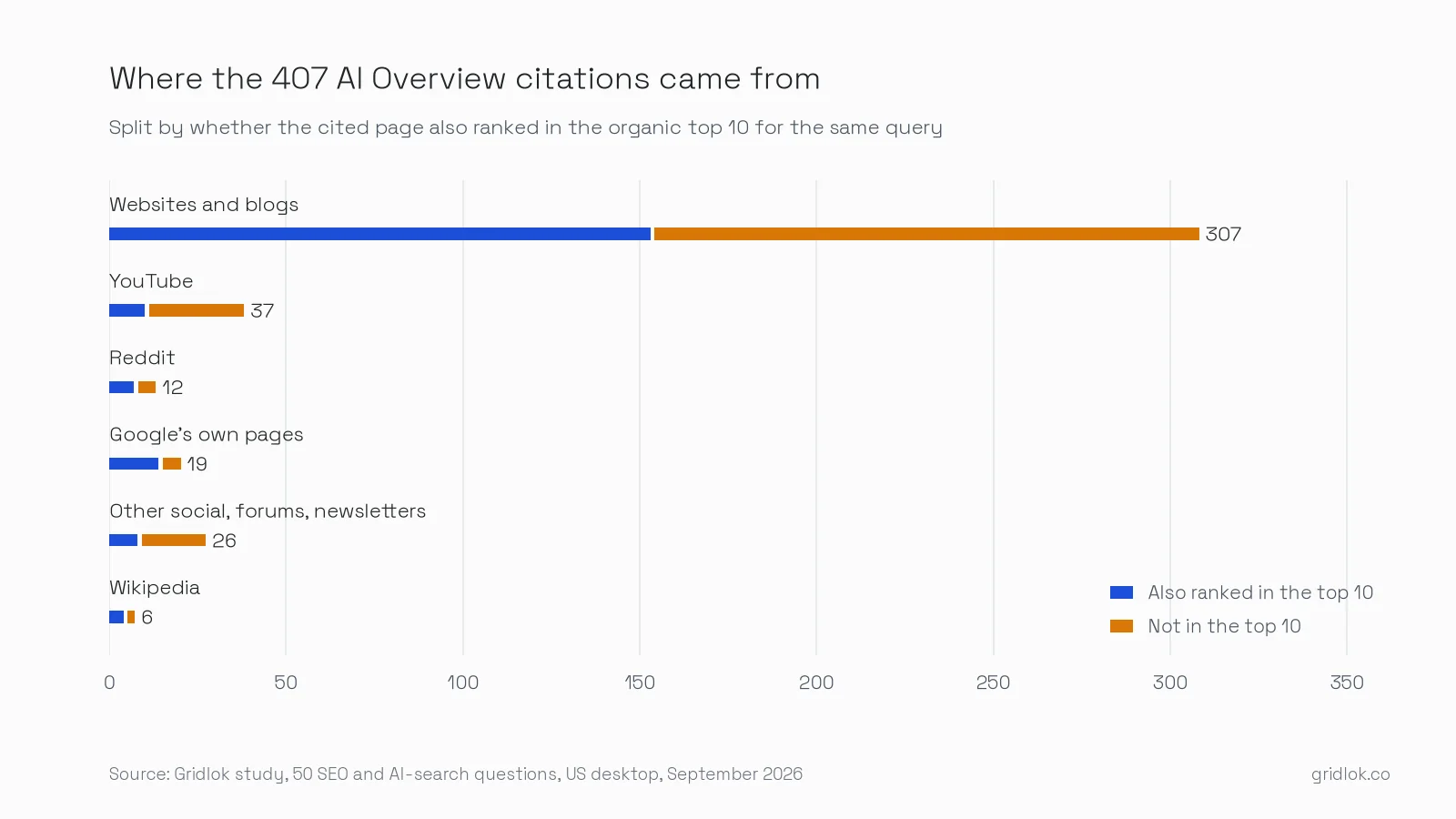
The off-page-one sources weren’t exotic. 73% were ordinary sites and blogs, 13% YouTube, 9% forums, newsletters, and social posts. The mechanism is the one the AI Mode guide describes as query fan-out: Google runs several related searches behind the scenes and pulls sources from all of them, so a page that ranks for a sub-question can be cited without ranking for the question itself.
That cuts both ways. You don’t need page one to be cited. And page one doesn’t get you cited, which the next number shows.
On page one, rank decides
Across the 50 questions, 47% of page-one results were cited in the overview above them. The share falls with position. The number one result was cited 62% of the time, number three 56%, number five 42%, and positions eight and nine about a third.
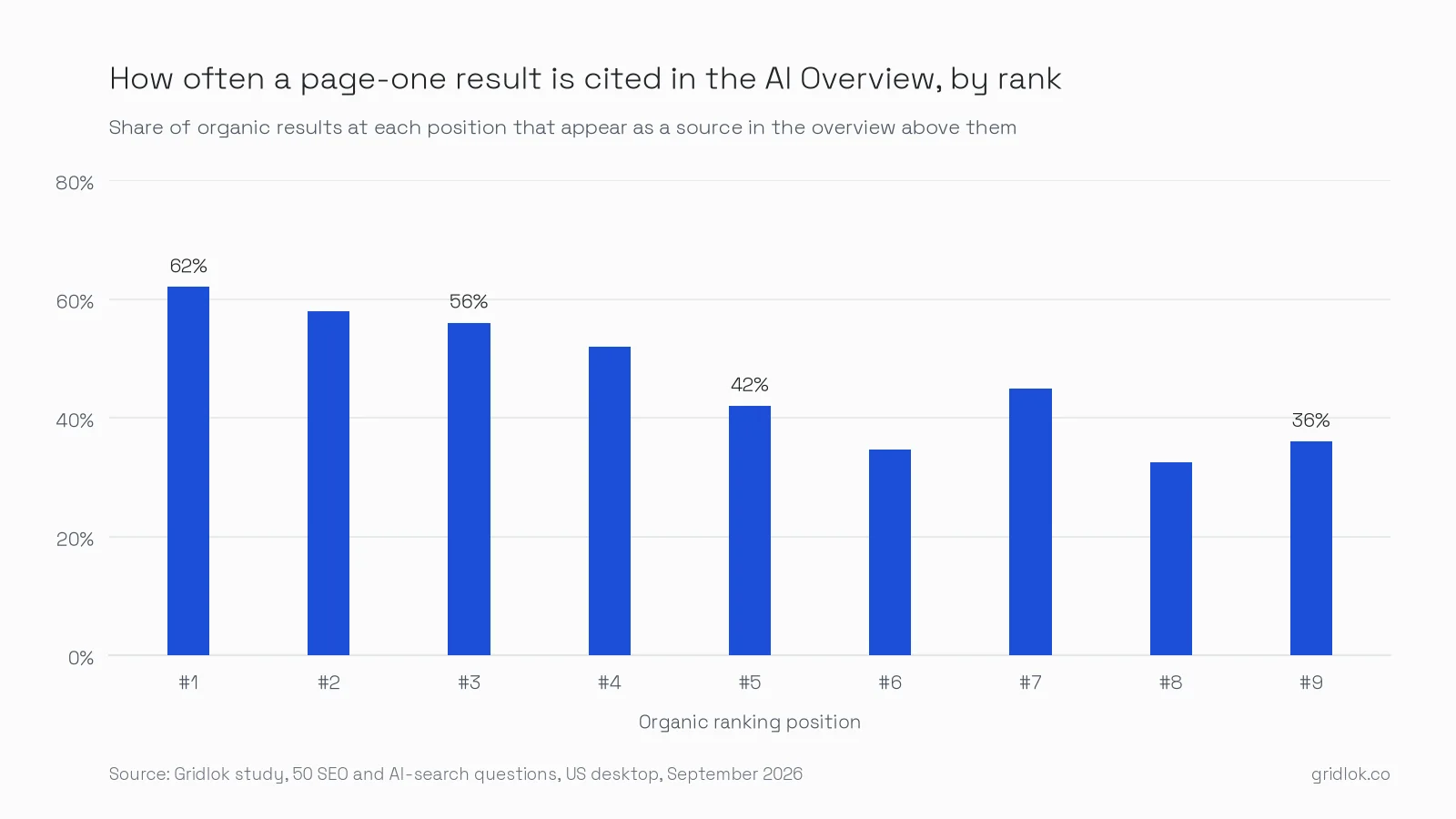
Rank is still the strongest thing a page-one result has going for it. The number one result was cited on 31 of the 50 questions. Nothing on the page moved the odds as much as moving up three positions did.
The checklist doesn’t separate cited from uncited
This is the part I expected to go the other way. The 145 cited pages I could score averaged 88.9 out of 100, with a median of 94. The 63 page-one pages that weren’t cited averaged 90.4, with a median of 92. Every category came out within four points.
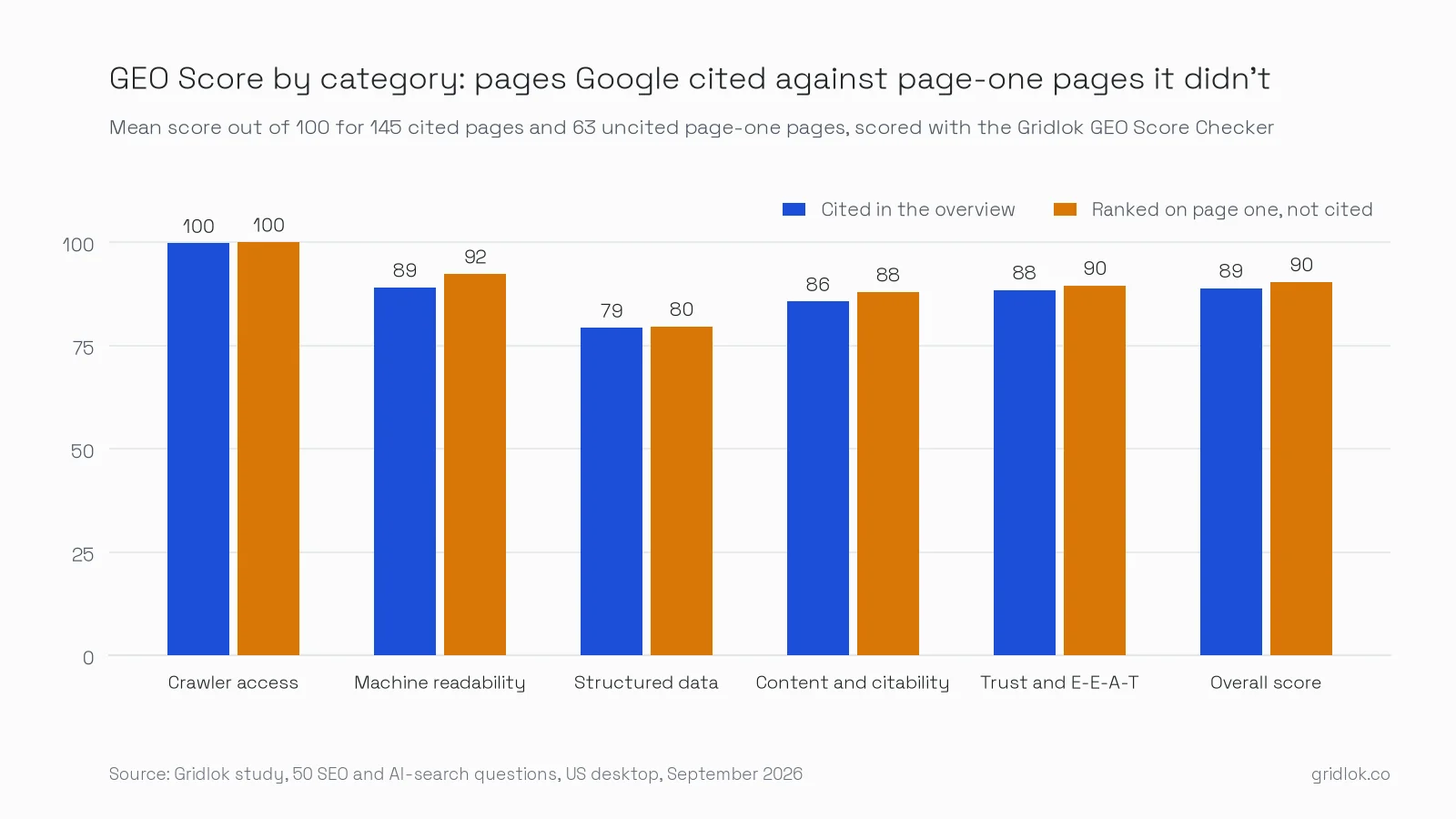
Check by check it’s the same story. The biggest gaps were 11 points in either direction, and with 63 pages in the uncited group that’s noise. The checks with the largest differences:
| Check | Cited pages passing | Uncited page-one pages passing | Gap (points) |
|---|---|---|---|
| Citations | 75% | 86% | -11 |
| sameAs entity links | 49% | 38% | +11 |
| Heading hierarchy | 77% | 67% | +10 |
| Server-rendered content | 88% | 97% | -9 |
| About and contact | 76% | 84% | -8 |
| Canonical URL | 83% | 90% | -7 |
| JSON-LD markup | 72% | 79% | -7 |
| Lists and tables | 85% | 92% | -7 |
| Section sizing | 57% | 63% | -6 |
| URL structure | 93% | 87% | +6 |
Two of those run the wrong way for the checklist story. Uncited pages linked out to sources more often than cited ones, and were more often fully server-rendered. And the cited pages that ranked in the top three averaged 86, below the 91 for cited pages ranking four to ten. The pages Google trusts most are big-brand documentation and tool vendors that skip a fair amount of the hygiene.
Seer’s larger study landed in the same place from a different direction. FAQ and HowTo schema made no difference in who won the first citation. Publishers whose pages nearly all carried author bios underperformed, and Reddit, with no bios and no schema, took 20.4% of first-citation slots across their 30 industries.
None of this makes the checklist worthless. All but one of the scored pages let the AI search crawlers in, and every one was indexable and passed snippet controls. The checklist is the price of entry. What it isn’t is the thing that gets you picked once you’ve paid it.
YouTube is in more than half the overviews
The most cited domain across the 50 overviews wasn’t an SEO site. It was YouTube, with 37 citations spread across 28 questions. Semrush came second with 22, then Reddit with 12, Google’s own developer documentation with 10, and Search Engine Land and Neil Patel with 8 each.
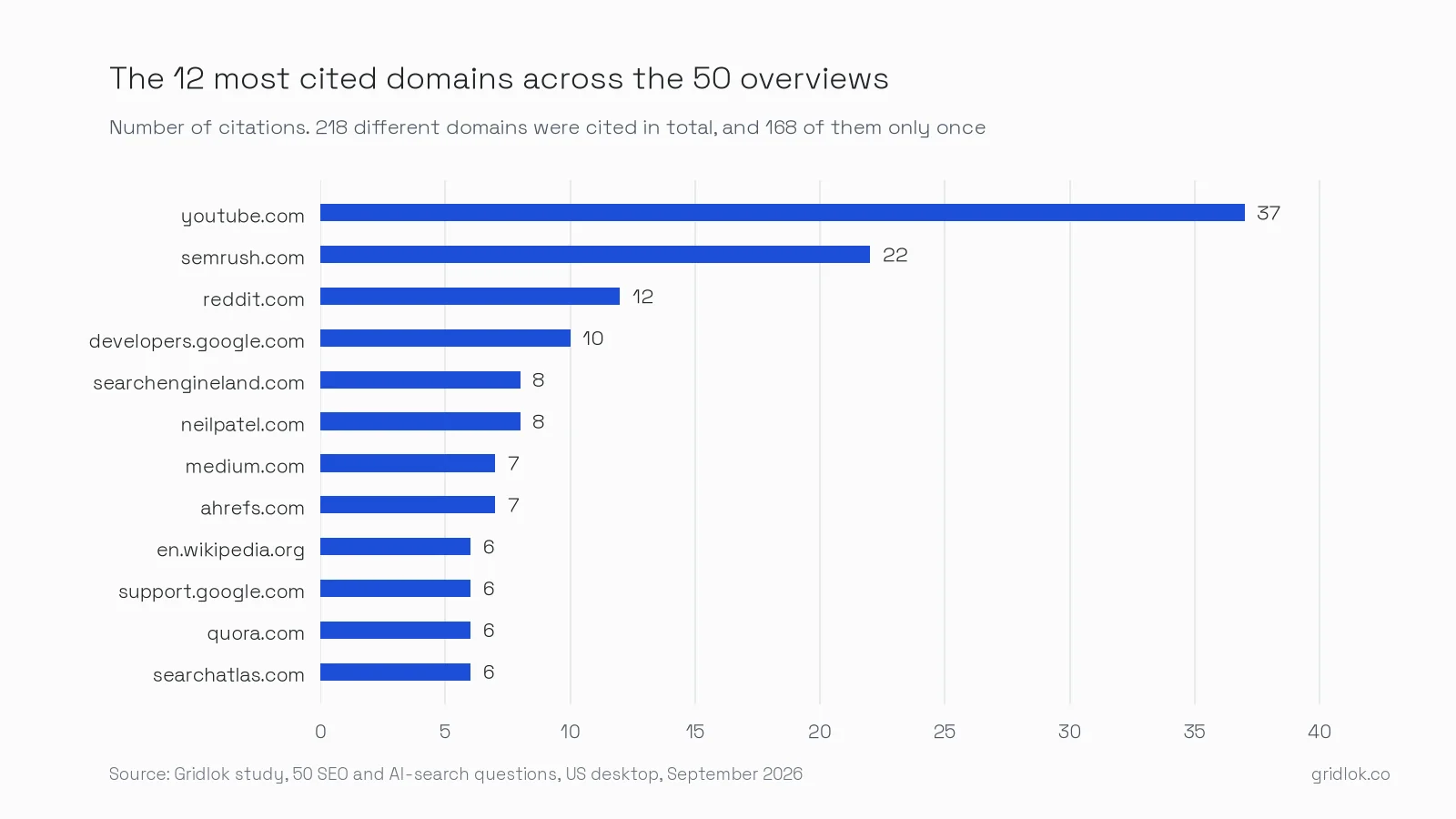
The tail matters as much as the head. 218 different domains were cited, and 168 of them appeared exactly once. The overview isn’t drawing from a short list of trusted publishers. It’s spreading citations across whoever answered a sub-question well, which is good news for a site that isn’t Semrush.
Reddit is the niche-dependent one. Seer found it taking a fifth of first citations across all industries. In SEO questions it showed up in 10 of 50 overviews, behind YouTube by a wide margin. Where your audience argues in threads, Reddit will matter more. Where they watch a walkthrough, YouTube will.
What this changes about Google AI Overviews SEO
Four things, based only on what the data supports.
- Get the floor right once. Crawlable, indexable, text in the HTML, no snippet restrictions. Every cited page had that. Score the page, fix the fails, and stop treating the checklist as the strategy.
- Rank in the top three or don’t count on the head term. Cited rates fell from 62% at number one to a third by number eight. If the top three is out of reach for the question itself, aim at the sub-questions the overview fans out to, where the competition is thinner and half the citations already come from.
- Put a video where your topic lives. A YouTube video was cited in 28 of 50 overviews. It doesn’t have to be polished. It has to answer the specific question in the title and the first minute.
- Measure it where it shows up. Search Console’s generative AI report now lists the pages that appeared in AI features. Use it to find the pages that are cited and the ones that rank without being cited, and treat those as two different jobs. This walkthrough covers checking citations by hand.
What this study can’t tell you
It’s one niche, one day, and one country on desktop. The 33 pages that blocked the checker were disproportionately big brands, so the scored cited group is a little less corporate than the real one. The checker sees the page and nothing else, so links, brand demand, and engagement are all outside the frame. And a citation is correlated with rank here, not caused by it. Both could be driven by the same thing.
I’ll rerun this in a few months against the same 50 questions. If the by-rank curve or the domain list moves, that’s the story.
FAQ
The checklist gets you into the room. Rank, sub-questions, and a video get you cited. That’s a less comfortable answer than “add schema,” and it’s the one the data gave.
The 50 questions
Every query in the study, with the number of sources its overview cited and how many of those ranked in the organic top 10.
| # | Query | Sources cited | Of which ranked in the top 10 |
|---|---|---|---|
| 1 | what is generative engine optimization | 9 | 5 |
| 2 | what is answer engine optimization | 7 | 4 |
| 3 | how do google ai overviews choose sources | 12 | 3 |
| 4 | how to get cited in ai overviews | 10 | 2 |
| 5 | what is zero click search | 9 | 4 |
| 6 | how to appear in chatgpt search results | 8 | 2 |
| 7 | what is llms.txt | 9 | 4 |
| 8 | does llms.txt work | 4 | 3 |
| 9 | what is webmcp | 9 | 3 |
| 10 | what is google ai mode | 7 | 5 |
| 11 | how does google ai mode work | 7 | 4 |
| 12 | what is query fan out | 6 | 4 |
| 13 | what is e-e-a-t in seo | 10 | 5 |
| 14 | how to improve click through rate in google search | 10 | 3 |
| 15 | what is a good ctr for organic search | 8 | 5 |
| 16 | what is schema markup | 8 | 4 |
| 17 | does schema markup help seo | 7 | 4 |
| 18 | what is preferred sources on google | 5 | 5 |
| 19 | how to block ai crawlers | 8 | 2 |
| 20 | should i block gptbot | 4 | 2 |
| 21 | what is the great decoupling in seo | 6 | 4 |
| 22 | why are my impressions up but clicks down | 7 | 2 |
| 23 | what is agentic seo | 11 | 7 |
| 24 | what is an ai agent | 8 | 4 |
| 25 | how do ai search engines rank content | 13 | 4 |
| 26 | what is perplexity ai | 11 | 5 |
| 27 | how does perplexity choose sources | 9 | 2 |
| 28 | what is a knowledge graph in seo | 9 | 3 |
| 29 | what is topical authority | 9 | 7 |
| 30 | how long should a blog post be for seo | 7 | 5 |
| 31 | what is search intent | 8 | 5 |
| 32 | what is a featured snippet | 6 | 1 |
| 33 | how to get a featured snippet | 10 | 4 |
| 34 | what is core web vitals | 8 | 5 |
| 35 | does page speed affect seo | 10 | 5 |
| 36 | what is technical seo | 9 | 4 |
| 37 | what is a canonical tag | 9 | 4 |
| 38 | what is hreflang | 8 | 5 |
| 39 | how to write a meta description | 8 | 5 |
| 40 | what is keyword cannibalization | 6 | 4 |
| 41 | what is an attention heatmap | 12 | 4 |
| 42 | what is eye tracking in ux | 8 | 5 |
| 43 | what is a saliency map | 7 | 4 |
| 44 | what is programmatic seo | 7 | 4 |
| 45 | is seo dead | 8 | 3 |
| 46 | what is ai search | 8 | 4 |
| 47 | how does chatgpt search work | 6 | 4 |
| 48 | what is reddit seo | 2 | 0 |
| 49 | why is reddit ranking so high on google | 9 | 4 |
| 50 | what is google discover | 11 | 6 |
Sources
- Gridlok, this study: 50 US desktop SERPs pulled on September 19, 2026 through DataForSEO, 407 AI Overview citations, 239 pages scored with the GEO Score Checker (206 succeeded).
- Datos (a Semrush company), State of Search Q2 2026: Behaviors, Trends, and Clicks Across the US & Europe. Desktop clickstream panel, April 2025 to June 2026.
- Seer Interactive, What It Takes To Rank In Google’s AI Overviews in 2026 Isn’t What You Think, May 2026. 8,500 keywords, 30 industries, 7,225 overviews.
- Seer Interactive, AIO Impact on Google CTR: 2026 Update, April 2026, for the cited-versus-uncited click figures.
- Google Search Central, AI features and your website.
See what ChatGPT is really searching
SubSeed captures the hidden Google queries ChatGPT runs behind every answer and enriches them with search volume, CPC, and keyword difficulty.
Related Posts
Read this post with an assistant
This is the whole prompt each button sends. Nothing hidden in it.
Read https://gridlok.co/blog/google-ai-overviews-seo-citation-study/ and give me the main points in a few sentences.
Make Gridlok a Preferred Source on Google
See Gridlok surfaced more often in your Top Stories, AI Overviews, and AI Mode. One click, applied across Google Search.