Google Now Takes 1 in 5 Clicks After a Search (Q2 2026 Data)
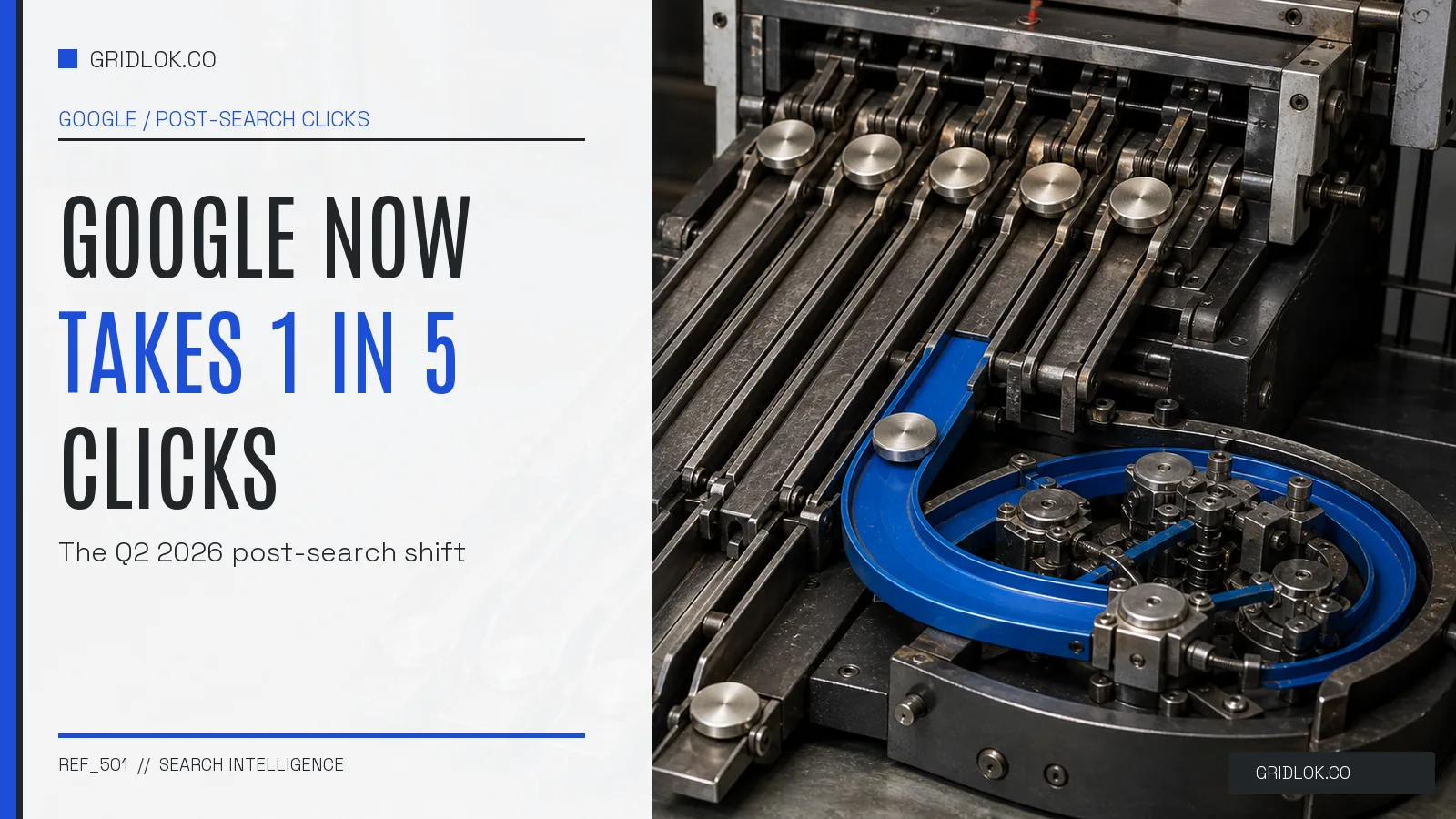
In June 2026, 20.4% of clicks following a desktop Google search went to a property Google owns. A year earlier that figure was 11.7%. Nearly nine percentage points moved in twelve months, and that is the single largest shift in the Q2 2026 clickstream data.
I want to sit with that number for a minute, because the obvious explanation for it turns out to be wrong.
Key takeaways
- Clicks to Google-owned properties after a search rose from 11.7% in April 2025 to 20.4% in June 2026, a new high in the series.
- Organic click-through fell over the same quarter, from 46% in March to 40.7% in June, its weakest level since April 2025.
- Zero-click search stayed flat, oscillating with no clear trend, so the missing organic clicks were not simply absorbed by people not clicking.
- The clicks did not disappear. They were redirected inside Google’s own ecosystem, which is a different problem than the one most of us have been preparing for.
What that 20.4% actually counts
The figure tracks where a desktop user lands immediately after running a Google search. A click to a Google-owned property means the searcher went to YouTube, Google Maps, Google Flights, Google Shopping, Google Images, or any of the other surfaces Alphabet operates, rather than out to an independent website.
Those destinations are legitimately useful and often exactly what the searcher wanted. Nobody looking for a video is poorly served by landing on YouTube. The measurement is not a judgment about quality.
What makes it worth noticing is the rate of change. A share that nearly doubles in four quarters is not drift. It is the composition of a search result page changing underneath everyone who depends on it.
Organic click-through fell at the same time
Across Q2, organic click-through on desktop Google searches slid from 46% in March to 40.7% in June. That is the lowest reading since April 2025, and it happened in a single quarter.
Paid clicks did not pick up the difference either. Paid share settled at 1.4% across April, May, and June, down from the 1.8% to 2.4% range recorded in Q1, and close to where it sat in the same months a year earlier.
So organic is down, paid is down, and Google-owned destinations are at a series high. Two of those three lines are moving the same direction and the third is moving the other way by a similar magnitude.
The part that changed my mind
My assumption walking into this report was that falling organic click-through would show up as rising zero-click behavior. People get their answer on the results page, nobody clicks anything, everyone’s traffic falls. That story has been the industry’s working model for about two years and I have repeated it myself.
The data does not support it this quarter. Zero-click share rose only slightly across Q2, from 24.7% in April to 25.3% in June, and it remains below the 27.8% recorded in June 2025. Over the last fifteen months it has oscillated inside a band with no clear direction.
People are still clicking at roughly the same rate they were. They are increasingly clicking somewhere else. That reframes the problem: the open web is not losing this fight to a searcher who stopped clicking, it is losing it to a competing destination that happens to own the results page. I have written before about why the data disagrees with the Google is dying narrative, and this is a case where the honest read is worse than the popular one rather than better.
What this changes if you rely on organic traffic
The strategic implication is different from the zero-click one. If searchers had simply stopped clicking, the answer would be to optimize for being the answer, get quoted in the summary, and accept less traffic. That is roughly the AEO playbook and it is still worth running.
If instead the clicks are being routed to Google surfaces, the question becomes which of those surfaces you can occupy. A local service business showing up properly in Maps is capturing one of those redirected clicks rather than losing it. A brand with real video presence catches the YouTube share. A product feed that is actually maintained catches the Shopping share.
That is less satisfying than a pure organic strategy, and I understand the objection that it amounts to renting space from the company that took your traffic. The counterargument is that the redirected click still represents a person with intent, and being absent from the surface they landed on is a choice too.
What I would actually do about it
Start by finding out whether this is happening to you specifically. Aggregate clickstream figures describe a market, not your site, and the honest first move is to open Search Console and compare impressions against clicks over the last four quarters. A widening gap between the two is this trend showing up in your own numbers.
Then check which Google surfaces already carry your category. Run the queries that matter to you and note what the result page actually gives back: a map pack, a video carousel, a shopping row, a knowledge panel. Those are the surfaces absorbing the clicks in your market, and they vary enormously by industry.
And keep doing the structural work, because it still pays on every surface at once. Clear hierarchy, a direct answer near the top, and content a machine can extract are what earn a place in summaries and citations, which is the argument in AEO being mostly SEO with new acronyms and the practical version in getting cited by AI as a service business.
What this data does not cover
This is desktop data. Datos measures desktop browsing behavior across its panel, and desktop is where more clicking is supposed to happen and where more opportunity is supposed to exist for independent sites. Mobile behavior can differ meaningfully, and I have looked at how different the mobile picture can be before.
It is also one quarter inside a longer series. The Google-owned share has been climbing steadily for over a year, which makes it a trend rather than a spike, but a single quarter never settles anything on its own.
FAQ
The story I expected from this quarter was that people had stopped clicking. The story the data tells is that they are clicking somewhere I do not control, and that is a harder problem with a narrower set of answers.
Sources
- Datos (a Semrush company), “State of Search Q2 2026: Behaviors, Trends, and Clicks Across the US & Europe.” Desktop clickstream panel, April 2025 to June 2026. datos.live
- Same report, click distribution section, on clicks to Google-owned properties, organic click-through, paid click share, and zero-click rates.
- Same report, methodology notes, on the desktop panel composition across the US, EU, and UK.
See what ChatGPT is really searching
SubSeed captures the hidden Google queries ChatGPT runs behind every answer and enriches them with search volume, CPC, and keyword difficulty.
Related Posts
Read this post with an assistant
This is the whole prompt each button sends. Nothing hidden in it.
Read https://gridlok.co/blog/google-keeps-the-clicks/ and give me the main points in a few sentences.
Make Gridlok a Preferred Source on Google
See Gridlok surfaced more often in your Top Stories, AI Overviews, and AI Mode. One click, applied across Google Search.