The Agentic Web Is a San Francisco Story (A Counter-Read of Google’s I/O 2026 Announcement)
Google’s I/O 2026 letter packaged Information Agents as the future of Search.
The data on whether consumers actually want this is a story most of the coverage skipped.
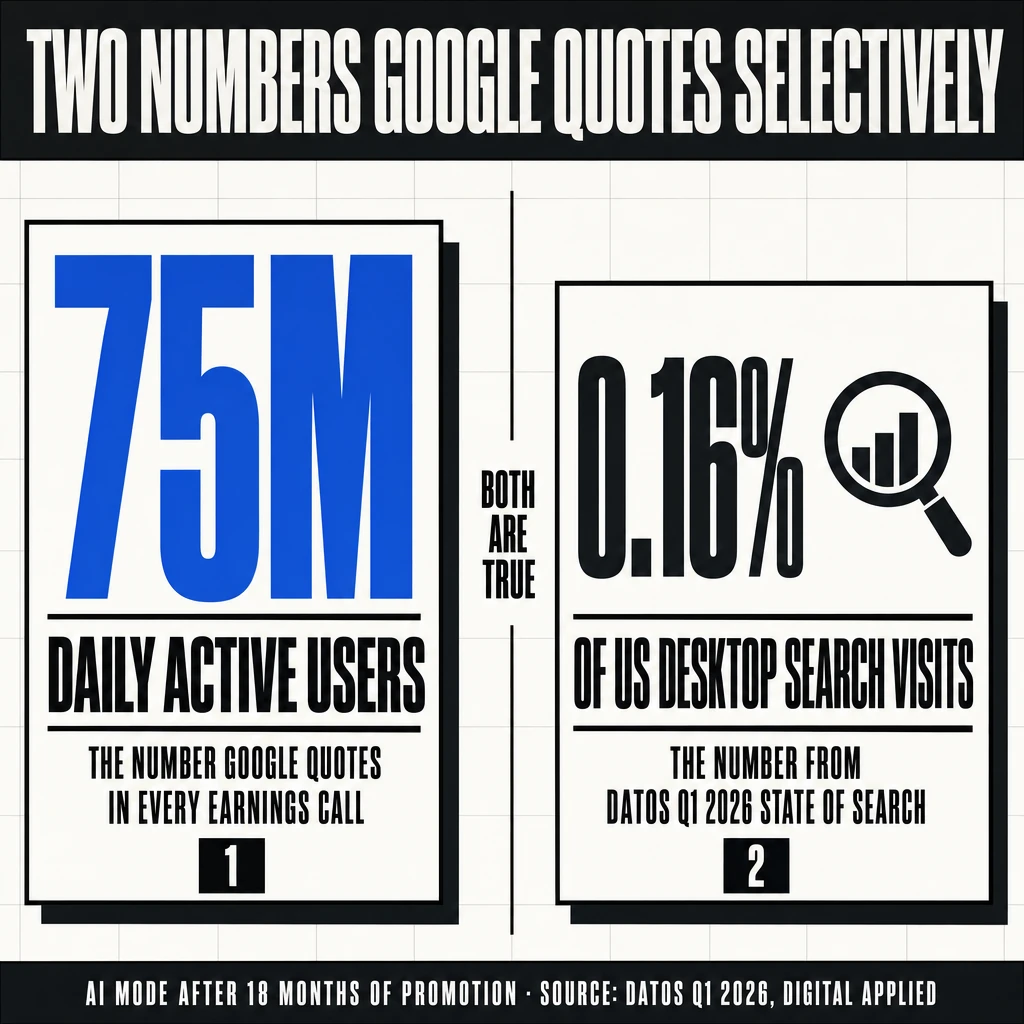
Google AI Mode reached 0.16% of US desktop search visits in March 2026, up from 0.06% in December (Datos Q1 2026). Eighteen months of aggressive promotion produced a number Google’s own analysts have to write in scientific notation.
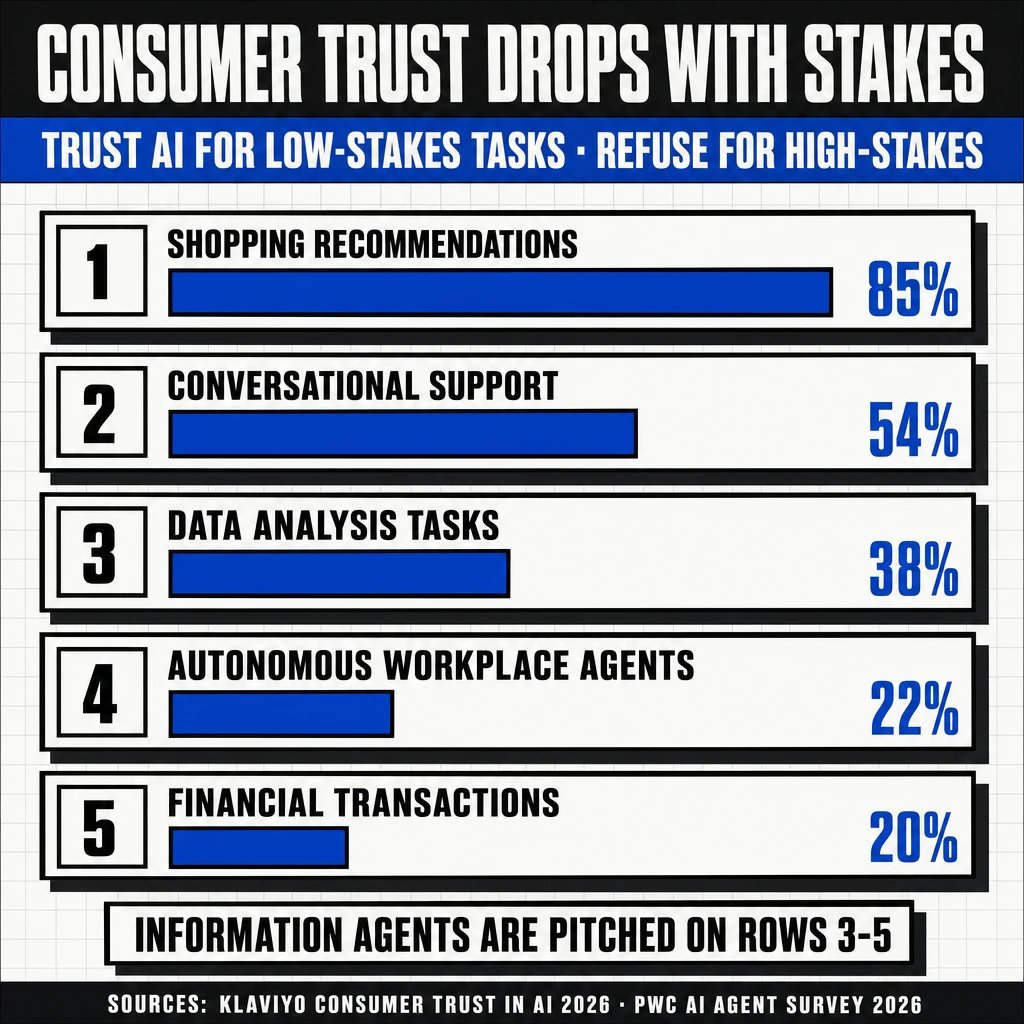
Consumer trust survey data tells the same story. People will let AI handle low-stakes work (shopping recommendations get 85% trust per Klaviyo’s 2026 consumer research). Trust drops to 20% for financial transactions. The agentic web pitch is centered on exactly the high-stakes tasks where users do not want delegation.
I wrote in my deep-dive on Information Agents that the architectural shift is real and worth preparing for structurally. This post is the other half. The consumer-side timing claim Google is selling is overcooked.
Key Takeaways
- Google AI Mode reached 0.16% of US desktop search visits in March 2026, up from 0.06% in December (Datos Q1 2026). EU/UK reached 0.21%. The growth rate is sharp; the absolute number is still tiny.
- Consumer trust in AI agents drops dramatically by task category. Shopping recommendations earn 85% trust. Financial transactions get 20%. Agentic search products are pitched on the lower-trust end of the spectrum.
- 73% of US consumers still prefer Google over ChatGPT for everyday searches (Quantumrun, 2026). The “agentic web replaces search” thesis ignores this preference signal.
- Seven in ten Americans believe Google’s AI search results are biased toward advertisers. They keep using it anyway. The trust deficit is real but coexists with usage.
- The cynical read on agentic search: Google may be preempting antitrust by positioning search as a category that no longer exists. Worth considering even if it is not the primary motivation.
- For most sites this quarter, the structural preparation work (entity completeness, citation extractability, MCP readiness) is worth doing. Building marketing campaigns around agentic search adoption is not.
The AI Mode Data Most Coverage Skips
Google reports AI Mode at 75 million daily active users and over 100 million monthly across the US and India (Digital Applied, 2026). That number gets quoted everywhere.
The number that gets quoted nowhere: AI Mode share of total desktop search visits in the US grew from 0.06% in December 2025 to 0.16% in March 2026 (Datos Q1 2026 State of Search). EU and UK reached 0.21%.
Both numbers can be true. AI Mode has a real user base in absolute terms because Google is the size of Google. As a share of how people actually search, it is statistically negligible.
Eighteen months of aggressive promotion. Free access to AI Mode for all users. Integration into the Google homepage. The result is a share number you measure with a microscope.
The growth rate (2.5x in a quarter) is impressive on a percentage basis and meaningless on an absolute basis. Doubling 0.16% twice gets to 0.64%. Useful framing for the people making product decisions inside Google. Not useful framing for sites planning content strategy around mass agentic adoption.
Information Agents are gated to AI Pro and Ultra subscribers at launch. The addressable population is a fraction of the AI Mode user base, which is itself a fraction of total search. Compound the dilutions.
Consumer Trust Falls Off a Cliff at High-Stakes Delegation
Multiple 2026 consumer research surveys agree on the same pattern: people will delegate low-stakes tasks to AI and refuse to delegate high-stakes ones.
The Klaviyo “Consumer Trust in AI” research (2026) found:
- 85% of consumers trust AI for shopping recommendations
- 54% trust AI for conversational support
The PwC AI Agent Survey (2026) found professional trust topping out at:
- 38% for data analysis tasks
- 35% for performance improvement work
- 22% for autonomous employee interactions
- 20% for financial transactions
Now look at the use cases Google highlighted for Information Agents at I/O: apartment hunting, real estate monitoring, celebrity sneaker drops, comparison shopping for high-value items.
These sit on the high-stakes side of the trust cliff. Apartment hunting is the trust equivalent of a financial transaction; getting it wrong costs months of suffering. Real estate monitoring touches the largest single purchase most people make. Celebrity product drops are a $200-2000 commitment.
The product pitch is for AI to handle exactly the tasks where users have already said they want to handle it themselves.
| AI task | Reported trust | Practical reading |
|---|---|---|
| Shopping recommendations | 85% | Low-cost and reversible decisions lead |
| Conversational support | 54% | Assistance is acceptable to a narrow majority |
| Data analysis | 38% | Trust falls once the output shapes judgment |
| Performance improvement | 35% | Autonomy remains limited |
| Autonomous employee interactions | 22% | People resist delegated representation |
| Financial transactions | 20% | High-stakes delegation has the weakest trust |
Sources: Klaviyo and PwC survey figures cited in the article. Trust drops as the cost of a wrong action rises.
Why the Bay Area Builds This Anyway
Two reasons I see, neither of them tied to consumer demand.
First, the engineers and product managers building these things live in the population most comfortable with high-stakes AI delegation. San Francisco product culture has a higher tolerance for AI overhead than the general consumer market. Building for the population you observe is a default failure mode.
I have friends who already delegate flight booking, calendar negotiation, and substack-style research synthesis to AI agents. They are in a tech-adjacent demographic where this looks like a small step. Outside that demographic the same prompts read as “letting a stranger handle the apartment hunt.”
Second, the agentic web is a satisfying engineering problem. Coordinating multiple specialized agents, building protocols like MCP, integrating tool use across applications, designing the asynchronous notification layer. All of this is genuinely interesting work.
The Jeff Goldblum quote from Jurassic Park applies: “Your scientists were so preoccupied with whether they could that they didn’t stop to think if they should.”
Sometimes the build happens because the build is fun. Marketing claims about consumer demand get bolted on later.
The Cynical Read (Antitrust Positioning)
There is a more cynical reading worth considering, even if it is not the primary explanation.
Google is in the middle of an ongoing DOJ antitrust case where the central question is whether Google has a monopoly on search. The remedy debate has included proposals to spin off Chrome.
One way to defang the antitrust argument is to make the category itself look obsolete. “Search” as a product is harder to break up if Google can credibly argue that Search is being replaced by something different (AI Mode, Information Agents, agentic experiences). The agentic web pitch is structurally useful for that case.
I am not claiming this is the actual motivation. The product roadmap was being built before the DOJ case heated up. But the positioning is convenient.
The same skepticism I applied to Google documentation in my piece on the May 2026 AI optimization guide applies here. Read product announcements with the assumption that they serve multiple purposes, not all of them aligned with what the consumer-facing pitch claims.
What This Means for Your Site
The honest framing for practitioners over the next twelve months:
- Do the structural prep work. Entity completeness, schema discipline, extractable answer blocks, citation rate tracking. None of this is wasted work; it pays off whether or not Information Agents take off. I covered the checklist in the Information Agents deep-dive.
- Do not allocate budget against an agentic adoption thesis. Spending real money preparing for mass agent-mediated traffic this year is premature. The aggregate adoption curve does not support it.
- If you have a B2B audience or a developer-heavy customer base, weight your effort heavier. The early agent adopters are in your audience. Even small adoption shifts may show up in your traffic before the aggregate numbers move.
- Watch the high-stakes-delegation trust numbers, not the platform usage numbers. When consumer trust in AI for financial transactions and major purchases moves above 50%, the agentic web pitch becomes credible. Until then, it is a Bay Area roadmap.
The structural shift Information Agents represent is real. The timeline most coverage is selling is wrong.
FAQ
Sources & References
- Datos. “State of Search Q1 2026: Behaviors, Trends, and Clicks Across the US & Europe.” 2026. datos.live
- PPC Land. “AI still under 2% but growing: Datos Q1 2026 state of search report.” 2026. ppc.land
- Digital Applied. “Google AI Mode: 75M Users, Ads in 25% of AI Results.” 2026. digitalapplied.com
- Quantumrun. “AI Mode Usage Statistics [2026 Updated].” 2026. quantumrun.com
- Klaviyo. “Consumer Trust in AI: What Brands Need to Know in 2026.” 2026. klaviyo.com
- PwC. “AI Agent Survey.” 2026. pwc.com
- Stanford HAI. “Public Opinion.” The 2026 AI Index Report. hai.stanford.edu
- Barchart. “Most Americans Think Google’s AI Is Biased. They’re Using It Anyway.” 2026. barchart.com
- Hunt, Jim. “Information Agents: When the Searcher Is Software, Not a Human.” Gridlok, May 2026. gridlok.co
- Hunt, Jim. “Google’s AI Content Rules: What ‘Meet the Standards’ Actually Means.” Gridlok, May 2026. gridlok.co
See what ChatGPT is really searching
SubSeed captures the hidden Google queries ChatGPT runs behind every answer and enriches them with search volume, CPC, and keyword difficulty.
Related Posts

Read this post with an assistant
This is the whole prompt each button sends. Nothing hidden in it.
Read https://gridlok.co/blog/agentic-web-san-francisco-story/ and give me the main points in a few sentences.
Make Gridlok a Preferred Source on Google
See Gridlok surfaced more often in your Top Stories, AI Overviews, and AI Mode. One click, applied across Google Search.