Zero-Click Search Is a Mobile Story (And Google Made the SERP More Clickable in 2025)
“Zero-click search is killing the web” is the headline that has refused to die for two years.
The framing is wrong because it conflates three distinct things that are happening at three different speeds.
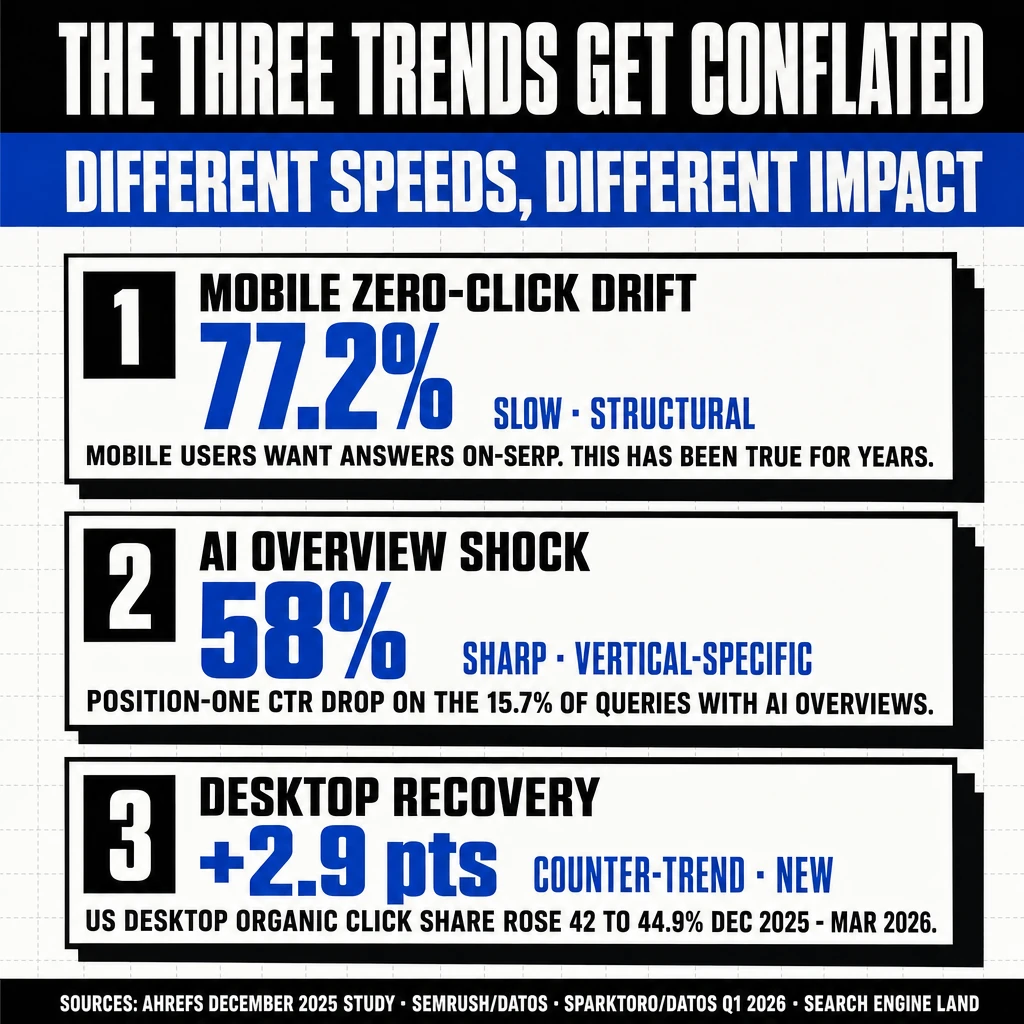
Mobile zero-click rates have been high and slowly creeping up for years. AI Overviews have cut CTR sharply in specific verticals. Desktop organic click share has actually been rising in early 2026 (SparkToro/Datos, 2026).
One of these is a structural shift. One is a vertical-specific shock. One is the opposite of what the narrative claims. Lump them together and the practitioner-level decisions get worse.
The other thing nobody is saying out loud: Google quietly made the SERP more clickable in 2025, not less. They pulled back AI Overview density after the July peak. They expanded shopping units. They killed FAQ rich results. Each move surfaced more clickable destinations.
Key Takeaways
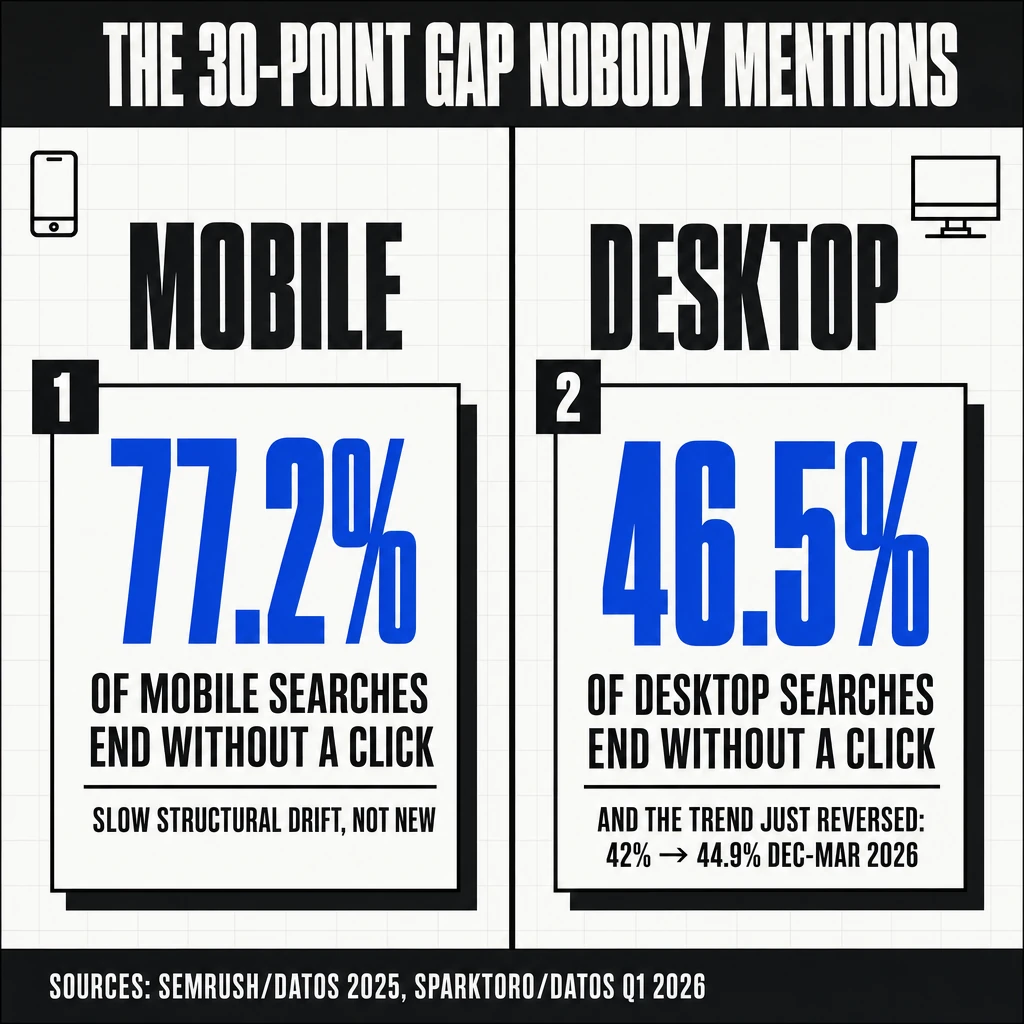
- Mobile zero-click rate is 77.2%. Desktop is 46.5% (Semrush/Datos, 2025). A 30-point gap that most “zero-click” coverage erases by averaging.
- US desktop organic click share rose from 42.0% in December 2025 to 44.9% in March 2026 (SparkToro/Datos). The desktop trend is up, not down.
- AI Overviews reduced position-one CTR by 58% in Ahrefs’ December 2025 study of 300,000 keywords, up from 34.5% in April 2025. The effect is real and concentrated on queries where AI Overviews actually appear.
- Google reduced AI Overview density after a July 2025 peak of nearly 25%. By November the rate stabilized at 15.7% (Search Engine Land, 2025). The product is being tuned for ad compatibility.
- Ads alongside AI Overviews rose from ~3% in January 2025 to ~40% by November. Google is monetizing the AI Overview real estate, not letting it cannibalize paid clicks.
- Three trends conflated into one story: a slow mobile drift, a sharp AI Overview shock by vertical, and a desktop recovery driven by Google making the SERP more clickable. Track them separately or you will diagnose the wrong problem.
The Mobile/Desktop Split Most Coverage Skips
Aggregate zero-click numbers are misleading. The single most important context for any zero-click claim is whether the data is mobile, desktop, or blended.
The Semrush/Datos study covering January through October 2025 found a US zero-click rate of 58.5% across all devices. Pull the device split apart and the picture is different.
- Mobile zero-click: 77.2%
- Desktop zero-click: 46.5%
- Aggregate blended: 58.5%
The 30-point gap means almost any conversation about zero-click that does not specify device is meaningfully incomplete. Mobile is the bigger problem. Mobile has been the bigger problem for years.
And on desktop, recent data shows the trend reversing. US desktop organic click share rose from 42.0% in December 2025 to 44.9% in March 2026 (SparkToro/Datos). EU and UK held in a 44-48% range over the same period.
I covered the broader counter-narrative case in my piece on why the “Google is dying” framing falls apart in the data. The desktop recovery is one of the strongest pieces of evidence there.
| Measurement | Reported value | Scope | Source cited in article |
|---|---|---|---|
| Mobile zero-click rate | 77.2% | US, Jan to Oct 2025 | Semrush / Datos |
| Desktop zero-click rate | 46.5% | US, Jan to Oct 2025 | Semrush / Datos |
| Blended zero-click rate | 58.5% | All devices | Semrush / Datos |
| Desktop organic click share | 42.0% to 44.9% | Dec 2025 to Mar 2026 | SparkToro / Datos |
| Position-one CTR loss with AI Overviews | 58% | 300,000-keyword sample, Dec 2025 | Ahrefs |
| AI Overview query presence | 15.7% | After a near-25% July peak | Search Engine Land |
These figures measure different behaviors and populations. Do not combine them into one universal click-loss rate.
The AI Overview Story Is Vertical-Specific
The Ahrefs December 2025 study is the cleanest measurement available of AI Overview impact on CTR.
Methodology: 300,000 keywords split evenly between queries that triggered an AI Overview and queries with informational intent that did not. Google Search Console data from December 2023 (pre-AI Overview rollout) compared to December 2025.
The finding: position-one CTR dropped 58% on queries where AI Overviews appeared. The April 2025 measurement was 34.5%. The effect roughly doubled in eight months as AI Overview behavior matured (Ahrefs, 2026).
For every 100 clicks that would have gone to the first-ranking page before AI Overviews, only 42 remain. The other 58 are kept by Google.
The detail most coverage skips: this is the impact on queries that actually have AI Overviews. In late 2025, AI Overviews appeared on roughly 15.7% of queries (Search Engine Land, 2025). The other 84% are unaffected by this specific effect.
So the AI Overview CTR shock is real, concentrated, and currently affects a minority of query volume. If a site is in a vertical where AI Overview density is high (consumer electronics, definitional queries, recipes, basic factual questions), the local experience is severe. If a site is in a vertical with low AI Overview density (commercial transactional queries, navigational queries, specific brand queries), the effect is minimal.
Audit by vertical before assuming the headline number applies.
Google Quietly Made the SERP More Clickable in 2025
The product-side changes during 2025 ran the opposite direction from “killing clicks.”
AI Overview density peaked at nearly 25% of queries in July 2025. By November it had pulled back to 15.7% (Search Engine Land, 2025). Google reduced the surface area of the most click-destroying feature on the SERP.
FAQ rich results died on May 7, 2026 (Search Engine Land, 2026). One more zero-click feature gone.
Shopping units expanded with new expandable product grids blending paid and unpaid listings (ALM Corp, 2026). AI Mode pulled from a 50-billion-product Shopping Graph that updates 2 billion entries per hour. The new shopping surface is dense with clickable destinations.
Ads alongside AI Overviews rose from ~3% in January 2025 to ~40% by November (Skai, 2025). The AI Overview real estate is being monetized rather than abandoned.
My read on why Google is doing this: Alphabet earned more than $400 billion in 2025, with search ad revenue up 17% in Q4. Paid clicks grew 9% year-over-year, a 19-quarter high (ALM Corp, 2026). The advertising machine needs people to click. A SERP that trains users not to click is a SERP that endangers the business model.
Google does not announce this strategy on earnings calls. The SERP changes do.
The Three Trends That Get Conflated
The clearest way to think about zero-click in 2026: three separate stories at three different speeds.
- Mobile zero-click drift (slow, structural). Mobile zero-click has been climbing for years and now sits at 77.2%. This is driven by screen size, single-tap features, and the structural reality that mobile users want answers in-app or on-SERP. The drift continues but is not new.
- AI Overview shock (sharp, vertical-specific). Position-one CTR dropped 58% on AI-Overview queries. This is the headline-grabbing number. It applies to ~15.7% of queries and is concentrated in specific verticals.
- Desktop recovery (counter-trend). US desktop organic click share rose 2.9 points from December to March. The visible product changes Google is making (FAQ rich result death, AI Overview trim, shopping unit expansion) are net positive for desktop clickability.
A site’s actual experience depends on which trend dominates its traffic mix.
An e-commerce site with 70% mobile traffic and product queries in the AI Mode shopping surface is feeling trend 1 and trend 2 simultaneously, with no benefit from trend 3. A B2B SaaS company with mostly desktop traffic on commercial transactional queries (which rarely trigger AI Overviews) is mostly seeing trend 3.
Same SEO industry, two completely different lived experiences. Both are reading the same headlines.
What Practitioners Should Actually Track
If you read the trade-press headlines on zero-click and applied them blindly, you would be optimizing for a problem that may or may not be yours.
Better approach: track four things specific to your site.
- Your mobile-vs-desktop traffic mix. If you are 70% mobile, the mobile zero-click drift is your dominant story. If you are 70% desktop, it is not.
- The percentage of your target keywords that show AI Overviews. Sample a hundred priority keywords every quarter. The AI Overview presence rate on your specific keyword set tells you how much of the 58% CTR shock applies to your traffic.
- Your impression-to-click ratio in Search Console, segmented by device. The change over time on this number tells you more than any blended industry stat.
- Citation rate in AI answers for your target queries. Click loss to AI Overviews and AI assistants is partially recovered through being cited. Track which of your queries show your domain as a source.
I cover the citation-rate KPI shift in more detail in my piece on what is actually new in AI-search optimization. The short version: clicks are becoming a lagging indicator, citation rate is becoming a leading one.
FAQ
Sources & References
- Ahrefs. “Update: AI Overviews Reduce Clicks by 58%.” February 2026. ahrefs.com
- Semrush / Datos. Zero-click search study January-October 2025. Cited via seoclarity.net
- SparkToro / Datos. “AI still under 2% but growing: Datos Q1 2026 state of search report.” PPC Land, 2026. ppc.land
- Schwartz, Barry. “Google AI Overviews surged in 2025, then pulled back: Data.” Search Engine Land, 2025. searchengineland.com
- Schwartz, Barry. “Google to no longer support FAQ rich results.” Search Engine Land, May 2026. searchengineland.com
- Skai. “Google’s AI Overviews and the New SERP Reality for Marketers.” 2025. skai.io
- ALM Corp. “Google Search Ad Clicks Just Hit a 5 Year High: Q4 2025 Benchmarks.” 2026. almcorp.com
- ALM Corp. “Google AI Overviews Now Appear on 14% of Shopping Queries.” 2026. almcorp.com
- Hunt, Jim. “The Data Disagrees With the ‘Google Is Dying’ Narrative.” Gridlok, May 2026. gridlok.co
- Hunt, Jim. “AEO Is Just SEO With New Acronyms.” Gridlok, May 2026. gridlok.co
See what ChatGPT is really searching
SubSeed captures the hidden Google queries ChatGPT runs behind every answer and enriches them with search volume, CPC, and keyword difficulty.
Related Posts


Read this post with an assistant
This is the whole prompt each button sends. Nothing hidden in it.
Read https://gridlok.co/blog/zero-click-mobile-story-paid-clicks-doubled/ and give me the main points in a few sentences.
Make Gridlok a Preferred Source on Google
See Gridlok surfaced more often in your Top Stories, AI Overviews, and AI Mode. One click, applied across Google Search.