Google’s AI Content Rules: What “Meet the Standards” Actually Means
Google’s new AI optimization guide spends most of its word count saying the quiet part out loud: keep doing SEO, just be smarter about it. Buried in the “create valuable, non-commodity content” section is one line that does a lot of work without explaining itself:
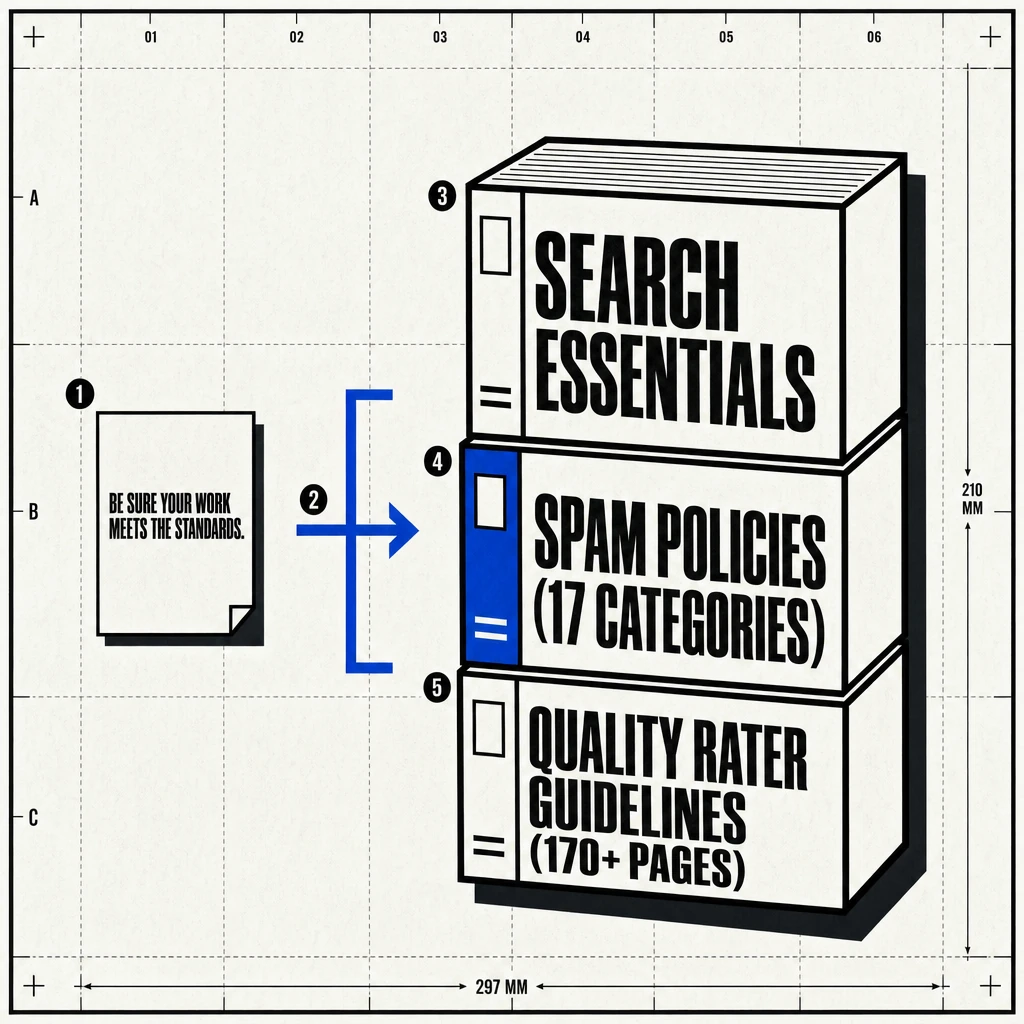
If you’re using generative AI tools to assist in content creation, be sure that your work meets the standards of the Search Essentials and our spam policies.
That sentence links to two documents. The two documents reference a third (the Quality Rater Guidelines, currently sitting at over 170 pages). The three together describe the bar Google says AI-assisted content has to clear before it earns a spot in search results. I read all of them so I could answer one question for myself: what does “meet the standards” actually mean in practice, and is the enforcement consistent enough to plan around?
Key Takeaways
- The one-sentence guidance in Google’s AI optimization guide expands into 17 spam policy categories, a Search Essentials hub page, a gen-AI content guidance page, and the Quality Rater Guidelines. None of them defines an acceptable AI percentage.
- Scaled content abuse is the policy doing most of the enforcement work. Originality.ai’s March 2024 study found 100% of deindexed sites in their 79,000-site sample showed AI signals, and half had 90-100% AI-generated posts.
- Enforcement is asymmetric. Reddit’s AI-translated subreddits keep ranking even though Google’s own policy lists machine translation without human involvement as a violation. Smaller sites doing similar things get hit.
- The practical bar I work to: a named author who can defend every claim, original analysis or data the AI cannot produce alone, and topic selection driven by what people actually ask, not what a keyword tool says has volume.
The One Sentence Google Used, and What It Skips
The line appears under the heading “Create valuable, non-commodity content for your audience.” It does three things at once: tells you AI is permitted, points to Search Essentials, and points to spam policies. What it does not do is define the threshold where AI assistance crosses into AI abuse. The reader is expected to follow the links and draw their own conclusion.
This is the pattern I keep running into with Google documentation. The guidance is written to be defensible in any direction. If a small site does something Google decides to penalize, the policy already covered it. If a large site does something similar and keeps ranking, the policy was about a different scenario. I wrote about a parallel example last year in “Why Nobody’s Using LLMs.txt”: the docs say one thing, the data shows another, and the gap never gets explained.
The 2024 leak of internal Google ranking documentation confirmed what plenty of people already suspected. Some signals public documentation downplays do influence rankings, and some “we don’t use that” claims were not strictly accurate. I read Google’s docs as a starting point now, not a closed answer. That mindset matters when interpreting a one-line policy that punts to three other documents.
What Search Essentials Actually Requires
Search Essentials is a hub page with three child sections: technical requirements, spam policies, and key best practices. The technical requirements are mechanical (Googlebot can crawl, the content is indexable, the page is not blocked or behind a login). The best practices section asks for “helpful, reliable, people-first content” without defining any of those words concretely.
The work is done by the spam policies page, which lists 17 categories. Most are about manipulation tactics that predate generative AI by a decade: cloaking, doorway pages, link spam, sneaky redirects, hidden text. A handful are the ones that actually catch AI content:
| Spam Policy | What It Catches |
|---|---|
| Scaled Content Abuse | Many pages generated to manipulate rankings without adding value, “no matter how it’s created” |
| Scraping | Republishing other sites’ content without original work or citation |
| Thin Affiliation | Affiliate pages copying merchant descriptions with no original review |
| Doorway Abuse | Pages targeting near-identical queries that funnel to a single destination |
| Keyword Stuffing | Unnatural keyword density, lists of city names or numbers |
The phrase “no matter how it’s created” inside the scaled content abuse policy is the one to read carefully. Google explicitly closed off the defense of “but humans were involved.” If the output looks like spam at scale, the policy applies even if a person hit the publish button. Mechanism does not matter to the policy. Outcome does.
What “Scaled Content Abuse” Really Catches
Google’s exact definition: “Scaled content abuse is when many pages are generated for the primary purpose of manipulating search rankings and not helping users. This abusive practice is typically focused on creating large amounts of unoriginal content that provides little to no value to users, no matter how it’s created.”
The four behaviors Google calls out explicitly:
- Using generative AI to produce many pages without adding value for users
- Scraping feeds or search results with light automated transformations like synonymizing or auto-translation
- Stitching together content from multiple pages without contributing new value
- Spreading the same scaled content across multiple sites to hide its scaled nature
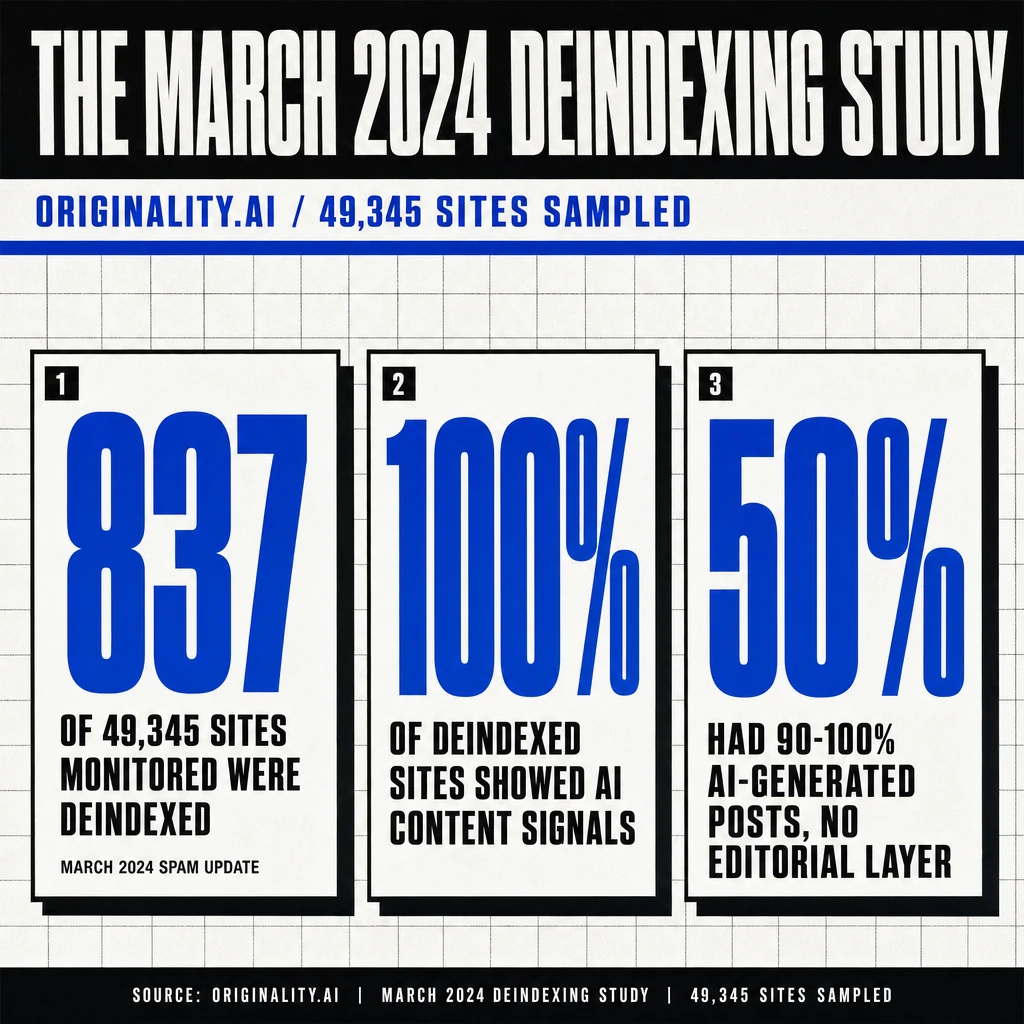
The clearest data on what the policy actually catches comes from the March 2024 spam update. Originality.ai’s analysis of 79,000 monitored sites found 1,446 received manual actions. In a separate sample of 49,345 sites, 837 were removed from the index entirely. Of the deindexed sites, 100% showed signals of AI generation, and 50% had 90-100% of posts produced by AI with no editorial layer.
The pattern repeated in the March 2026 core update with sharper edges. Sites publishing 50 to 500 AI-generated articles per day with no human review took 60-90% ranking losses. Most never received a manual action message in Search Console. The algorithm simply stopped surfacing the pages. There is no reconsideration request for scaled content abuse the way there is for a manual link penalty.
The mechanism is not “AI was involved.” The mechanism is “the output looks like spam at scale, and the algorithm can detect that pattern.” That distinction is the one most sites get wrong.
The Enforcement Asymmetry I Can’t Ignore
Glenn Gabe at G-Squared Interactive has been tracking Reddit’s AI translation expansion for over a year. Reddit machine-translates threads into Spanish, French, German, Portuguese, and other languages, then publishes them as separate URLs that get indexed and rank. Google’s own scaled content abuse policy lists “translating content with automated tools” as an example of the violation. Yet Reddit’s translated pages have boomed in rankings, not crashed.
I do not have an inside view on why the policy applies asymmetrically. The cynical read is that large sites with strong ranking signals get the benefit of the doubt, and small sites without that authority do not. The more charitable read is that Reddit is adding contextual value somehow (an English thread getting a Spanish wrapper around it counts as useful for Spanish speakers who would not otherwise find it). Both reads can be true at once.
What this means for planning: I do not treat the spam policy as a uniform rulebook applied equally to everyone. I treat it as a description of what algorithmic enforcement looks for at sites without a strong reputation cushion. If I were building a brand-new site today, I would assume the policy is enforced strictly against me and softly against incumbents. That asymmetry shapes how I work.
How Google’s Quality Raters Actually Evaluate AI Content
The Quality Rater Guidelines are the manual Google’s contracted human evaluators use to score search result quality. Raters do not directly affect rankings, but their judgments train the systems that do. The January 2025 update added a formal definition of generative AI for the first time:
Generative AI is a type of machine learning model that can take what it has learned from the examples it has been provided to create new content, such as text, images, music, and code.
Two lines from the same section actually tell me what raters are instructed to do when they encounter AI content:
- “The use of Generative AI tools alone does not determine the level of effort or Page Quality rating. Generative AI tools may be used for high quality and low quality content creation.”
- “If all or nearly all of the main content is auto- or AI-generated (with little or no added value), raters should apply the lowest rating.”
The first line is the one Google quotes publicly. The second is the operational instruction. Read together, they describe a system where AI assistance is fine and AI domination is not. Whether content sits on which side of that line is a judgment call raters make per page, not a percentage rule applied uniformly.
For YMYL content (Your Money or Your Life: medical, financial, legal, safety), the standard is sharper. E-E-A-T (Experience, Expertise, Authoritativeness, Trust) gets applied more strictly. Heavy AI use on a YMYL topic without verified author expertise tilts the rating toward the bottom regardless of how polished the writing is.
The Practical Bar I Use Before Publishing AI-Assisted Content
Working backwards from the three documents and the Quality Rater Guidelines, the compliance checklist I actually run before hitting publish:
- A named author who can defend every claim. The post has a byline. The byline is a real person with a public footprint. If a journalist called me and asked “who wrote this and how do they know it’s correct,” I have an answer.
- Original work the AI could not produce. First-person experience, original data, primary research, opinion that takes a defensible position. If an AI could produce the same piece with the same prompt, the piece is not adding to the public record.
- Topic chosen because people ask about it. Not because a keyword tool flagged volume. Real user questions show up in support tickets, social media, ChatGPT sessions, Reddit threads. The closer I get to “this exact question came from a real person,” the safer the topic selection.
- Disclosure where the audience expects it. Most readers do not need a banner that says “AI was used.” E-commerce product descriptions generated by AI do, per Google’s gen-AI content guidance. Posts where I cite specific AI tools as sources do.
- An editorial pass against the 17 spam policies. Most posts do not come close to any of them. The check still takes 60 seconds and has caught one or two cases where I accidentally drifted toward a doorway pattern.
- A working title that promises a specific answer, not a category overview. “What Google’s policy actually requires” beats “Google AI content policy explained.” Specific framing forces the article to actually answer something, which weeds out filler before it gets written.
The third point is where I keep coming back to topic selection as the highest-leverage filter. Most AI content failures I see are not about prose quality. They are about producing the wrong content in the first place: a page that exists because a tool said the keyword had volume, with no real user behind the volume number. That is the gap I built SubSeed to close. The Chrome extension pulls the actual fan-out queries and reasoning steps from real ChatGPT sessions so the topic list starts from real user questions, not phantom search demand.
What Changes for Site Owners Using AI Today
Nothing in the new AI optimization guide changes the underlying policy. The guide pulls together rules that already existed and frames them for the AI-search era. If I had to summarize the shift in one line: the bar is the same, but the cost of failing it went up because the algorithm got better at detecting failure.
Two operational changes I think are worth making this quarter:
- Audit any page that was AI-drafted and never edited. If a human would not put their name on it, take it down or rewrite it. Indexed pages that look like scaled content abuse drag down sitewide quality signals.
- Move topic selection upstream of writing. If the topic list is generated from a keyword tool with no user-question validation, the writing quality will not save it. The cheapest fix is asking real users (support emails, customer interviews, social listening) what they actually want explained.
That second point is the one most teams skip. Writing quality is visible. Topic selection quality is invisible until the page underperforms, at which point most teams blame the writing.
FAQ
Sources & References
- Google. “Optimizing for generative AI search.” Google Search Central, 2026. developers.google.com
- Google. “Google Search Essentials.” Google Search Central, 2026. developers.google.com
- Google. “Spam policies for Google web search.” Google Search Central, 2026. developers.google.com
- Google. “Google Search guidance on AI-generated content.” Google Search Central, 2026. developers.google.com
- Google. “Search Quality Rater Guidelines.” Google, January 2025 update. services.google.com
- Originality.ai. “Google’s March 2024 spam update and deindexing study.” March 2024. Referenced via Tech Startups
- Gabe, Glenn. “Reddit AI translations have been scaling across languages and Google rankings are booming.” G-Squared Interactive, 2025. gsqi.com
- DigitalApplied. “Scaled Content Abuse: Google’s AI Page Crackdown Guide.” 2026. digitalapplied.com
- Hunt, Jim. “Why Nobody’s Using LLMs.txt.” LinkedIn, October 2025. linkedin.com
See what ChatGPT is really searching
SubSeed captures the hidden Google queries ChatGPT runs behind every answer and enriches them with search volume, CPC, and keyword difficulty.
Related Posts


Read this post with an assistant
This is the whole prompt each button sends. Nothing hidden in it.
Read https://gridlok.co/blog/googles-ai-content-rules/ and give me the main points in a few sentences.
Make Gridlok a Preferred Source on Google
See Gridlok surfaced more often in your Top Stories, AI Overviews, and AI Mode. One click, applied across Google Search.