Information Agents: When the Searcher Is Software, Not a Human
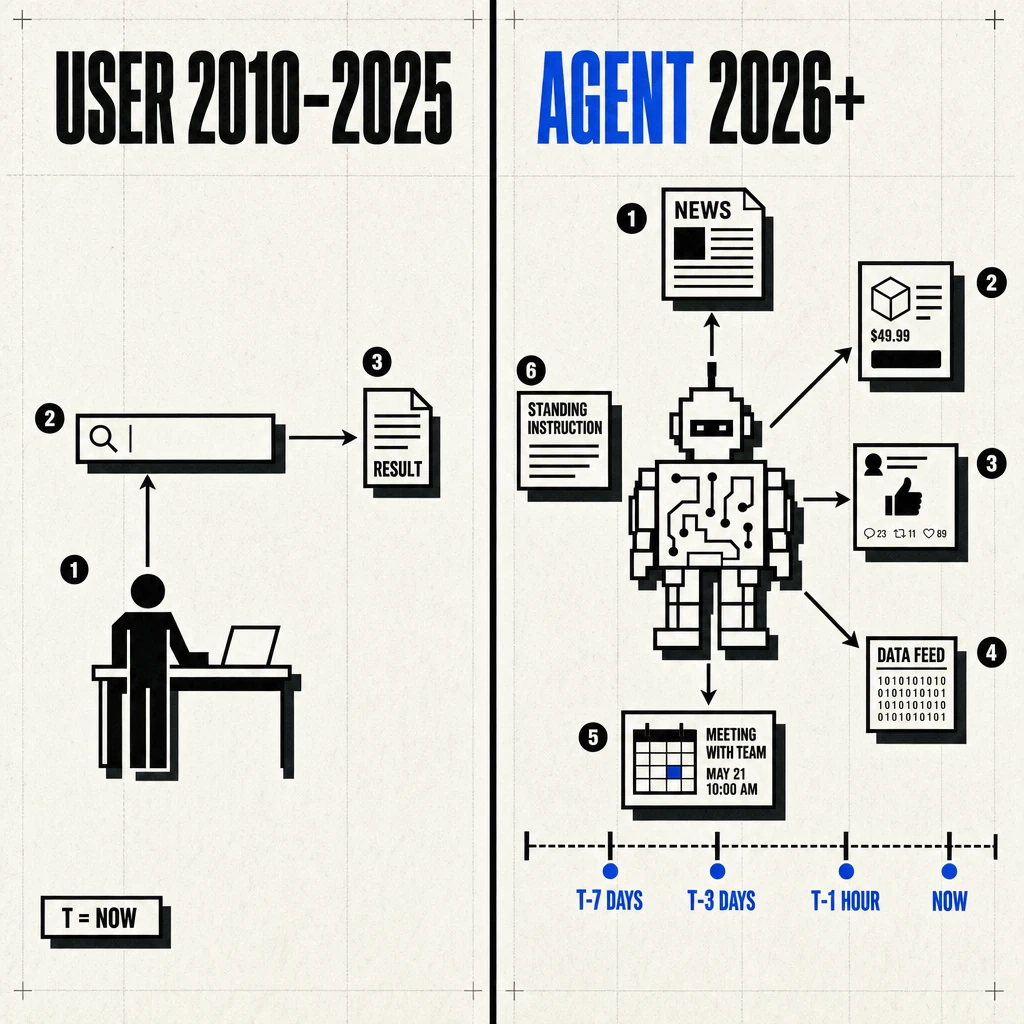
Google’s I/O 2026 letter dropped one announcement that nobody is sequencing properly. Most of the recap coverage led with AI Mode hitting 1 billion monthly active users or AI Overviews reaching 2.5 billion. The bigger story was a paragraph buried under those numbers: Information Agents. Personalized AI agents running 24/7, monitoring the web for users, rolling out this summer to Google AI Pro and Ultra subscribers.
Liz Reid, the head of Google Search, framed it this way: “We’re entering the era of Search agents, where you can easily create, customize and manage multiple AI agents for your many tasks, right in Search.”
Read past the marketing language and there is a structural change here that is bigger than AI Mode and bigger than AI Overviews. The thing changing is not what Search returns. The thing changing is who is doing the searching.
Key Takeaways
- Information Agents launch summer 2026 to AI Pro and Ultra subscribers. The agents monitor the web 24/7 against a user-defined task, then send synthesized updates with one-click actions. On September 28, 2026, Google opened them to everyone, free, in the Google app.
- This is the first time Google has shipped a Search product that does not require a human to type a query. The searcher can be software working on a standing instruction.
- The downstream effects ladder into measurement, content structure, trust signals, and conversion attribution. Click-through rates will drift down. Citations will become the operational success metric.
- MCP (Model Context Protocol), the Anthropic-originated standard now supported by Google, OpenAI, and Anthropic, is becoming the interface layer between agents and publisher sites. Over 500 public MCP servers existed by early 2026.
- The parallel that fits best is mobile-first in 2010. The architectural shift is real even when the early framing is overcooked. Sites that get the audit and entity work done this quarter will own the agent attention layer.
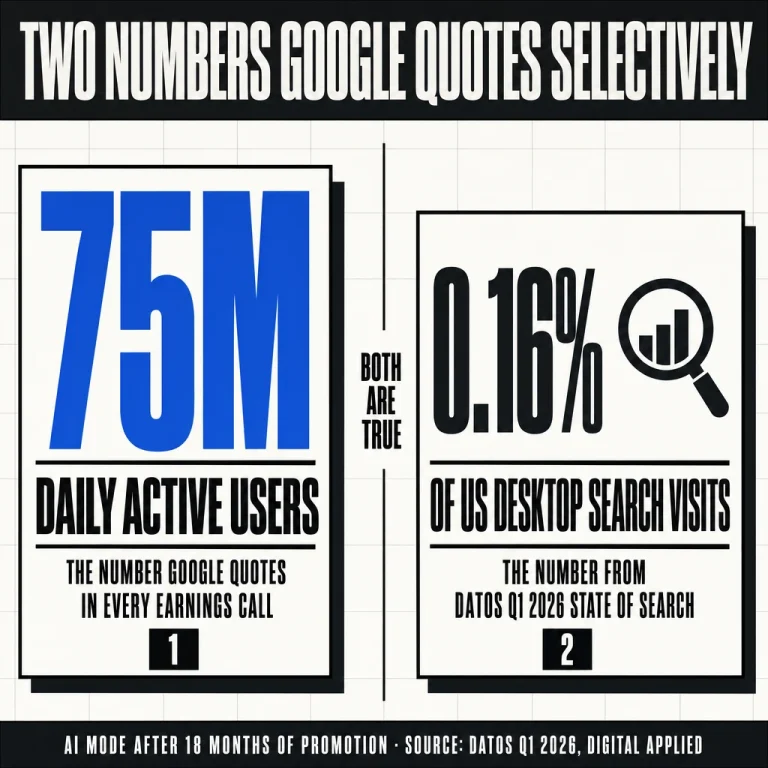
- Brands cited inside AI Overviews already earn roughly 35% more organic clicks than non-cited competitors (Wellows, 2026). The citation premium will be larger inside agent-mediated Search.
What Google Actually Announced
The literal product description from Google’s I/O 2026 Search post: Information Agents “intelligently look across everything on the web, like blogs, news sites and social posts, plus our freshest data, such as real-time info on finance, shopping and sports, to monitor for changes related to your specific question.” Users receive “an intelligent, synthesized update, with the ability to take action.”
Four product details matter for planning:
- Tier: Google AI Pro and Ultra subscribers only at launch. Not free. Not for everyone.
- Timing: Summer 2026 rollout.
- Use cases Google highlighted: apartment hunting with specific requirements, celebrity sneaker drops, real-estate monitoring. Standing instructions, not one-shot queries.
- Action capability: The synthesized update lets users “take action” directly from the agent’s output. That is the part most coverage skipped.
The paid tier matters because it tells me how Google is thinking about agent usage internally. Information Agents are compute-expensive. Continuous scanning, continuous synthesis, continuous personalization. Google is not eating that cost on free tier. They are charging directly. That suggests agents will be more common at the high-value query end (real estate, financial services, B2B research, comparison shopping) and rare at the low-intent end. If your site sells things, expect agent traffic disproportionately on the bottom-of-funnel queries.
Updated 29 September 2026. Google has since taken the paywall off. On September 28, Robby Stein, Google’s VP of Product for Search, said the info monitoring Ultra and Pro subscribers had been using is rolling out to everyone, globally, in the Google app. You tell AI Mode what to watch for, and Search keeps checking sites, forums, social posts, real-time data, and a Shopping Graph of more than 60 billion products, then alerts you when something changes. His examples were new restaurants and pop-ups nearby, local holiday activities for kids, and back-in-stock and price-drop updates. Two of those three are everyday local tasks, so expect standing instructions for local searches as well as high-value purchases.
Why This Is Different From AI Mode or AI Overviews
AI Overviews compress the SERP into a synthesized summary. AI Mode lets users have a conversational thread inside Search. Both of those still assume a human typing a query, reading the result, and deciding what to click. The optimization playbook is different from blue-link SEO, but the unit of work is the same: a person is searching.
Information Agents remove the human typing and remove the session boundary. The user gives the agent a standing instruction once. The agent runs against that instruction continuously, surfaces updates asynchronously, and sometimes takes action without a human in the loop. That is not “search with AI assistance.” That is a different category of product wearing the Search label.
The unit of work shifts from “a user has an intent right now” to “a user gave an agent a standing instruction last week.” Most SEO assumptions break at the level of that one sentence.
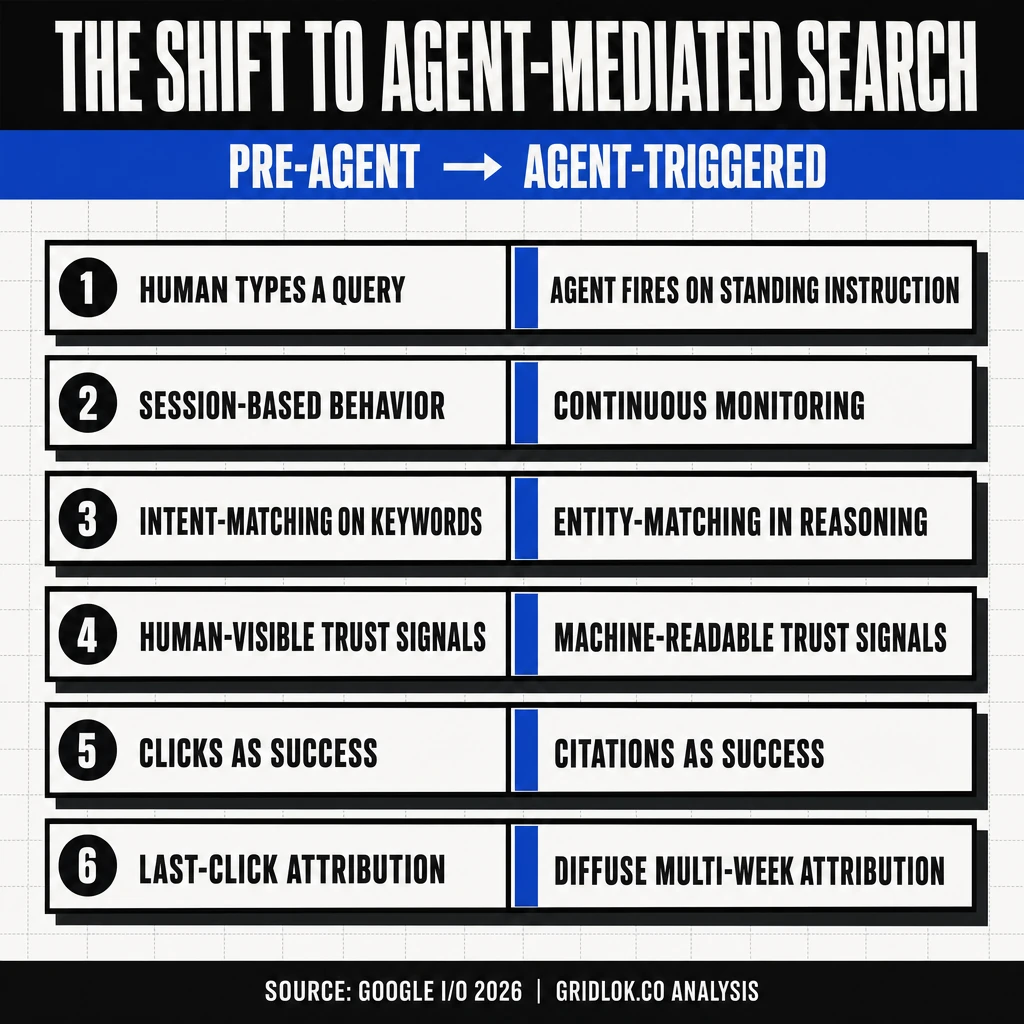
The Architectural Shifts Information Agents Trigger
Working through what changes when the searcher becomes software:
1. Human-triggered queries become agent-triggered queries
The query no longer fires at the moment of intent. It fires whenever the agent decides the standing instruction warrants a check. That timing is opaque to publishers. A site might be queried by an agent at 3 a.m. while indexed at 9 a.m. by Googlebot. Whether the site is ready to answer at the moment the agent looks is now a freshness and entity-completeness problem, not a publishing-cadence problem.
2. Session-based behavior becomes standing-instruction behavior
A traditional search session has a beginning, a middle, and an end. The user starts with a query, evaluates results, clicks something, completes or abandons the task. An agent-triggered query has none of that structure. The agent monitors continuously, accumulates context across many micro-queries, and synthesizes across all of them before surfacing anything to the human. Single-touch attribution will report nothing useful in that model.
3. Intent-matching becomes entity-matching at the agent’s reasoning layer
Traditional SEO matches keyword intent to page intent. An agent does not search by keyword in the same way. It reasons about entities (a company, a product, a location, a price, an availability state) and selects sources based on which ones expose the entities cleanly. Sites that show up well in agent-mediated Search will be the ones with the cleanest structured data, the most complete entity coverage, and the most consistent presentation of canonical attributes across pages.
4. Human-visible trust signals become machine-readable trust signals
Human searchers respond to design polish, social proof badges, review counts, brand familiarity. An agent reads none of that. It reads schema, citations, source authority signals, structured reviews, and canonical attribute completeness. The cosmetic layer of a website becomes invisible to the part of the audience that an agent represents. The signals that survive translation into machine-readable form are the ones that matter.
5. Clicks-as-success becomes citations-as-success
An agent reading a page does not always click. The agent might synthesize the answer and surface it to the user without ever sending the user to the source. The publisher’s success in that case is being cited as the source, not being clicked. Citation rate will replace click-through rate as the leading indicator of agent-mediated visibility. Click-through rate will keep showing up in Search Console because human queries still happen, just not as the only signal.
6. Conversion attribution becomes diffuse across the agent’s monitoring window
A traditional purchase path attributes credit to the last click or some weighted touch model across a discrete journey. An agent monitoring a standing instruction for three weeks before surfacing an update does not produce a clean attribution path. The user might never visit the site that influenced the recommendation. The conversion event might happen in a different channel entirely (direct traffic, email, paid social). Last-click attribution will systematically under-count SEO contribution in agent-mediated journeys. Multi-touch models built around session boundaries will not handle the standing-instruction window at all. Attribution is going to need new primitives, not just new weights.
What This Does to Search Console and Analytics
Operational consequence most coverage skipped: the dashboards will lie to you for the next 18 months.
Search Console measures impressions and clicks against queries Google logs. Agent-mediated queries fired on a user’s behalf are still queries. The impression counts. The click does not, because the agent does not click in the same way. Sites that are cited inside agent updates will see their impression-to-click ratio degrade even as their actual influence on user decisions grows. That degradation will look like a drop in CTR. It will be misread as a content quality problem and trigger the wrong cleanup.
The same pattern will show up in Google Analytics 4. Session counts will not capture agent-mediated influence on a purchase decision. The user might never visit the site directly. They might act on a synthesized agent update that named the site as a source. The conversion attaches to a direct visit or a different channel later, and the SEO contribution looks weaker than it actually is.
The work-around is not a tool. It is a measurement framework change. Track citation rate inside AI Overviews and inside agent updates as separate KPIs from click-through. Audit which entities a site is named alongside. Treat being cited as the leading indicator and clicks as the lagging one. I expect this framework to become standard practice over the next two years.
MCP and Why It Matters for Publishers
Pichai’s I/O letter mentioned MCP integration for Gemini Spark. That detail looks like plumbing if you read the letter quickly. It is not plumbing. It is the interface layer that determines which sites are first-class agent destinations and which sites get scraped into invisible context.
MCP (Model Context Protocol) is an open standard Anthropic released in November 2024. It defines how an AI application connects to external sources and tools. By early 2026, more than 500 public MCP servers existed (Digiday, 2026). Anthropic, OpenAI, and Google DeepMind all support the protocol. It is the rare standard that emerged before lock-in.
For publishers, two things follow:
- Sites that expose an MCP server become first-class agent destinations. An agent looking for product availability, pricing, current article inventory, or any other structured data can query an MCP endpoint directly instead of parsing HTML. The response is faster, more accurate, and more likely to be used as a citation.
- MCP servers can be monetized. Services like TollBit are building marketplaces where publishers expose MCP endpoints and charge AI agents per query. That is the first credible alternative to ad-funded content I have seen emerge in five years.
Google also announced WebMCP, a proposed browser API that lets websites expose structured callable tools directly to agents. WebMCP is upstream of all of this. If it ships and gets adoption, agent-to-site interaction will run over WebMCP the way human-to-site interaction runs over HTML today. That is far enough out that I would not build for it yet. But I would know it exists and I would track whose browsers ship it.
The Mobile Parallel and the Mobile Lesson
The honest version of this story: every announcement of a paradigm shift in Search has been over-hyped. AMP was supposed to change publishing. Knowledge Graph was supposed to end blue links. Voice search was supposed to dominate by 2020. Each one was real, none of them was as big as the announcement framing suggested, and the practitioners who responded too hard wasted a year. So I want to be careful about treating Information Agents as the inflection point.
The parallel that fits best is not AMP or voice. It is mobile-first in 2010. When Google started talking about mobile-first indexing, most SEOs treated it as a slogan and waited. The sites that audited their mobile experience early, fixed the obvious problems, and built mobile-readable templates owned mobile rankings for the next decade. The ones that waited until 2017 spent two years catching up.
Information Agents has the same shape. The full agentic Search experience is two or three years out. The work that prepares a site for it (entity completeness, structured data discipline, citation extractability, MCP readiness) is work I would be doing anyway because it also helps with AI Overviews and AI Mode today. The downside risk of acting now is small. The downside risk of waiting is larger than most teams will admit until it is too late to catch up cheaply.
What to Audit on a Site This Quarter
The checklist I would run against any site preparing for agent-mediated Search:
- Entity completeness. Every product, person, location, and service mentioned on the site should have a stable canonical page that an agent can resolve to. If three pages mention a product and none of them is the authoritative page for it, the agent has to guess.
- Schema coverage on the high-stakes templates. Product, LocalBusiness, Organization, Article, FAQPage where it still helps for understanding (the visual rich result is dead, but the schema still tells the agent what the page is). Verify with the Rich Results Test even though FAQ visual is gone.
- Citation extractability. Read a page and ask: if an agent had to summarize this and name the source, what is the cleanest 30 words it could extract? If the page does not have an extractable answer block, write one.
- Freshness audit on time-sensitive pages. Agents check continuously. Stale dates on pages that should be updated will get the page deprioritized. The lastmod field in sitemaps and visible “Updated” timestamps both matter.
- Author-level expertise signals. Named author, public footprint, body of related work. Agents weighting source authority will weight this the same way human Quality Raters do.
- MCP readiness audit (if you sell things or list inventory). Does the site have an API or feed that exposes current inventory, pricing, and availability in a machine-readable way? If yes, wrapping it as an MCP server is a one-week project that pays off for the next five years. If no, build the feed first, then the MCP wrapper.
Honest Skepticism About Google’s Framing
Three things in Google’s announcement deserve a skeptical read.
First, the “exactly the right moment” framing is marketing. Agents do not know the right moment any better than search does. They know when their continuous monitoring detected a change that matches a standing instruction. That is useful, but it is not magic. Marketing the lag time as omniscience is something I expect a year of disillusioned users to push back on.
Second, the AI Pro and Ultra subscription gating is doing real work for Google. Continuous scanning is expensive. Putting it behind a paywall limits compute exposure while letting Google market the feature to everyone. Expect heavy advertising of the feature combined with relatively low actual usage in the first six months. That gap between marketing reach and user adoption will produce a lot of bad takes about adoption rates either way. (Google removed the paywall on September 28, 2026, so usage from here on reflects free access.)
Third, the same editorial caveat I applied to Google’s AI optimization guide in my piece on the May 2026 content rules applies here. Google’s documentation describes the world as Google wants it to be, not as it currently is. The 2024 leak of internal ranking documentation showed gaps between the public claims and operational reality. Read Information Agents announcements the same way. The architectural direction is real. The timing claims, the use case examples, and the framing of who benefits are sales copy.
FAQ
Sources & References
- Pichai, Sundar. “Google I/O 2026: An important next step on our AI journey.” Google Blog, May 2026. blog.google
- Google. “Google Search’s I/O 2026 updates: AI agents and more.” Google Blog, May 2026. blog.google
- Schwartz, Barry. “Google Search gains information agents and improved agentic experiences.” Search Engine Land, May 2026. searchengineland.com
- Search Engine Journal. “Google’s Task-Based Agentic Search Is Disrupting SEO Today, Not Tomorrow.” 2026. searchenginejournal.com
- Anthropic. “Introducing the Model Context Protocol.” November 2024. anthropic.com
- Digiday. “WTF is Model Context Protocol (MCP) and why should publishers care?” 2026. digiday.com
- Wellows. “Google AI Overviews Ranking Factors: 2026 Guide to Winning Citations.” 2026. wellows.com
- Hunt, Jim. “Google’s AI Content Rules: What ‘Meet the Standards’ Actually Means.” Gridlok, May 2026. gridlok.co
- Hunt, Jim. “Why Nobody’s Using LLMs.txt.” LinkedIn, October 2025. linkedin.com
See what ChatGPT is really searching
SubSeed captures the hidden Google queries ChatGPT runs behind every answer and enriches them with search volume, CPC, and keyword difficulty.
Related Posts
Read this post with an assistant
This is the whole prompt each button sends. Nothing hidden in it.
Read https://gridlok.co/blog/information-agents-searcher-is-software/ and give me the main points in a few sentences.
Make Gridlok a Preferred Source on Google
See Gridlok surfaced more often in your Top Stories, AI Overviews, and AI Mode. One click, applied across Google Search.