What Does It Mean to Get Cited by AI? A Guide for Service Businesses
Key Takeaways
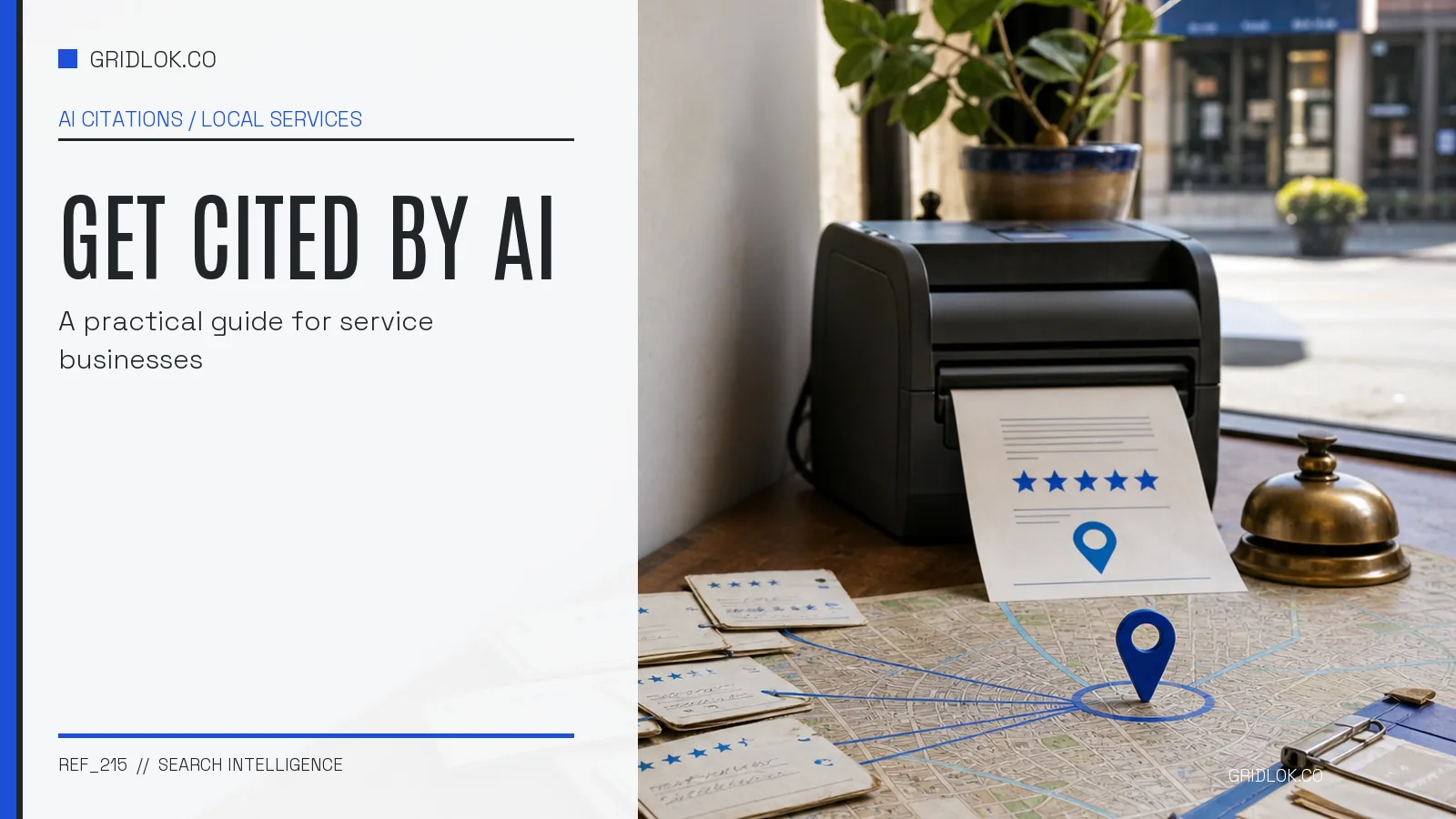
- When someone asks ChatGPT or Google AI “who’s the best plumber in Austin” or “what should I look for in a family law attorney,” the AI gives a direct answer and cites specific businesses. Getting cited means your business is the one it names.
- AI citation is different from Google ranking. You can rank #1 on Google and still be invisible to AI answers. The two systems pull from different signals.
- For service businesses, AI citations act like word-of-mouth at scale. When AI recommends you by name, the person on the other end treats it like a trusted referral.
- The businesses that get cited share specific patterns: strong review profiles, consistent directory listings, content that answers the exact questions customers ask, and structured data that AI can read.
What It Actually Means When AI Cites Your Business
AI citation means that when a potential customer asks an AI tool a question about your service, the AI names your business in its response. It might say “Based on reviews and local ratings, [Your Business] is highly rated for residential HVAC repair in the Dallas area” and link to your website or Google Business Profile.
This is happening right now across ChatGPT, Google AI Overviews, Perplexity, and Gemini. People are asking these tools for recommendations the same way they used to ask friends or scroll through Google results. The difference is that AI gives one answer, not ten blue links. If your business is that answer, you get the call. If it’s not, your competitor does.
Why This Matters for Service Businesses Specifically
Service businesses run on trust. A homeowner hiring a roofer, a business owner choosing an accountant, a parent picking a pediatric dentist. These are high-stakes decisions where people want a recommendation, not a list of options.
AI is becoming that recommender. AI search usage doubled in 2025, and the growth is accelerating. When someone asks “who’s the best electrician near me” into ChatGPT, the AI doesn’t show them 10 results to pick from. It recommends specific businesses based on reviews, website content, and directory data.
That recommendation carries weight. The user didn’t search for your brand. They asked for a recommendation and got your name. That’s the digital equivalent of a friend saying “call these guys, they’re great.” The trust transfer is immediate.
AI Citation vs. Google Ranking: They’re Not the Same Thing
This is the part most business owners miss. You can rank on the first page of Google for your target keywords and still be completely absent from AI answers for the same queries.
Google rankings are based on backlinks, domain authority, on-page SEO, and hundreds of other ranking signals. AI citation is based on different criteria: structured data, review signals, directory consistency, and content specificity.
A business with a clean website, 200+ Google reviews, consistent NAP (name, address, phone) data across directories, and content that directly answers customer questions is more likely to get cited by AI than a business with better Google rankings but weaker review signals and inconsistent directory listings.
Google AI Overviews and ChatGPT also cite different sources for the same query. A business might be recommended by ChatGPT but not by Google AI, or vice versa. Each platform has its own selection logic.
| Dimension | Traditional search result | AI-generated answer | What to measure |
|---|---|---|---|
| Output | A ranked list of pages | A synthesized answer that may name a business | Ranking and impression vs mention and citation |
| Winning unit | A page or URL | A fact, entity, brand, or source | Which exact business and source appear |
| Evidence | Relevance, links, technical quality, local signals | Consistent entities, reviews, specific answers, readable facts | Accuracy and consistency across sources |
| Common gap | Page ranks but the brand is not named | Brand is named inaccurately or without a link | Test the same service-and-location prompts |
The systems overlap. A strong local search foundation still supports AI citation, but the output and measurement are different.
What AI Looks for When Recommending a Service Business
AI systems don’t just randomly pick a business. They evaluate signals from across the web to determine which businesses to recommend. Here’s what moves the needle for service companies.
Review Volume and Quality
Reviews are the strongest signal for local AI citation. Businesses with profiles on Google, Yelp, Trustpilot, and industry-specific platforms have 3x higher chances of being cited by ChatGPT compared to businesses without review presence on these platforms.
It’s not just about star ratings. AI reads review text to understand what a business does well. A plumbing company with 50 reviews that mention “same-day service,” “fair pricing,” and “explained everything clearly” gives the AI specific language to use when recommending that business for those exact needs.
Consistent Directory Listings
Your business name, address, and phone number need to be identical across every directory: Google Business Profile, Yelp, BBB, Angi, industry directories, and local chamber of commerce listings. When AI sees conflicting information across sources, it loses confidence in recommending you.
This is old-school local SEO, but it matters more for AI citation than it does for traditional Google rankings. AI systems cross-reference multiple sources to verify business information before making a recommendation.
Content That Answers Customer Questions
Your website needs to answer the questions your customers are asking AI. “How much does a roof replacement cost in Phoenix?” “What’s included in a standard home inspection?” “How long does a kitchen remodel take?”
If your website has clear, specific answers to these questions, AI has something to cite. If your website is a brochure with generic service descriptions and a contact form, AI has nothing to work with.
FAQ pages structured around real customer questions are the highest-value content for service business AI citation. Add FAQ schema markup so AI systems can extract the question-and-answer pairs directly.
Service Area and Specialty Specificity
Generic “we serve the greater metro area” content doesn’t help AI make specific recommendations. Pages that target specific neighborhoods, zip codes, and service types give AI the detail it needs.
“Emergency plumbing repair in Round Rock, TX” is citable. “We offer plumbing services” is not.
A Real Example of What AI Citation Looks Like
Imagine a homeowner in Nashville types into ChatGPT: “I need a reliable HVAC company for a full system replacement. Who do you recommend in the Nashville area?”
If your HVAC company has 300+ Google reviews mentioning system replacements, a website page specifically about HVAC replacement with pricing ranges and timeline estimates, FAQ schema covering common replacement questions, and consistent listings across Angi, HomeAdvisor, and BBB, the AI has everything it needs to recommend you by name.
It might respond: “Based on customer reviews and service information, [Your Company] is highly rated for full HVAC system replacements in Nashville. They offer free estimates and have over 300 reviews averaging 4.8 stars.”
That response just sent a high-intent lead your way. No ad spend. No SEO competition. Just a trusted AI recommendation.
How to Check if You’re Getting Cited Right Now
Open ChatGPT and type a question your customer would ask. Don’t use your business name. Use the service and location.
“Who’s the best [your service] in [your city]?”
“I need [specific service]. Who do you recommend in [area]?”
Run the same queries in Google (look for the AI Overview box at the top) and on perplexity.ai. Record whether your business appears, which competitors appear instead, and what sources the AI links to.
If you’re not showing up, that’s not a permanent condition. It’s a fixable gap. We wrote a step-by-step guide to checking your AI citation visibility if you want the full walkthrough.
Want me to run this check for you? Send me your business name and service area and I’ll run a full AI citation audit across ChatGPT, Google AI, and Perplexity. You’ll see exactly what AI says about your business today.
What to Fix First
If you ran the check and your business didn’t show up, here’s the priority order for service businesses:
Get your review count up. If you have under 50 Google reviews, that’s your biggest gap. AI heavily weights review signals for local recommendations. Make review collection part of your post-service workflow.
Fix your directory consistency. Audit your listings across Google Business Profile, Yelp, BBB, Angi, and any industry-specific directories. Make sure name, address, phone, and website URL are identical everywhere.
Add FAQ content to your website. Write out the 10 questions your customers ask most often. Give specific, helpful answers. Add FAQ schema markup. This is the fastest path to giving AI something to cite from your domain.
Create service-specific location pages. If you serve multiple areas or offer multiple services, each combination should have its own page with specific content. “Water heater installation in [City]” with local pricing, timeline, and FAQ content is infinitely more citable than a generic services page.
Not sure where to start? Check out our AEO services or get in touch for a free citation check. I’ll tell you exactly where you stand and what to prioritize.
Frequently Asked Questions
Do I need to pay to get cited by AI?
No. AI citation is organic. You can’t pay ChatGPT or Google AI to recommend your business. The recommendation is based on your online presence: reviews, content, structured data, and directory consistency. The investment is in optimizing those assets, not in paying the AI platforms directly.
How is this different from traditional SEO?
Traditional SEO gets your website to rank in Google search results. AI citation gets your business named in AI-generated answers. You can rank #1 on Google and still not be cited by AI, because they use different selection criteria. The strongest position is having both: Google rankings for click-through traffic and AI citations for recommendation traffic. Read more about how the two systems differ.
How many people are actually using AI to find service businesses?
AI search tool usage doubled in 2025 and is still growing. ChatGPT alone has hundreds of millions of monthly users. The number using it specifically for local business recommendations is smaller but growing fast, especially among younger demographics who default to AI for any question they’d previously have Googled.
Can a small, local business compete with bigger companies for AI citations?
Yes. AI citation for local services weights review quality and local relevance heavily. A local HVAC company with 200 reviews and specific service area content can get cited over a national chain with weaker local signals. The advantage goes to businesses with strong community presence and specific, helpful content. Reach out and I’ll show you where your specific opportunities are.
See what ChatGPT is really searching
SubSeed captures the hidden Google queries ChatGPT runs behind every answer and enriches them with search volume, CPC, and keyword difficulty.
Related Posts

Read this post with an assistant
This is the whole prompt each button sends. Nothing hidden in it.
Read https://gridlok.co/blog/ai-citations-service-businesses/ and give me the main points in a few sentences.
Make Gridlok a Preferred Source on Google
See Gridlok surfaced more often in your Top Stories, AI Overviews, and AI Mode. One click, applied across Google Search.