AI Search Doubled in a Year – What That Actually Means

Key Takeaways
- AI tools grew from 0.42% to 0.77% of desktop events in the US (83% year-over-year)
- European growth was stronger at 102% (0.44% to 0.89%)
- Traditional search held steady at roughly 10% of desktop events throughout 2025
- Google’s search market share remained at 93-96%, essentially unchanged
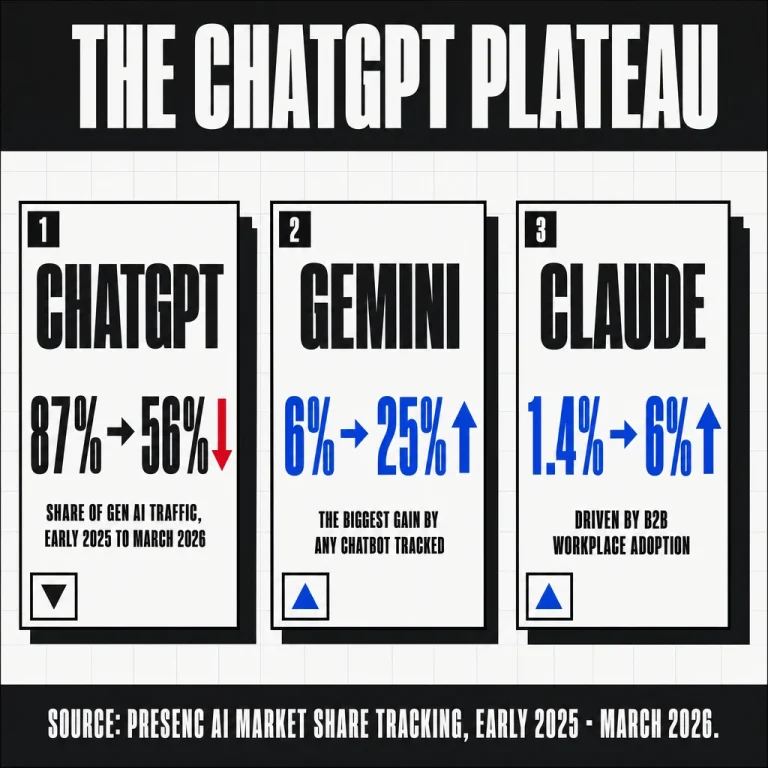
- Gemini tripled its user base while ChatGPT’s growth slowed below 50%
- The competitive picture within AI is shifting faster than the AI vs. traditional battle
The Numbers Everyone’s Talking About
Let’s start with what the headlines get right: AI search tools roughly doubled their share of desktop activity in 2025.
In the US, the category grew from 0.42% of total desktop events in early 2025 to 0.77% by Q4. The European Union and UK saw even faster adoption, moving from 0.44% to 0.89% over the same period.
Within that category, ChatGPT maintained its lead with 25-37% of AI tool users in the US (34-46% in Europe). Gemini emerged as the clear second player, tripling its user share from roughly 4% to 12% by year’s end. Google AI Mode, while still tiny at 0.06% of events, showed consistent month-over-month growth throughout the year.
The trajectory is clear. More people are using AI tools as part of their information-seeking workflow. The year-over-year growth rate is significant by any measure.
Now Let’s Put That in Context
Here’s where most analysis stops. The growth rate sounds dramatic, so the conclusion must be dramatic too. But percentages need context.
0.77% is still less than 1% of total desktop activity.
still 13x larger than AI
Traditional search, by comparison, held steady at approximately 10% of desktop events throughout 2025. That means traditional search is still roughly 13 times larger than AI tool usage. Google alone maintains 93-96% of the search market, a number that barely budged over the past twelve months.
When something doubles from a small base, it’s still small. When something doubles from a large base, that’s a different story. AI search is in the first category.
This isn’t to dismiss the growth. A category that doubles in a year demands attention. But the framing matters for strategic decisions. If you’re allocating resources between traditional SEO and AI optimization, the data suggests traditional search still deserves the larger share of your effort.
The “AI takeover” narrative assumes a trajectory that the numbers don’t yet support. Linear growth from 0.77% doesn’t threaten Google’s 10% anytime soon. Even aggressive exponential growth would take years to reach parity.
What’s Actually Happening Under the Hood
The more interesting story isn’t AI vs. traditional search. It’s what’s happening within the AI category itself.
ChatGPT still leads, but its growth rate slowed significantly. Rand Fishkin noted in the SparkToro report that ChatGPT grew less than 50% year-over-year with a “slowing trajectory.” For a category leader, that’s a warning sign.
Gemini, meanwhile, tripled. Google’s AI tool went from roughly 4% of AI tool users to 11-12% in the US by December. In Europe, Gemini reached about 14%. That’s aggressive growth from a company that has the distribution advantage of owning the dominant search engine.
Google AI Mode tells another part of the story. This feature, which provides conversational AI responses directly within Google Search, grew from 0.01% of events in May to 0.06% by December. The absolute number is tiny, but the direction is consistent. Google is integrating AI into its core product rather than ceding ground to standalone tools.
Fishkin’s interpretation: “The new narrative that Google is gaining the upper-hand in AI is certainly reinforced by these charts.”
For marketers, this suggests the AI environment is more competitive and fluid than the “ChatGPT vs. everybody” framing implies. Optimizing for one AI system without considering how Google is responding might leave you exposed.
Why Traditional Search Isn’t Going Anywhere
One data point that gets less attention: the number of searches per user declined about 20% in the US over 2025. At first glance, that sounds like bad news for Google. Fewer searches means less engagement, right?
Not necessarily. The decline might actually reflect AI’s impact on search behavior, but not in the way you’d expect.
When users get better answers faster, they don’t need to run as many searches. The old pattern of searching, clicking, refining the search, clicking again, and eventually finding an answer is getting compressed. AI Overviews, featured snippets, and yes, ChatGPT are all reducing the number of queries needed to resolve an information need.
Fewer searches per user doesn’t mean less search activity overall. It might mean more efficient search activity.
Meanwhile, the metrics that matter for marketers held steady:
Zero-click searches stabilized around 24.5% in the US. This number has been relatively flat, despite predictions that AI Overviews would send it skyrocketing.
Organic clicks to non-Google properties remained stable at 42-45%. When users do click, they’re still clicking through to external websites at roughly the same rate.
Informational intent dominates. Between 55-63% of searches are informational in nature. Users are researching, learning, and solving problems through search.
The foundation hasn’t cracked. Search behavior is evolving, but the core value proposition of search engines—and the opportunity for brands to capture traffic through them—remains intact.
What This Means for Your Strategy
The temptation after reading “AI doubled” is to pivot hard toward AI optimization. Resist it.
The data supports an “and” strategy, not an “or” strategy.
Traditional SEO still delivers the majority of discovery opportunities. Google processes billions of searches daily, maintains near-total market share, and drives significant traffic to websites. Abandoning that channel because AI tools grew from 0.42% to 0.77% would be a mistake.
At the same time, ignoring AI would be equally shortsighted. The growth rate matters, even if the absolute numbers are still small. ChatGPT is now a top-10 destination domain after Google searches. Users are incorporating AI into their workflows, and that integration will likely deepen.
The Practical Approach:
FAQ
Is AI search going to replace Google?
Not based on current data. AI tools represent less than 1% of desktop activity while traditional search holds at 10%. Google’s market share among search engines is unchanged at 93-96%. The growth trajectory for AI is real, but replacement would require sustained exponential growth for years. More likely, AI becomes another layer in the discovery process rather than a wholesale replacement.
Should I stop investing in SEO?
No. Traditional search still delivers the overwhelming majority of discovery opportunities. The fundamentals of SEO (technical excellence, quality content, authority signals) also tend to support AI visibility. Think of AI optimization as an addition to your strategy, not a replacement for it.
Which AI tool should I focus on?
The safest answer is “none of them exclusively.” ChatGPT leads today, but Gemini tripled in a year and Google AI Mode is growing inside the dominant search platform. Content structured for AI citation generally works across multiple systems. Focus on principles (clarity, authority, specific data) rather than gaming any single platform.
Why did searches per user decline if search isn’t dying?
Better answers mean fewer follow-up searches. When AI Overviews, featured snippets, and ChatGPT provide direct answers, users don’t need to run multiple queries to find what they need. The decline in searches per user may actually indicate that search is working better, not that it’s being abandoned.
Is the EU different from the US?
Somewhat. AI tool adoption grew faster in Europe (102% vs. 83%), but from a similar starting point. Google’s market share is actually slightly higher in the EU/UK (94-96% vs. 93-95%). The patterns are similar, with Europe showing slightly faster AI adoption and slightly stronger Google dominance.
The Bottom Line
AI search doubled in 2025. That’s true, and it matters.
But “doubled” means going from 0.42% to 0.77% of desktop activity. Traditional search is still 13 times larger. Google’s grip on the search market hasn’t loosened. The fundamentals of how users find information online haven’t changed as dramatically as the headlines suggest.
The smart response isn’t panic or dismissal. It’s measured preparation.
Keep building your SEO foundation. Add AI optimization practices where they complement your existing strategy. Watch how Google integrates AI into search, because that integration may matter more than any standalone tool.
The data tells a story of evolution, not revolution. Plan accordingly.
Data source: Datos/SparkToro State of Search Q4 2025 Report, covering October-December 2025 desktop user behavior across the US, EU, and UK.
See what ChatGPT is really searching
SubSeed captures the hidden Google queries ChatGPT runs behind every answer and enriches them with search volume, CPC, and keyword difficulty.
Related Posts
Read this post with an assistant
This is the whole prompt each button sends. Nothing hidden in it.
Read https://gridlok.co/blog/ai-search-doubled-in-a-year-what-that-actually-means/ and give me the main points in a few sentences.
Make Gridlok a Preferred Source on Google
See Gridlok surfaced more often in your Top Stories, AI Overviews, and AI Mode. One click, applied across Google Search.