Chrome’s New Agentic Browsing Audit: What’s Worth Doing and What’s Hype
On May 7, 2026, Chrome did something quiet that matters more than the announcement suggested.
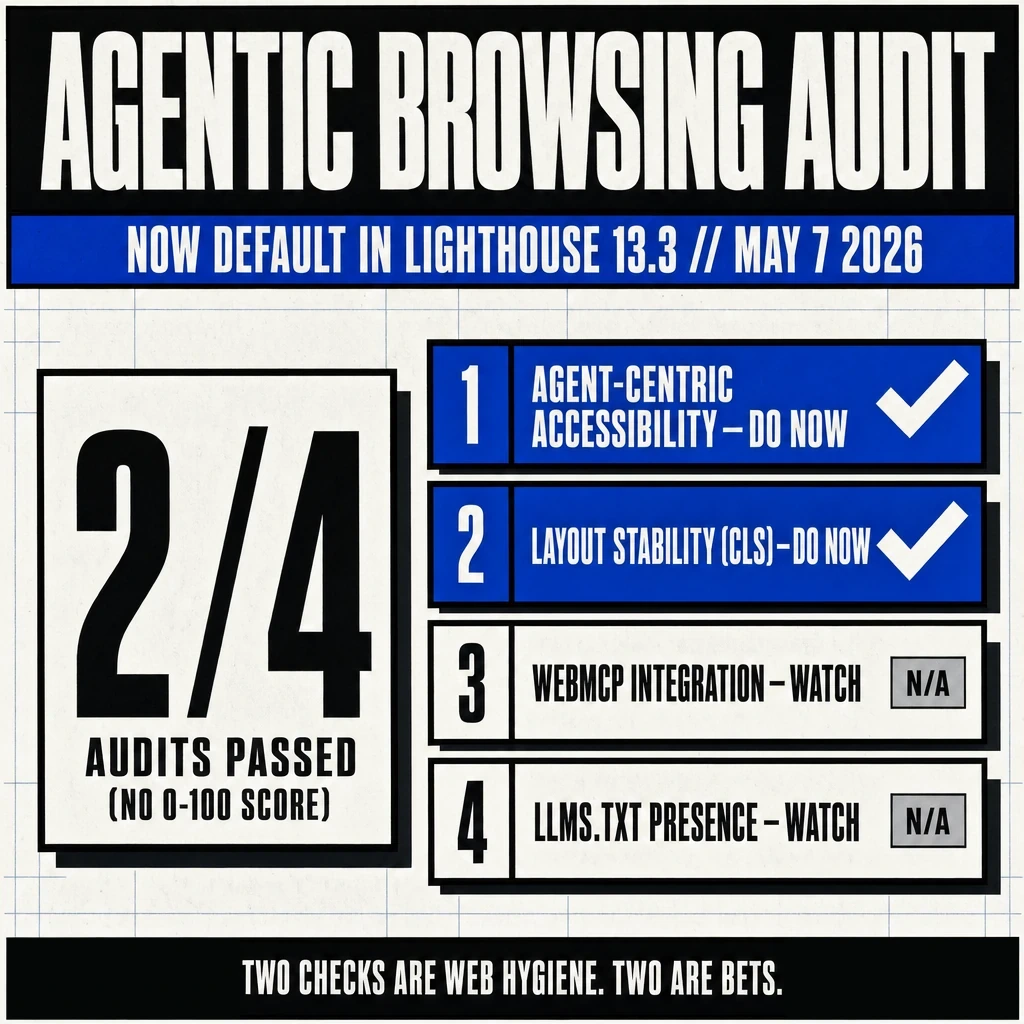
Lighthouse 13.3.0 moved the new Agentic Browsing audit category from experimental into the default config. Every Lighthouse run now returns it, alongside Performance, Accessibility, Best Practices, and SEO. PageSpeed Insights included.
The signal volume went from “developers who opted in” to “anyone who audits your site.” Your prospects, your competitors, and your clients can now see how many agentic-readiness checks your site passes without doing anything special.
The vendor industry reacted the way it always does. Within days there were “Pass llms.txt in 2 minutes” landing pages and “your competitor will pass 4/4 while you’re stuck at 1/4” panic posts selling agentic-ready CMS upgrades.
I ran the audit on real sites and read the actual scoring documentation. Here is what is worth doing today, what is speculative, and how to read the score without getting sold something you do not need.
Key Takeaways
- Lighthouse 13.3.0 (May 7, 2026) made Agentic Browsing a default category. It now appears in every Lighthouse and PageSpeed Insights run (Chrome for Developers, 2026).
- It scores four checks: WebMCP integration, llms.txt presence, agent-centric accessibility, and layout stability. There is no 0-100 score. You get a fractional pass ratio like “2 / 4 audits passed.”
- Two of the four checks are worth doing today because they help humans and traditional SEO too: accessibility-tree quality and layout stability. You were probably doing these already.
- Two are speculative: WebMCP integration (early preview, proposed standard) and llms.txt (which Google Search Central explicitly tells you to skip). Both return N/A rather than Fail if you skip them.
- The audit’s design is honest about its own immaturity. The fractional scoring exists precisely because the standards are not settled. Read it as a data-gathering signal, not a ranking factor.
- Do the two real checks now. Watch the two speculative ones. Ignore anyone selling a panic-priced fix for a category that cannot fail you.
What Actually Changed on May 7
The Agentic Browsing category existed before May 7 as an experimental opt-in. The version 13.3.0 release moved it into the default config.
That distinction is the whole story. An experimental audit is something a developer chooses to run. A default audit is something everyone sees by accident.
PageSpeed Insights uses the default Lighthouse config. So does the Chrome DevTools Lighthouse panel. So do the dozens of third-party site-audit tools that wrap Lighthouse under the hood. All of them now surface an agentic-readiness ratio.
The practical effect is social, not technical. Nothing about your site changed on May 7. What changed is that a visible number now exists for anyone evaluating your site to point at. That is the mechanism the vendor panic is built on.
A score that did not exist last month now appears on your audit. The score did not change your site. It changed the conversation about your site.
The Four Audits, Ranked by Whether They Matter Today
Here is the full category, ordered by how much I would prioritize each check right now.
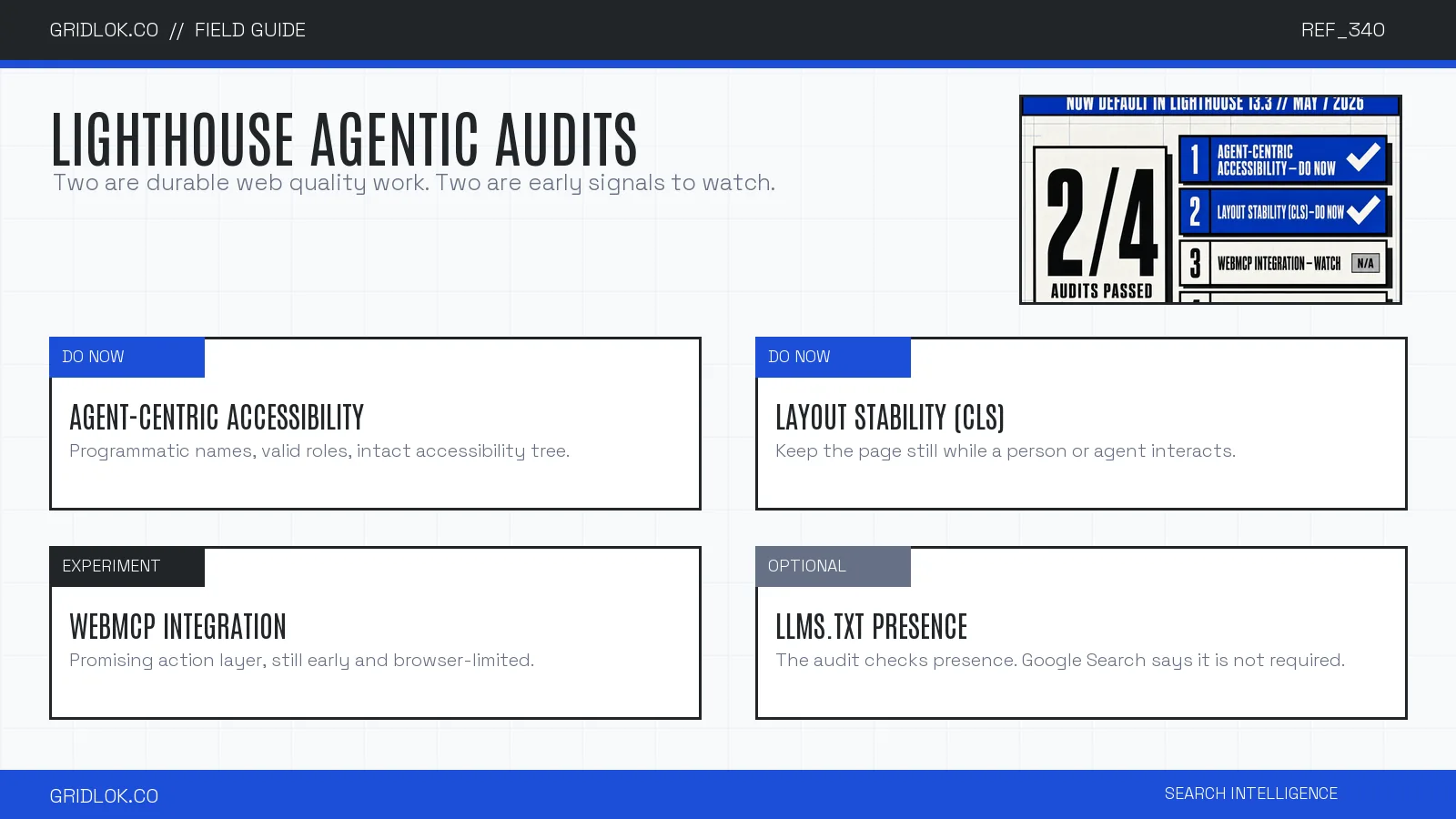
| Audit | What it checks | Worth doing now? |
|---|---|---|
| Agent-Centric Accessibility | Interactive elements have programmatic names, valid ARIA roles, intact accessibility tree | Yes. Helps humans and SEO too. |
| Layout Stability (CLS) | Elements do not shift unexpectedly while an agent interacts | Yes. Already a Core Web Vital. |
| WebMCP Integration | Site exposes callable tools to agents via the WebMCP API | Not yet. Early preview, proposed standard. |
| llms.txt Presence | A machine-readable summary file at the domain root | Optional. Google Search says skip it. |
The split is clean. The top two are established web-quality practices wearing an agentic label. The bottom two are bets on standards that have not settled.
Both speculative checks return Not Applicable rather than Fail when you skip them. A site with no llms.txt and no WebMCP tools is not penalized. It shows N/A, which signals only that you have not adopted an emerging standard, not that anything is wrong.
What’s Worth Doing Now
Two of the four checks are worth your time this quarter. Both because they pay off regardless of whether the agentic web arrives on schedule.
1. Fix the accessibility tree
The agent-centric accessibility audit checks whether every interactive element has a programmatic name, whether ARIA roles and parent-child relationships are valid, and whether interactive content is hidden from the accessibility tree.
This is the same work that helps screen-reader users. An AI agent reads your page through the accessibility tree, the same machine-eye view a screen reader uses. Fixing it serves disabled users, improves traditional SEO signals, and satisfies the agentic check at the same time.
If you have been deferring accessibility work, the agentic audit is a second business reason to stop deferring it.
2. Reduce layout shift
Cumulative Layout Shift has been a Core Web Vital since 2021. The agentic audit checks it because an agent clicking a button needs that button to stay where it was a half-second ago.
You should already be optimizing CLS for human users. The agentic framing adds no new work, just a new reason the existing work matters.
Both of these are what I mean when I argue that most “agentic readiness” is existing web hygiene with a fresh coat of vocabulary. I made the broader version of that case in AEO Is Just SEO With New Acronyms.
What’s Speculative
The other two checks are bets. They might pay off. They might not. Neither is worth budget today for most sites.
WebMCP integration
WebMCP is a proposed browser API that lets sites expose callable tools to agents. It is in early preview. The standard is not finalized.
For a site that sells things or exposes live structured data (inventory, pricing, availability), WebMCP is worth tracking and prototyping if you have engineering capacity to spare. For everyone else, it is a watch-and-wait item.
I covered why MCP and WebMCP matter structurally in my Information Agents deep-dive. The summary: real direction, premature to build against the unfinalized spec.
llms.txt
The llms.txt check is the controversial one, because Google’s own teams disagree about it.
Lighthouse checks whether you have a machine-readable summary file at your domain root. Google Search Central, separately, has told people to skip llms.txt. John Mueller compared it to the keywords meta tag and called building separate markdown files for bots “a stupid idea.”
I wrote about why the format does not work for AI search visibility in my October 2025 piece on LLMs.txt. Nothing in the Lighthouse audit changes that conclusion. The audit checks for the file’s presence; it does not demonstrate that any agent reads it.
The Google-vs-Google llms.txt Problem
The cleanest way to understand the llms.txt check is to recognize that two different Google teams are giving opposite advice.
- Google Search team: Skip llms.txt. It does nothing for search visibility.
- Chrome Lighthouse team: Here is an audit that checks for llms.txt.
Both can be internally consistent because they answer different questions. Search visibility and browser-agent readiness are different problems. The Lighthouse audit measures readiness for browser-based agents like Gemini in Chrome, not your Google ranking.
That said, the audit is weak evidence that llms.txt matters. The check has no Pass condition. It fails only on a server error and returns N/A on a 404. The documentation itself says providing the file is optional. No agent is named that actually reads it.
My read on Google’s documentation generally applies here: read it as the world Google wants, not the world that exists. I unpacked that editorial stance in my piece on Google’s AI content rules. A check appearing in a tool is not the same as a confirmed ranking or retrieval signal.
The Agentic Readiness Checklist
If you want to act on the audit without overspending, this is the priority order I would use. Copy it, share it, run it against any site.
FAQ
Sources & References
- Chrome for Developers. “Lighthouse agentic browsing scoring.” 2026. developer.chrome.com
- Chrome for Developers. “llms.txt | Lighthouse.” 2026. developer.chrome.com
- Chrome for Developers. “WebMCP is available for early preview.” 2026. developer.chrome.com
- Schwartz, Barry. “Google adds llms.txt check to Chrome Lighthouse.” Search Engine Land, 2026. searchengineland.com
- Search Engine Journal. “Google’s llms.txt Guidance Depends On Which Product You Ask.” 2026. searchenginejournal.com
- DebugBear. “Google Lighthouse Has A New Agentic Browsing Category.” 2026. debugbear.com
- Hunt, Jim. “Why Nobody’s Using LLMs.txt.” LinkedIn, October 2025. linkedin.com
- Hunt, Jim. “AEO Is Just SEO With New Acronyms.” Gridlok, May 2026. gridlok.co
- Hunt, Jim. “Information Agents: When the Searcher Is Software, Not a Human.” Gridlok, May 2026. gridlok.co
- Hunt, Jim. “Google’s AI Content Rules: What ‘Meet the Standards’ Actually Means.” Gridlok, May 2026. gridlok.co
See what ChatGPT is really searching
SubSeed captures the hidden Google queries ChatGPT runs behind every answer and enriches them with search volume, CPC, and keyword difficulty.
Related Posts

Read this post with an assistant
This is the whole prompt each button sends. Nothing hidden in it.
Read https://gridlok.co/blog/chrome-lighthouse-agentic-browsing-audit/ and give me the main points in a few sentences.
Make Gridlok a Preferred Source on Google
See Gridlok surfaced more often in your Top Stories, AI Overviews, and AI Mode. One click, applied across Google Search.