Stop Guessing How Your Customers Search (The Data Will Surprise You)
You know your business better than anyone. That is exactly why guessing how your customers search for it is so easy to get wrong.
The words you and I use every day are not always the words people type into Google. When I pulled the real search data for this, the gap surprised me too.
So this is a look at how people actually search, where my own assumptions fell apart, and how to find the words that match what your customers really type.
Key takeaways
- “Avoid jargon, use plain words” is right about as often as it is wrong. Real US search volumes show the plain term winning big in some categories and the technical term winning big in others.
- Plain-language demand often hides in the long tail. One short phrase can look tiny while splitting into a hundred or more longer variants that each pull traffic.
- Searches are getting longer. Datos clickstream data for Q1 2026 shows mid-length and longer queries growing while short queries hold steady.
- Guessing is the trap. The reliable move is to read data you can already get to: Search Console, People Also Ask, reviews, and keyword tools.
- It matters more in AI search, where the answer engine tends to mirror the phrasing of the question it was asked.
Intuition about search language goes wrong in both directions
The common advice is to drop the industry jargon and write the way real people talk. Sometimes that holds up. Sometimes the data points the other way.
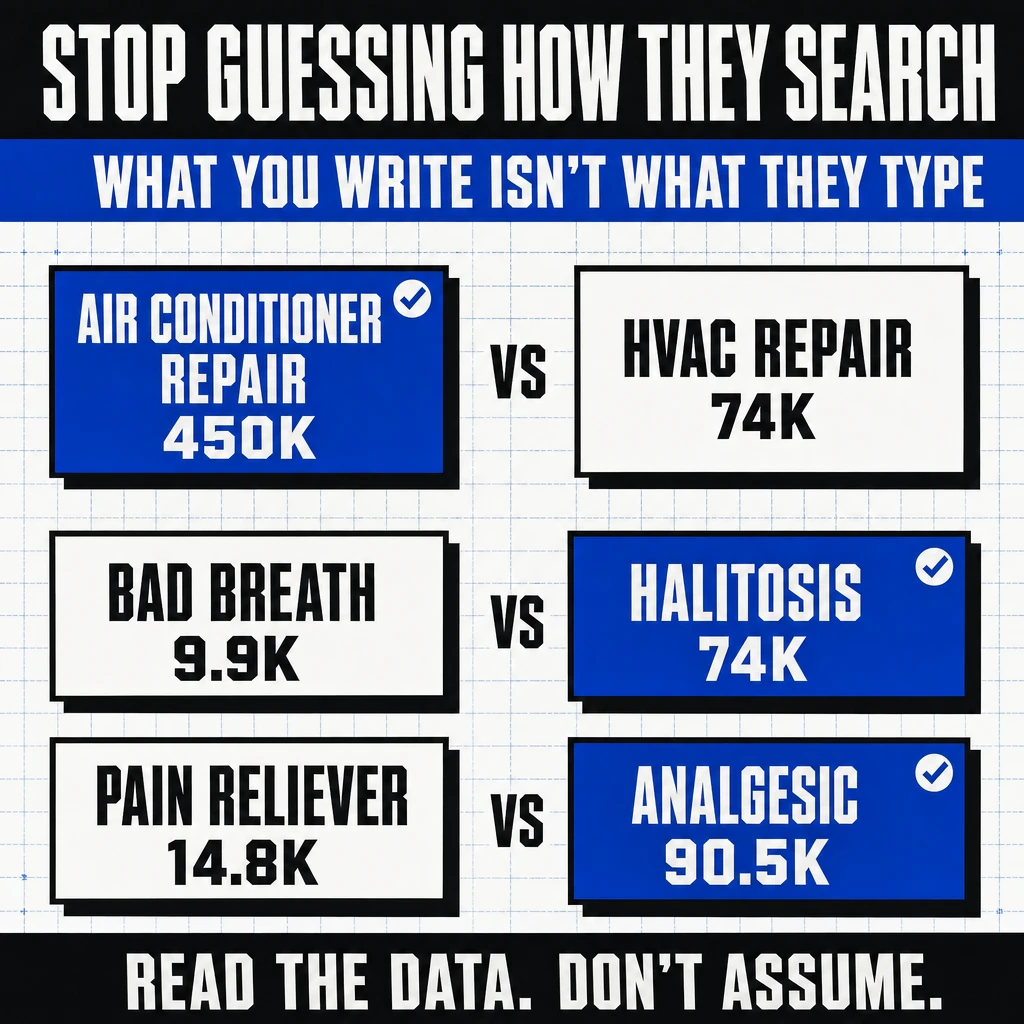
I pulled US monthly search volumes for matched pairs, the technical term against the everyday term for the same thing. They do not line up behind a single rule.
| Everyday term | Monthly searches | Technical term | Monthly searches | Winner |
|---|---|---|---|---|
| air conditioner repair | 450,000 | hvac repair | 74,000 | Plain, ~6x |
| high blood pressure | 165,000 | hypertension | 301,000 | Technical, ~1.8x |
| pain reliever | 14,800 | analgesic | 90,500 | Technical, ~6x |
| bad breath | 9,900 | halitosis | 74,000 | Technical, ~7.5x |
Watch what that does to the “use plain words” advice.
For an HVAC company, “air conditioner repair” is the clear winner, six times the volume of “hvac repair,” the term the trade itself uses.
Then healthcare flips it. “Hypertension” beats “high blood pressure,” “analgesic” beats “pain reliever,” and “halitosis” outsearches “bad breath” by more than seven to one.
People pick up the clinical words from labels, diagnoses, and pharmacy shelves, so for them that is the plain language. I would have guessed wrong on at least half of these, and that is the part worth sitting with.
A lot of demand hides in the long tail
There is a second trap, and I walked right into it. A phrase can look small as an exact match while the real demand is spread across dozens of longer versions.
“Bad breath” gets 9,900 searches a month on its own. That number talked me out of caring about it, until I expanded it.
It fans out into more than 120 distinct variants, each with its own traffic:
- mouthwash for bad breath: 40,500
- tongue scraper for bad breath: 22,200
- sugar-free gum for bad breath: 14,800
Those three already dwarf the head term, and there are over a hundred more behind them: questions, product modifiers, and symptom phrasings.
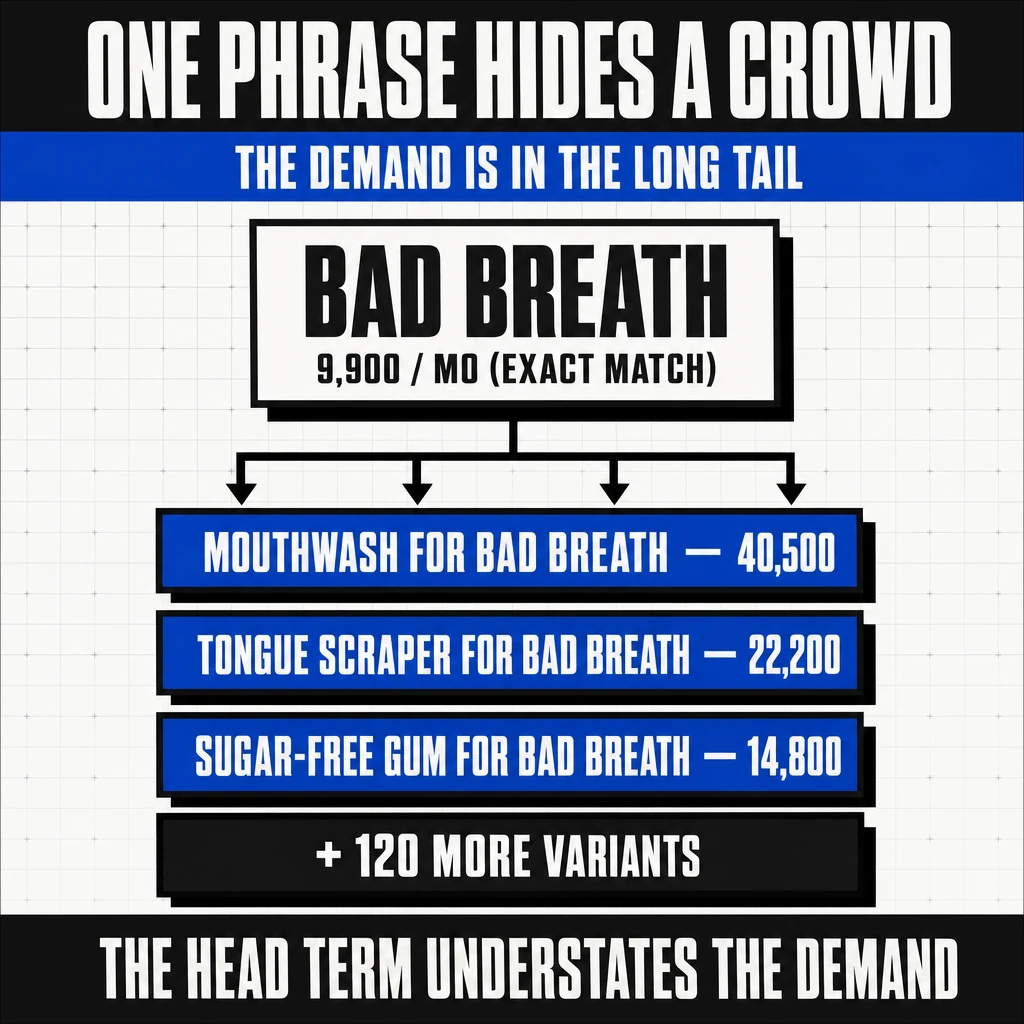
That is the long tail at work. Ahrefs has found that roughly 92% of keywords get ten or fewer searches a month, so a lot of real demand sits in these specific, quieter phrases rather than the obvious short ones.
Build only for the head term and the rest of that demand quietly goes to someone else.
The trend is making this harder, not easier
If matching your customers’ words were a one-time job, you could grind through it once and move on. It is not a one-time job.
The way people search keeps moving toward longer, more detailed queries. The Datos State of Search report for Q1 2026, built on large-scale clickstream data, measured it.
In the US, six-word queries reached 6.3% of searches and seven-word queries hit 4.4%, with mid-length queries still climbing. Even 15-plus word queries rebounded to 1.7%.
Short queries did not shrink, so the longer phrasing is adding on top rather than replacing. People are putting more words into how they search.
Mid-length and longer queries continued to grow, while shorter queries remained stable, indicating users are refining how they search rather than changing platforms.
Datos, State of Search Q1 2026
This continues a pattern I wrote about when the 2025 numbers landed, in Search Queries Are Getting Longer. The Q1 2026 data shows it holding.
The same report has informational intent on Google up to 64.6%, with Reddit and Wikipedia climbing the destination rankings.
People are asking more, in fuller sentences, and heading to places where other people describe problems in plain speech. Every extra word in a query is one more chance for your page to match or miss.
How to find the words your customers actually search
None of this needs clever wording. It needs a look at what people actually type, and that lives in a few places, roughly in order of how close they sit to your real customers:
- Google Search Console. The Performance report lists the exact queries already bringing people to your site. These are your customers’ real words, free, with no guessing involved. Sort by impressions and look for phrasings you would never have written yourself.
- People Also Ask and autocomplete. Type your core topic into Google and read the questions it suggests. That is Google handing you the phrasing of real searches.
- Reviews, Reddit, and support tickets. People describe their problem in their own words here, before any marketer cleans it up. The phrase “treats for dogs with sensitive tummies” will never come out of a brand brief, but it is how a worried owner searches.
- A keyword tool, read for intent. Volume tells you how many people search a phrase. Intent tells you why. Pull both, and put the technical term next to the plain one the way the table above does.
The best source is the one you already have. I let a Search Console account sit for months without really reading the query report. When I finally did, it was full of phrasings I would never have written myself.
Why this matters even more in AI search
Classic search is forgiving. Google can rank a page for a phrase that never appears on it, leaning on links and context to bridge the gap.
AI search is tighter. When someone asks ChatGPT or Google’s AI Mode a question, the model leans on content that matches how the question was phrased, and it often answers back in that same language.
Phrase your page the way people actually ask, and you are the kind of source it pulls from. Wrap the same idea in your internal vocabulary, and it can pass right over you, even on a page that would have ranked the old way.
This is the same shift I keep coming back to. Getting found by AI starts with being readable and sounding like the people you are writing for.
For the wider picture, see why AEO is mostly SEO with new acronyms and how to check whether AI is citing your site.
The Datos data adds some urgency: Google AI Mode usage in the US grew 2.5x in a single quarter, off a small base but climbing.
A repeatable process you can run this week
- Open Search Console and export your top 200 queries. Highlight any phrasing that surprises you.
- Pick your three most important topics. For each, pull the plain term and the technical term and compare real volume and intent.
- Read one Reddit thread and ten reviews in your space. Note the exact words people use for their problem.
- Rework your most important page so its headings and opening lines use the winning phrases, not your internal names for things.
- Re-check in 30 days. Search behavior keeps shifting, so this works better as a habit than a one-off.
FAQ
So here is where I landed. The words your customers use are knowable, they are usually not the ones I would have picked, and they keep getting longer.
Worth pulling the data before you write the page. If you want to see whether AI can read and understand your pages once the language is right, the Agentic Readiness Check is built for that.
See what ChatGPT is really searching
SubSeed captures the hidden Google queries ChatGPT runs behind every answer and enriches them with search volume, CPC, and keyword difficulty.
Related Posts

Google I/O 2026: What Its AI Agents Actually Do (and What They Mean for Your Business)
The Agentic Web Is a San Francisco Story (A Counter-Read of Google’s I/O 2026 Announcement)
Google’s Preferred Sources Comes to AI Search: Why You Can’t Optimize for It (and What Actually Helps)
Read this post with an assistant
This is the whole prompt each button sends. Nothing hidden in it.
Read https://gridlok.co/blog/stop-guessing-how-customers-search/ and give me the main points in a few sentences.
Make Gridlok a Preferred Source on Google
See Gridlok surfaced more often in your Top Stories, AI Overviews, and AI Mode. One click, applied across Google Search.