Google’s Preferred Sources Comes to AI Search: Why You Can’t Optimize for It (and What Actually Helps)
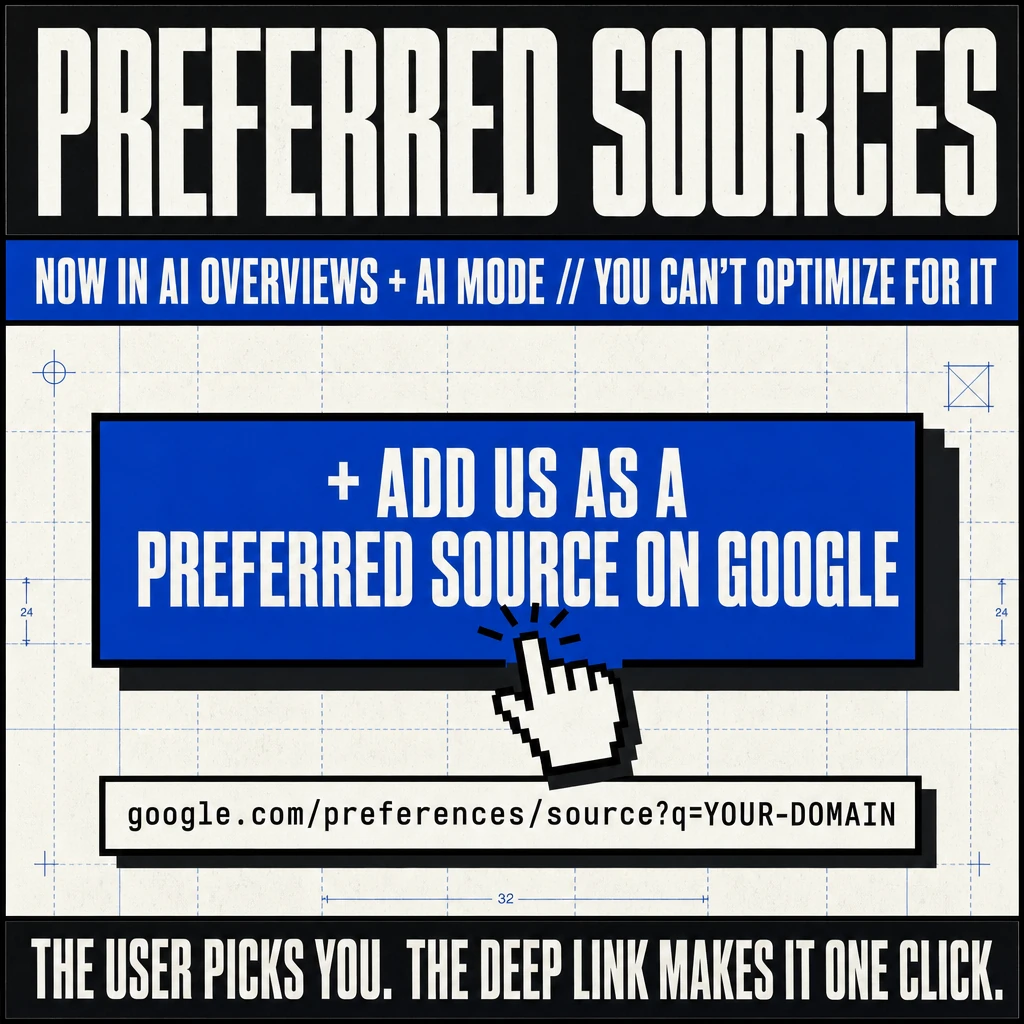
On May 27, 2026, Google extended its Preferred Sources feature into AI Overviews and AI Mode.
It is one of the few levers in AI search that a publisher can actually pull. It is also one of the most misunderstood, because the vendor content that appeared within days framed it as something you can optimize for. You cannot. The user picks you.
What you can do is make it one step easier for a reader to choose you, using a deep link Google documents but barely promotes. That is the actionable part, and I will give you the exact format below.
Here is what Preferred Sources does now, how to add sources, how to get your own site added, and the honest read on whether it moves the needle.
Key Takeaways
- Preferred Sources now surfaces inside AI Overviews and AI Mode, not just Top Stories. Selected sources get a label and show up more often in AI responses for the user who picked them (Google, May 27, 2026).
- You cannot optimize your way in. A user chooses your site in their settings. Your only lever is making the choice easy and giving people a reason to make it.
- Google publishes a deep link that pre-fills your site in the add-source dialog:
https://www.google.com/preferences/source?q=YOUR-DOMAIN. Put it behind a button on your site. - Eligibility is domain or subdomain level only. A full domain like example.com qualifies. A subdirectory like example.com/blog does not.
- You cannot currently track Preferred Sources traffic in Google Analytics. Google has not exposed the data. Plan your measurement around that blind spot.
- Selections do not override relevance. You still have to publish fresh, relevant content. Preferred Sources tilts the surface toward you; it does not carry weak content.
What Preferred Sources Actually Does Now
Preferred Sources launched in 2025 as a Top Stories feature. A user picks the publications they want to see more of, and those sources get prioritized in the Top Stories block.
The May 27 announcement, written by Google Search product manager Duncan Osborn, extended the feature into AI Overviews and AI Mode. Google’s wording: “you’ll be able to easily spot links in AI responses from the sources you’ve already selected.”
The same announcement shipped two related features. A “Highly Cited” badge marks articles that other stories frequently reference, which Google frames as a way to find primary reporting. And a developing-topic carousel highlights your preferred sources on evolving stories.
Google cites two numbers: users are “twice as likely to click through to a Preferred Source,” and people have “already selected more than 345,000 unique sources.”
One claim worth flagging. Secondary coverage reported that Google is working on using Preferred Sources as a ranking signal across AI features. That line is not in Google’s official blog post. The post describes surfacing and labeling, not ranking influence. Treat the ranking-signal angle as reported, not confirmed.
How to Add Sources (As a User)
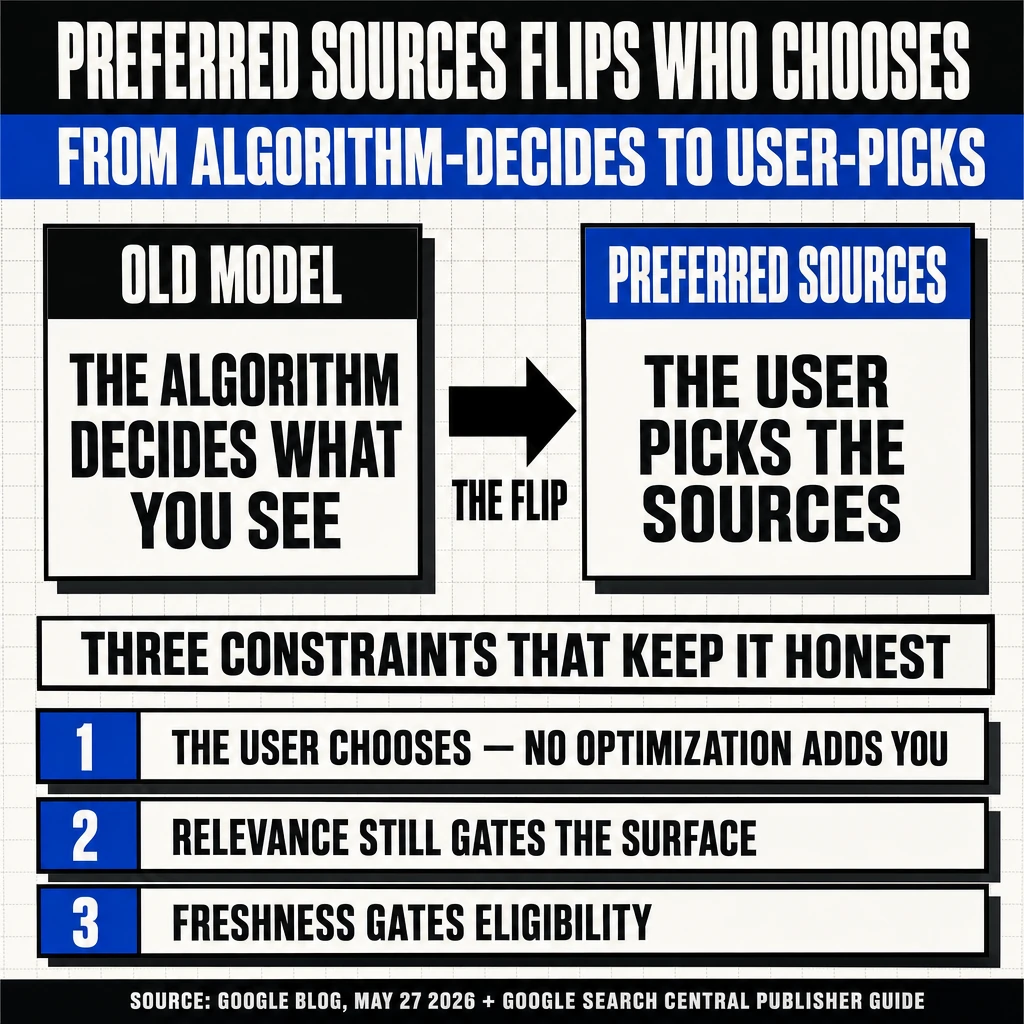
Three ways to add the sites you want to see more of.
- Direct link. Open
google.com/preferences/source(opens in a new tab), search for the sites you want, and check them. - Top Stories icon. Search a recent news topic. When the Top Stories block appears, click the cards icon to the right of the header (two rectangles with a plus). Search for sources, check them, and reload results.
- Settings. On google.com or the Google app, tap your profile picture, then Search personalization, then Source preferences.
One caveat from Google’s help docs: sources that are not updated regularly may not appear as selectable. Publishing cadence is a gate on eligibility.
How to Get Your Own Site Added (As a Publisher)
This is the part that matters if you run a site. You cannot make Google rank you as a preferred source. You can make it trivially easy for a reader to add you.
Google documents a deep link that opens its source preferences page with your site pre-filled. Readers need to be signed in to Google, and anyone signed out gets the sign-in page first. The format:
The preferred source button generator on this site builds the link, the button, and Google’s badge code for any domain you type in.
Where to place the button: alongside your existing social follow CTAs, in your newsletter, in your email signature, and in social posts. Anywhere you already ask people to follow you, you can now ask them to add you as a preferred source.
The mechanic is the same as the citation-visibility work I covered in my post on checking whether AI is citing your content. Preferred Sources is the rare case where the user, not the algorithm, decides your visibility, and the deep link is the one concrete action available to you.
Why You Still Can’t Game It
The vendor content treating Preferred Sources as a new ranking hack misses the structure of the feature.
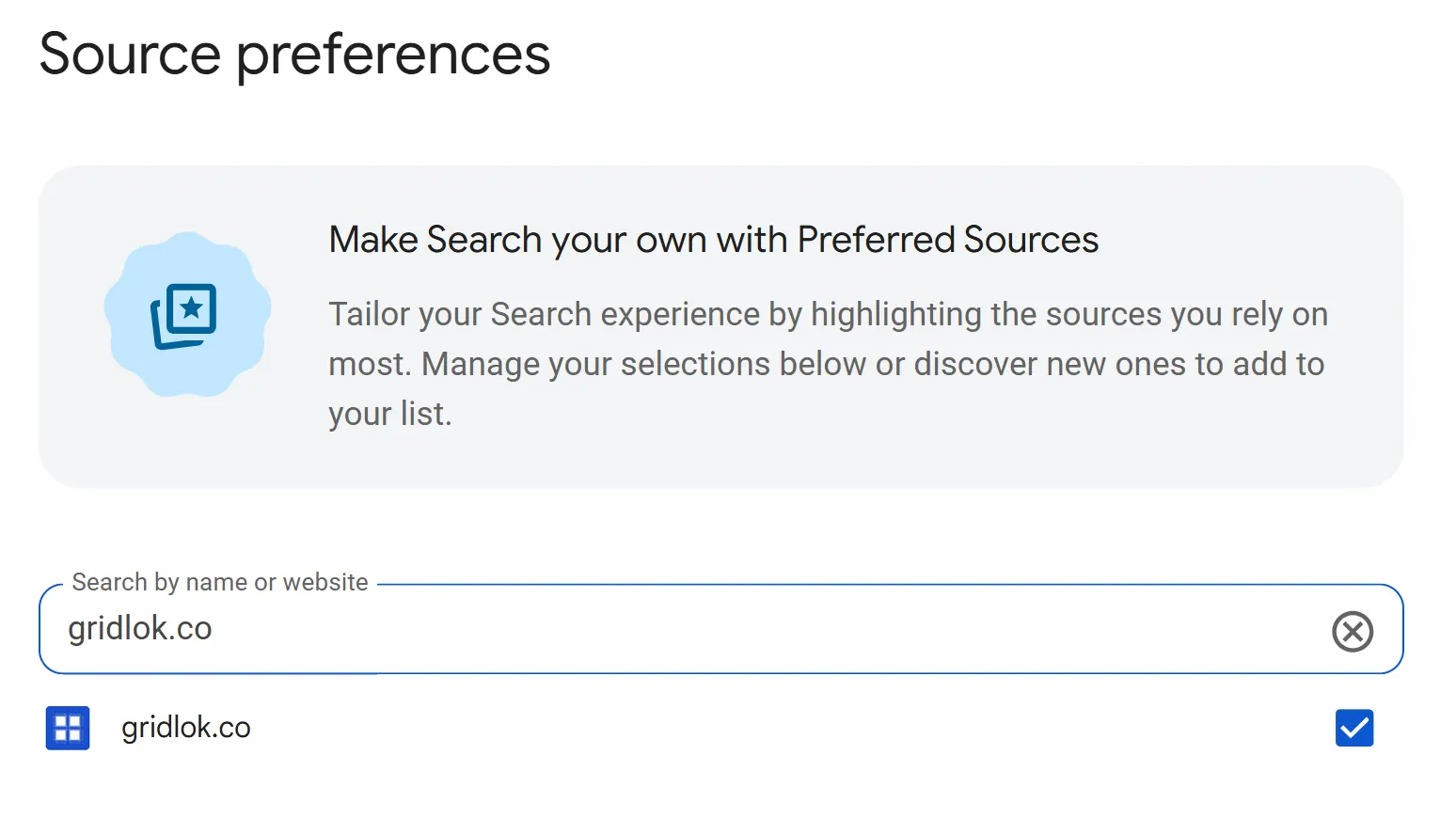
Three constraints keep it honest.
- The user chooses. No amount of technical optimization adds you to someone’s preferences. A human decides you are worth following. That is a brand-strength problem, not an SEO problem.
- Relevance still gates the surface. Being someone’s preferred source does not force your content into every result. It tilts toward you when your fresh content is relevant to the query. Weak or off-topic content still does not appear.
- Freshness gates eligibility. Sites that do not publish regularly may not even be selectable. The feature rewards consistent publishing, which no one can fake at scale without the underlying editorial work.
This is the same pattern I keep coming back to in AI search. The new feature looks like a hack until you read the mechanics, and then it turns out to reward the same things good publishing always rewarded. I made the broader version of that argument in AEO Is Just SEO With New Acronyms.
The Measurement Blind Spot
The honest limitation nobody selling badge generators mentions: you cannot track Preferred Sources traffic in Google Analytics.
Google has not exposed the data. There is no segment in GA4 that says “this visit came because the user added you as a preferred source.” Traffic from Preferred Sources blends into your general organic search numbers.
The practical consequence: you cannot directly prove ROI on a Preferred Sources campaign. You can measure proxies (clicks on your add-source button if you wrap it in an event, overall organic trend after a promotion push), but the direct attribution does not exist.
That blind spot fits the broader attribution problem in AI-mediated discovery. When the surface decides what a user sees and the click does not carry a clean source tag, the dashboards stop telling you the whole story. I unpacked that shift in my piece on Information Agents.
The Honest Take
Preferred Sources is worth acting on, with realistic expectations.
Add the deep-link button to your site this week. It is a ten-minute job and it is the only direct lever the feature offers. There is no downside.
Do not expect it to transform your traffic. It rewards sites that already have an engaged audience willing to actively choose them. If you have that audience, this converts some of them into a durable visibility advantage. If you do not, the button will sit unclicked and the feature will do nothing for you.
That is the realistic framing. A genuine advantage for publishers with real audience loyalty, a non-event for everyone else, and a brand-building project rather than a technical optimization either way.
FAQ
Sources & References
- Osborn, Duncan. “New ways to find your favorite sources and original content in AI Search.” Google Blog, May 27, 2026. blog.google
- Google Search Central. “Guide to Preferred Sources in Google Search for Web Publishers.” 2026. developers.google.com
- Google Search Help. “Preferred Sources in Google Search.” 2026. support.google.com
- Google. “How to select your preferred sources in Top Stories in Search.” Google Blog, 2025. blog.google
- Search Engine Journal. “Google Preferred Sources Hit 345K, Expand Into AI Search.” 2026. searchenginejournal.com
- PPC Land. “Google brings Preferred Sources into AI Overviews and AI Mode today.” 2026. ppc.land
- Hunt, Jim. “Is Your Site Getting Cited by AI? How to Check Right Now.” Gridlok, 2026. gridlok.co
- Hunt, Jim. “AEO Is Just SEO With New Acronyms.” Gridlok, May 2026. gridlok.co
- Hunt, Jim. “Information Agents: When the Searcher Is Software, Not a Human.” Gridlok, May 2026. gridlok.co
See what ChatGPT is really searching
SubSeed captures the hidden Google queries ChatGPT runs behind every answer and enriches them with search volume, CPC, and keyword difficulty.
Related Posts
Read this post with an assistant
This is the whole prompt each button sends. Nothing hidden in it.
Read https://gridlok.co/blog/google-preferred-sources-ai-search/ and give me the main points in a few sentences.
Make Gridlok a Preferred Source on Google
See Gridlok surfaced more often in your Top Stories, AI Overviews, and AI Mode. One click, applied across Google Search.