The EU/UK Paradox: AI Adoption Up, Google Share Also Up
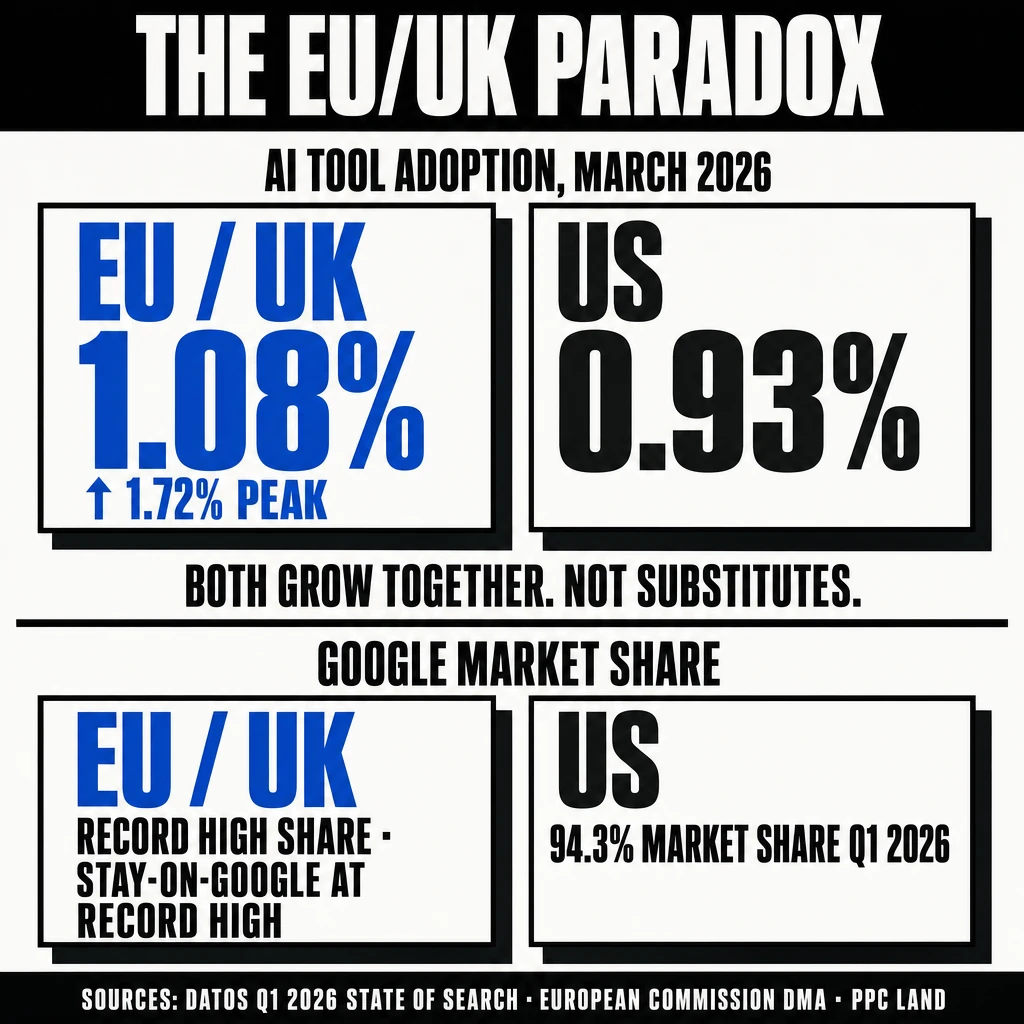
Common sense says regulation should hurt Google in Europe. Common sense says higher AI tool adoption should pull users away from Google in Europe. Both should compound.
The actual numbers say something else.
EU and UK desktop AI tool adoption nearly doubled from 0.54% in January 2025 to 1.08% in March 2026, reaching a Q1 2026 high of 1.72% (Datos / PPC Land, 2026). The US figure rose from 0.41% to 0.93% over the same window. EU/UK is consistently 15-20% ahead of the US on AI tool adoption.
And yet Google’s share of searches in the EU/UK is at a record high. The aggregate Google search share recovered to 94.3% in Q1 2026 with EU/UK trending similarly (Datos, 2026). Loyalty to Google in the EU/UK is, by some measures, stronger than in the US.
The “AI is eating Google” thesis falls apart hardest in the region the regulators have tried hardest to break Google’s grip.
Key Takeaways
- EU/UK AI tool adoption was 1.72% at Q1 2026 peak. US was 0.93%. EU/UK is the higher-adoption region (Datos Q1 2026 State of Search).
- Google’s market share in EU/UK is at or near record highs across all measurement methodologies. The “stay on Google after a search” rate is also at record highs in both regions.
- The European Commission opened two new DMA specification proceedings against Google on January 27, 2026, covering Android AI interoperability and search data sharing with third parties.
- Six years of GDPR plus active DMA enforcement have done close to nothing to dent Google’s share of EU consumer search behavior.
- The “AI tools and Google grow together” pattern is the cleanest expression of why the AI-vs-Google substitution framing is wrong. They are complements, not substitutes, for the foreseeable future.
- For sites with global audiences, the implication is straightforward: optimize Google-first in Europe, build AI tool citation tracking as a parallel measurement, and expect both channels to grow together.
The Numbers Side by Side
From the Datos Q1 2026 State of Search dataset (Datos, 2026; PPC Land, 2026):
- US AI tool share, January 2025: 0.41%
- US AI tool share, March 2026: 0.93%
- EU/UK AI tool share, January 2025: 0.54%
- EU/UK AI tool share, March 2026: 1.08%
- EU/UK AI tool peak in Q1 2026: 1.72%
EU/UK is consistently 30-85% ahead of the US in the share of desktop visit events going to AI tools, depending on the month sampled.
Now look at Google share in the same regions over the same period. Google has held or grown its share in EU/UK while AI tool usage doubled. The two curves rose together.
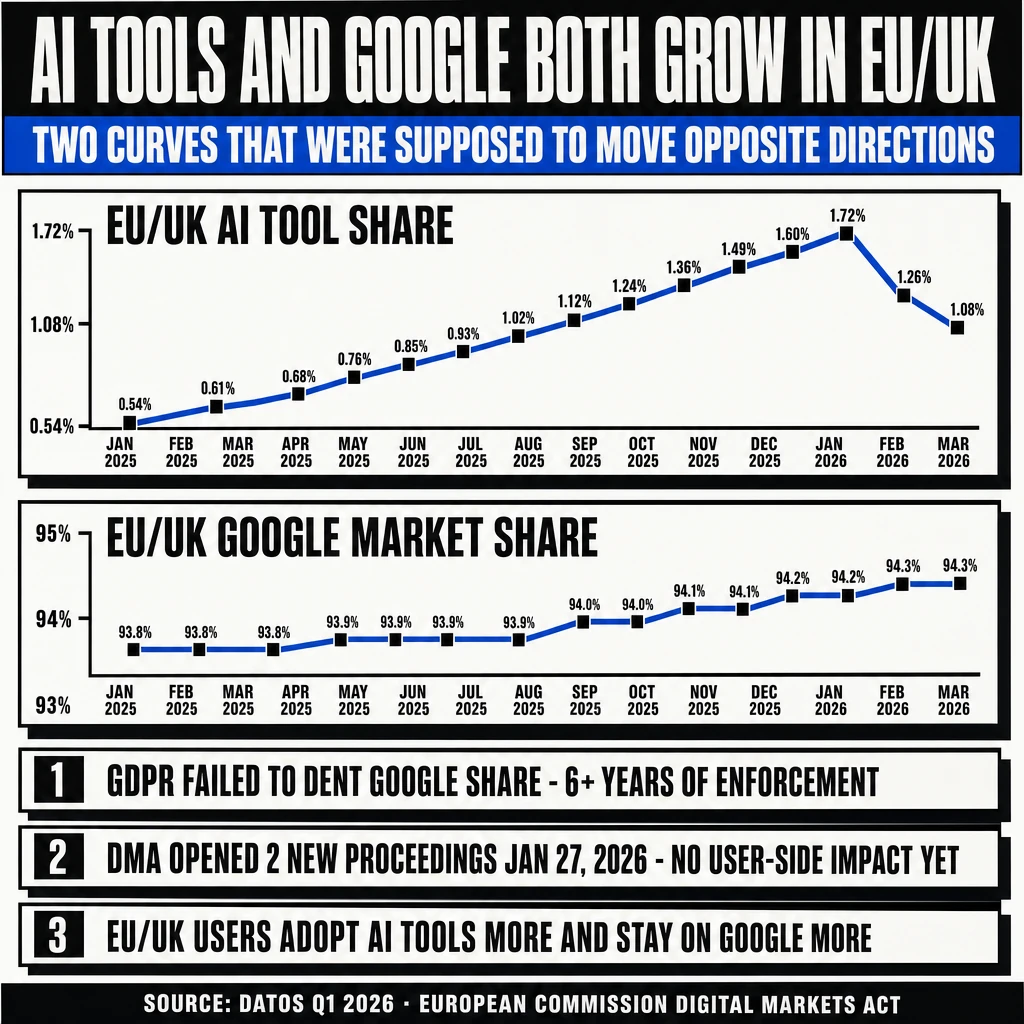
| Region and metric | January 2025 | March 2026 | Q1 2026 context |
|---|---|---|---|
| US AI tool share | 0.41% | 0.93% | Growth, but below EU and UK |
| EU and UK AI tool share | 0.54% | 1.08% | Q1 peak reached 1.72% |
| Aggregate Google search share | Not compared in this series | 94.3% | Recovered to a Q1 high |
Source: Datos Q1 2026 and PPC Land coverage cited in the article. AI tool share and Google search share can rise at the same time.
Why Regulation Has Not Moved the Share Needle
Six years of GDPR. Three years of the Digital Markets Act. Multiple self-preferencing investigations including a 2024 finding that Google was in breach of DMA obligations on search self-preferencing.
None of it has produced a measurable shift in EU/UK consumer behavior toward alternative search engines.
The European Commission’s January 2026 announcement opened two new proceedings against Google (European Commission, 2026):
- Android AI interoperability under Article 6(7), focused on giving third-party AI providers the same OS access Gemini has
- Search data sharing under Article 6(11), requiring Google to share anonymized ranking, query, click, and view data with third-party search providers under FRAND terms
These are substantive remedies if they ship. The DMA framework is also being used to potentially force Google to open Android to ChatGPT and Claude as default assistants (TheNextWeb, 2026).
The track record so far: regulators win the cases and Google’s user share keeps rising. The remedies do not change the user-side reality fast enough to dent the share metrics.
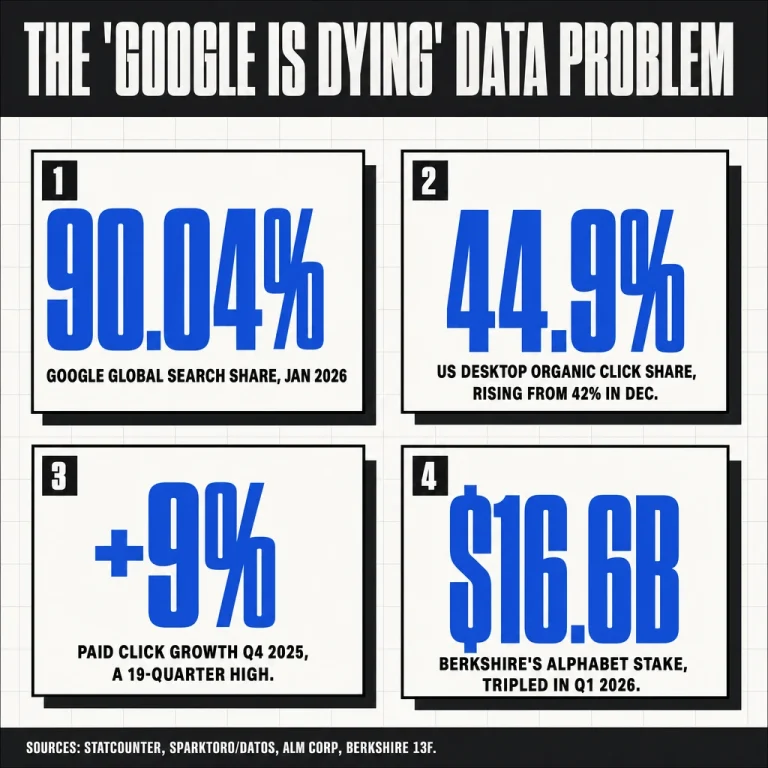
I covered the broader institutional read in my piece on why the “Google is dying” narrative falls apart in the data. The Berkshire 13F position tripling is one data point. The EU’s regulatory failure to move the needle on share is another.
Why EU/UK Consumers Adopt AI Tools Faster
Several factors converge to make EU/UK consumers more open to AI tool experimentation.
- Higher trust in EU privacy frameworks. GDPR has been operational for years. Users in EU/UK have stronger default privacy protections, which lowers the perceived risk of trying a new AI service.
- Earlier ChatGPT-equivalent rollouts of regional alternatives. Mistral, the French AI lab, has cultivated strong EU enterprise relationships. Consumer brand exposure to multiple credible AI options is higher than in the US, where ChatGPT dominated cultural awareness for longer.
- More multilingual content needs. AI tools handle translation, summarization across languages, and cross-cultural research better than traditional search. The use cases land harder in EU/UK where users routinely interact with content in 2-3 languages per day.
- Less American techno-fatigue. EU/UK consumer attitudes toward tech have not been worn down by the same volume of US-domestic AI hype. The product still feels novel rather than overhyped.
None of these factors push users away from Google. They push users toward trying AI tools in addition to Google.
This is the central insight: AI tools and Google are complements, not substitutes. EU/UK proves the pattern more cleanly than the US because the AI tool curve is steeper and Google’s share holds anyway.
The Practitioner Implications
For sites with European audiences or global audiences serving EU/UK traffic:
- Optimize Google-first in EU/UK as much as in the US. The regulatory pressure does not change the user-share reality. Google is still where 94%+ of search behavior happens.
- Build AI tool citation tracking as parallel measurement. The AI tool share is higher in EU/UK and rising faster. Coverage in Claude, Gemini, ChatGPT, and Mistral matters incrementally more for European audiences than US.
- Account for multilingual content in AI citation strategy. Where US sites might focus AI optimization on English content, European sites benefit from optimization across the 2-3 primary languages of their audience because that is how the audience uses AI tools.
- Treat DMA enforcement as a forcing function for technical readiness. If Google has to share more data with third-party search engines under FRAND terms, those engines may become marginally more relevant for EU/UK traffic. Sites should have basic Bing and DuckDuckGo crawl-ability today.
The audience-segmentation point from my B2B-vs-consumer adoption piece applies here too. EU/UK and US are not interchangeable audiences for AI search optimization purposes. The platform mix differs, and the timing of adoption differs.
FAQ
Sources & References
- Datos. “State of Search Q1 2026: Behaviors, Trends, and Clicks Across the US & Europe.” 2026. datos.live
- PPC Land. “AI still under 2% but growing: Datos Q1 2026 state of search report.” 2026. ppc.land
- European Commission. “Commission opens proceedings to assist Google in complying with interoperability and online search data sharing obligations under the Digital Markets Act.” January 27, 2026. ec.europa.eu
- European Commission. “Commission proposes measures to Google on sharing search engine data with third parties under DMA.” 2026. ec.europa.eu
- TheNextWeb. “EU prepares to force Google to open Android to ChatGPT and Claude under Digital Markets Act.” 2026. thenextweb.com
- St. Louis Fed. “AI Adoption in Europe and the U.S.” March 2026. stlouisfed.org
- Brookings. “Mind the gap: AI adoption in Europe and the US.” 2026. brookings.edu
- Hunt, Jim. “The Data Disagrees With the ‘Google Is Dying’ Narrative.” Gridlok, May 2026. gridlok.co
- Hunt, Jim. “AI Adoption Is a B2B Story.” Gridlok, May 2026. gridlok.co
See what ChatGPT is really searching
SubSeed captures the hidden Google queries ChatGPT runs behind every answer and enriches them with search volume, CPC, and keyword difficulty.
Related Posts

Read this post with an assistant
This is the whole prompt each button sends. Nothing hidden in it.
Read https://gridlok.co/blog/eu-uk-ai-adoption-google-share-paradox/ and give me the main points in a few sentences.
Make Gridlok a Preferred Source on Google
See Gridlok surfaced more often in your Top Stories, AI Overviews, and AI Mode. One click, applied across Google Search.