AI Adoption Is a B2B Story (Not a Consumer Story, and That’s Why Earnings Calls Get It Wrong)
The “everyone is using AI” hot take and the “my e-commerce client sees no AI traffic” practitioner frustration are both correct.
They are describing two different populations.
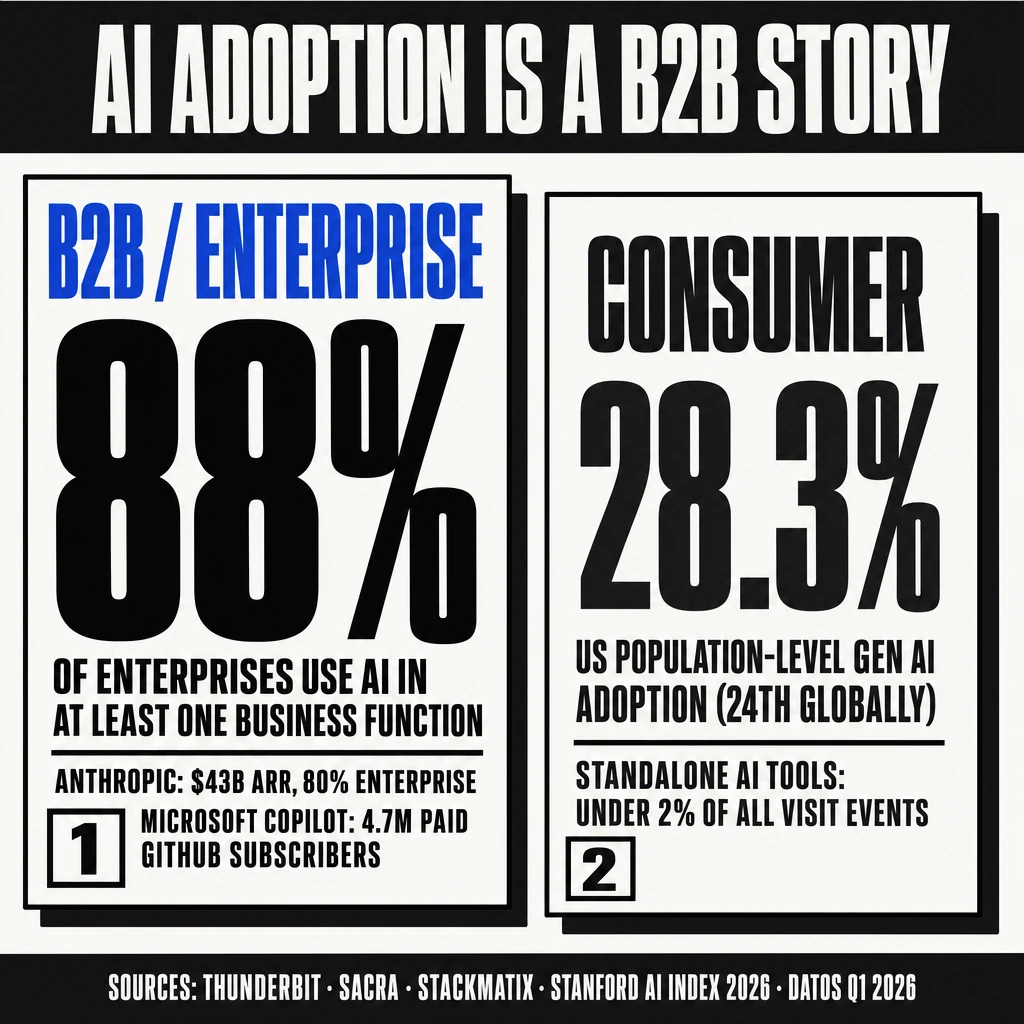
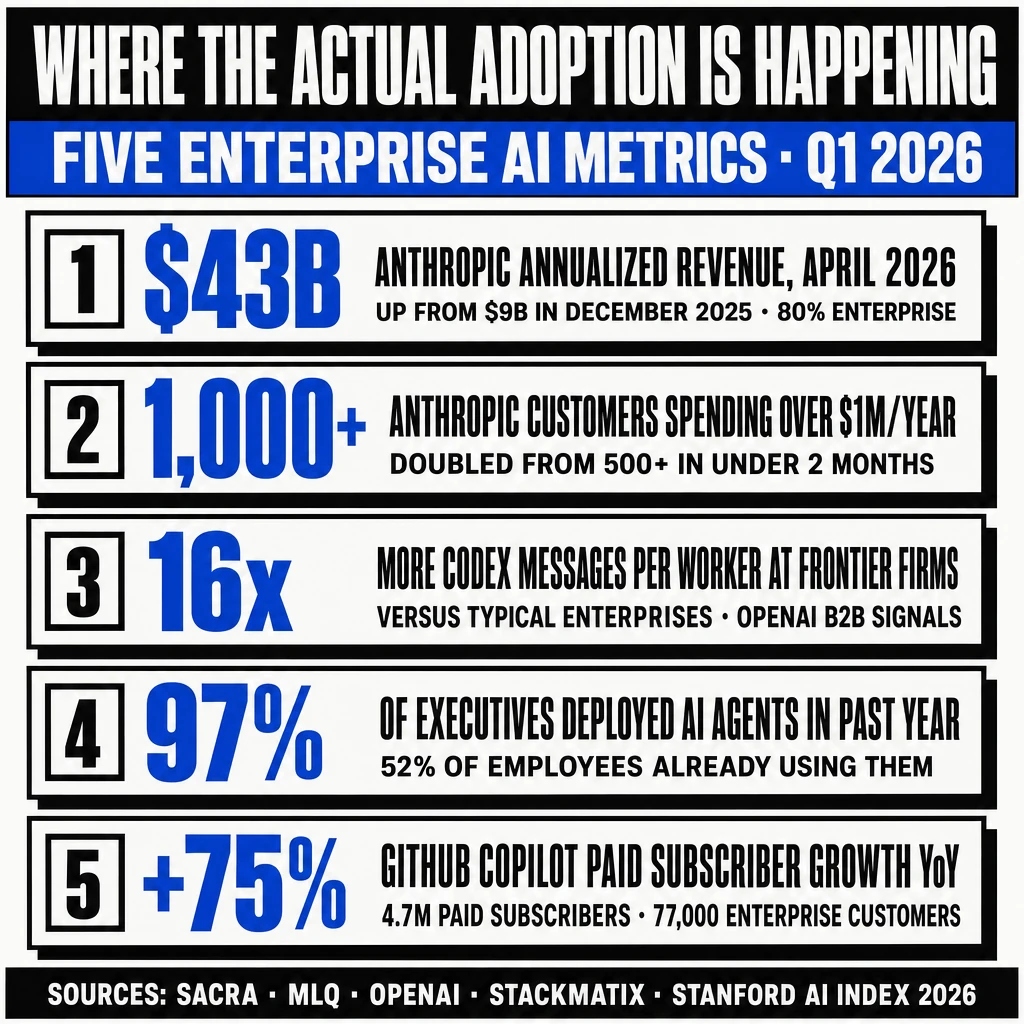
Anthropic’s annualized revenue went from $9 billion at end of 2025 to $43 billion by April 2026 (Sacra, 2026). Over 1,000 customers now spend more than $1 million per year on Anthropic, doubling from 500+ in under two months. 80% of Anthropic revenue comes from business customers.
The consumer side is different. Stanford’s 2026 AI Index reports the US ranks 24th globally in population-level gen AI adoption at 28.3% (Stanford HAI, 2026). The global figure reached 53% in three years, but that average masks enormous workplace concentration.
If your content strategy assumes one audience, the model is wrong. The data has been screaming “AI is a B2B story” for over a year.
Key Takeaways
- 88% of enterprises use AI in at least one business function in 2026, up 44% year over year (Thunderbit, 2026). 97% of executives say their company deployed AI agents in the past year.
- Anthropic hit $43B annualized revenue by April 2026, up from $9B at end of 2025. 80% of that revenue is enterprise. Claude Code alone went from $1B ARR (November 2025) to $2.5B ARR (February 2026).
- Microsoft Copilot has 420 million monthly active users, but only 15 million paid M365 seats with 33 million actually active. The workplace conversion rate is 35.8% (Stackmatix, 2026).
- GitHub Copilot has 4.7 million paid subscribers (75% YoY growth) across 77,000 enterprise customers. Coding workflows are the cleanest B2B AI success story available.
- Consumer adoption is real but slower. US population-level gen AI adoption is 28.3%, ranking 24th globally (Stanford AI Index, 2026). The gap between workplace mandate and consumer choice is large.
- For SEO and content work, this means: B2B audiences require different optimization than B2C audiences. The platform mix (Claude, Copilot, Gemini) and citation patterns differ. One-size-fits-all “AI search optimization” is mis-modeling the audience.
The Enterprise Numbers Dwarf the Consumer Numbers
Three independent data sources tell the same story when you compare enterprise spend to consumer spend.
Anthropic’s $43 billion annualized revenue in April 2026 is roughly 4.8x ChatGPT’s reported $25 billion ARR (TechnologyChecker, 2026). Anthropic generates more revenue with substantially fewer users because its users are paying enterprise rates, not consumer rates.
Over 1,000 Anthropic customers spend more than $1 million per year. That number doubled in less than two months in early 2026 (MLQ.ai, 2026). The shape of the curve is enterprise sales acceleration, not consumer subscription growth.
OpenAI’s own published B2B Signals data showed frontier firms sending 16x more Codex messages per worker than typical firms. The AI usage gap between heavily-tooled enterprises and average enterprises is itself an order of magnitude.
| Signal | Reported value | Population or unit | Source cited in article |
|---|---|---|---|
| Enterprise AI use | 88% | Enterprises using AI in at least one function | Thunderbit |
| Anthropic enterprise revenue mix | 80% | Share of revenue from business customers | Sacra and company reporting |
| Microsoft Copilot paid seats | 15 million | Paid Microsoft 365 seats | Stackmatix |
| GitHub Copilot paid subscribers | 4.7 million | Across 77,000 enterprise customers | Cited company data |
| US population-level gen AI adoption | 28.3% | US population, rank 24 globally | Stanford AI Index 2026 |
| Standalone AI visit share | Under 2% | Desktop visit events | Datos Q1 2026 |
These are different denominators. Read them as directional signals of workplace concentration, not one combined adoption rate.
Anthropic’s Growth Curve Is Almost Entirely Enterprise
Anthropic publishes more enterprise data than most AI companies, which makes the shape of its growth visible.
The numbers from Anthropic’s own disclosures and SEC-adjacent reporting (Sacra, 2026):
- 300,000+ business customers
- ~80% of revenue from enterprise and startup API customers
- 100,000+ customers running Claude on Amazon Bedrock
- $43B annualized revenue (April 2026), up from $9B (December 2025)
- Claude Code: $2.5B annualized revenue in February 2026
The consumer side of Anthropic (Claude.ai subscriptions) exists and is healthy, but it is a fraction of the revenue. The audience that wins for Anthropic is engineers using Claude Code, support agents wrapping Claude into helpdesks, researchers using Claude for analysis, and product teams building AI features into their software.
I covered the share-shift dynamic in my post on the ChatGPT plateau. Anthropic’s enterprise positioning is the reason it has been the fastest-growing competitor. The product is genuinely good. The distribution is enterprise IT, not consumer marketing.
Microsoft Copilot’s Engagement Gap Tells the Same Story
Microsoft reports 420 million monthly active users for Copilot in Q1 2026. The headline looks like consumer success.
Read the next line in the same data: Microsoft Copilot has 15 million paid M365 seats but only 33 million active users (Stackmatix, 2026). The workplace conversion rate is 35.8%.
Three observations:
- The 420M MAU figure is dominated by light-touch usage inside Microsoft properties (Bing, Edge, Windows). Most of those users are not opening Copilot deliberately.
- The paid seat count tells you what enterprises are actually buying. 15 million is a real number, but it is two orders of magnitude smaller than the MAU number Microsoft quotes in earnings.
- Active users above paid seats (33M vs 15M) signals corporate trials, sandbox use, and free-tier Copilot exposure inside enterprise. That gap will close once enterprises decide what to renew.
GitHub Copilot is the contrast. 4.7 million paid subscribers, 75% year-over-year growth, 77,000 enterprise customers. The market for AI inside the coding workflow is genuinely large and growing fast. The workplace conversion rate for developer-targeted AI dwarfs the conversion rate for general-purpose office AI.
This pattern is consistent across vendors. Where the tool plugs cleanly into an existing workflow that produces measurable output (code, support tickets, research summaries), adoption is high. Where the tool is offered as a generic productivity overlay (Office Copilot), adoption is lower than the marketing numbers suggest.
What the Consumer Numbers Actually Look Like
Stanford’s 2026 AI Index is the cleanest single source on consumer AI adoption.
The headline number: 53% of the global population has used generative AI within three years of mainstream availability. The detail underneath:
- US ranks 24th globally at 28.3% population-level adoption
- The leading countries are concentrated in regions where workplace AI mandates are unusually strong
- Adoption correlates strongly with GDP per capita, but the workplace-driven concentration is the dominant explanatory factor
The Stanford economy chapter goes deeper. Employment for software developers ages 22-25 has fallen ~20% since 2024 as junior coding work gets automated. AI-related skills appear in 2.5% of US job postings, a 297% increase over a decade. Mid-career and senior workers in AI-exposed roles have held steady or grown.
None of this is consumer-side. It is workforce-side. The story is “AI is changing what jobs exist and how they get done” rather than “consumers are buying AI products.”
When LinkedIn feeds are full of AI-positive enthusiasm and your e-commerce client is asking why they don’t see AI traffic, both are seeing accurate slices of reality. The LinkedIn feed is workforce-adjacent professionals; the e-commerce traffic is general consumers. Different populations.
What This Means for SEO and Content Work
Two distinct optimization approaches depending on audience.
If your audience is B2B professional
Optimize heavily for Claude and ChatGPT citations. These are the workplace tools your audience uses several times a day. Citation in Claude or ChatGPT search responses is high-leverage because the audience consumes those answers inside their workflow.
Treat content as something an AI agent might extract on behalf of a developer, analyst, or researcher. Structure for that user.
If your audience is general consumer
Optimize for traditional Google Search and AI Overviews first. The consumer adoption rate of standalone AI tools is still 28% in the US. The vast majority of your audience is still searching Google as their primary discovery channel.
Track AI citations as a leading indicator that may shift over the next 24-36 months, not as a near-term traffic source.
If your audience is mixed
Run separate measurement for the two audience segments. The shared underlying SEO foundation is the same (extractable answer blocks, entity completeness, schema discipline), but the priorities differ.
I unpack the operational layer of this in my piece on what is actually new in AI-search optimization. The audience-segmentation point is one of the most under-considered parts of AI-search planning.
FAQ
Sources & References
- Thunderbit. “Enterprise AI Usage Trends & B2B Statistics for 2026.” 2026. thunderbit.com
- Sacra. “Anthropic revenue, valuation & funding.” 2026. sacra.com
- VentureBeat. “Anthropic says it hit a $30 billion revenue run rate after ‘crazy’ 80x growth.” 2026. venturebeat.com
- SaaStr. “Anthropic Just Hit $14 Billion in ARR. Up From $1 Billion Just 14 Months Ago.” 2026. saastr.com
- MLQ.ai. “Anthropic Hits $30 Billion Annual Run Rate With Enterprise Surge.” 2026. mlq.ai
- Stackmatix. “Microsoft Copilot Enterprise Adoption in 2026: What the Data Shows.” 2026. stackmatix.com
- Stanford HAI. “The 2026 AI Index Report.” 2026. hai.stanford.edu
- Stanford HAI. “Economy chapter, 2026 AI Index Report.” 2026. hai.stanford.edu
- OpenAI. “How frontier firms are pulling ahead.” OpenAI B2B Signals report, 2026. openai.com
- PPC Land. “AI still under 2% but growing: Datos Q1 2026 state of search report.” 2026. ppc.land
- Hunt, Jim. “AEO Is Just SEO With New Acronyms.” Gridlok, May 2026. gridlok.co
- Hunt, Jim. “The ChatGPT Plateau.” Gridlok, May 2026. gridlok.co
See what ChatGPT is really searching
SubSeed captures the hidden Google queries ChatGPT runs behind every answer and enriches them with search volume, CPC, and keyword difficulty.
Related Posts
Read this post with an assistant
This is the whole prompt each button sends. Nothing hidden in it.
Read https://gridlok.co/blog/ai-adoption-b2b-not-consumer/ and give me the main points in a few sentences.
Make Gridlok a Preferred Source on Google
See Gridlok surfaced more often in your Top Stories, AI Overviews, and AI Mode. One click, applied across Google Search.