Google I/O 2026: What Its AI Agents Actually Do (and What They Mean for Your Business)
Google’s I/O 2026 keynote was long, but it kept circling one idea. Google is moving from AI that only answers you to AI that does things for you. Google calls it the “agentic era.”
If you run a business, here is the plain version. Google is shipping software that books, buys, watches prices, and checks out on a customer’s behalf. People are starting to hand the clicking to an agent.
This was not one feature on one slide. It ran through Search, shopping, Gmail, and a brand new personal agent that keeps working while your phone is off.
That matters because the job used to be simple to describe. Get a person to land on your page. The person is still there, but now there is a piece of software sitting between them and you, deciding what to read, what to recommend, and soon what to buy. That is the real story of I/O, and it is worth understanding before it gets pointed at your market.
Key takeaways
- Google framed the entire keynote around agents, AI that takes action rather than AI that just responds.
- The announcement with real money behind it is agentic shopping: a Universal Cart that follows you across Google, plus a checkout where Google completes the purchase for you on the merchant’s own site.
- Two new personal agents, Gemini Spark and Daily Brief, run in the background and keep working when your phone is off.
- Google will now call local service businesses on a customer’s behalf to book an appointment.
- For anyone with a website, the audience is changing. More and more, you have to be the source an agent trusts, not only the page a human clicks.
The short version of what Google announced
There were a lot of names on stage. Google’s own recap ran past 100 announcements, so here is the map, stripped down to what each thing actually does.
- Gemini Spark. A personal agent that runs around the clock and handles multi-step tasks for you.
- Daily Brief. An overnight agent that reads your inbox, calendar, and tasks, then hands you a prioritized plan for the day.
- Information Agents. Background agents in Search that watch a topic, a price, or a news story and ping you when something changes.
- Agentic Booking. Search can now phone certain local businesses and make a reservation for you.
- Universal Cart. One shopping cart that works across Search, the Gemini app, YouTube, and Gmail.
- Agent payment protocols. The plumbing (AP2 and UCP) that lets an agent pay a store directly, with limits you set.
The rest of this is what those mean for you, starting with the one that moves money.
The announcement with real money behind it: agentic checkout
Google’s biggest swing was on shopping, and it is worth slowing down on.
The Universal Cart is one cart that travels with the shopper across Search, the Gemini app, YouTube, and Gmail. Add something while reading a review on your phone and it is there when you open Gmail later.
It also works in the background. It tracks price history, flags when an item drops or comes back in stock, and warns you when two products will not work together before you buy the wrong one.
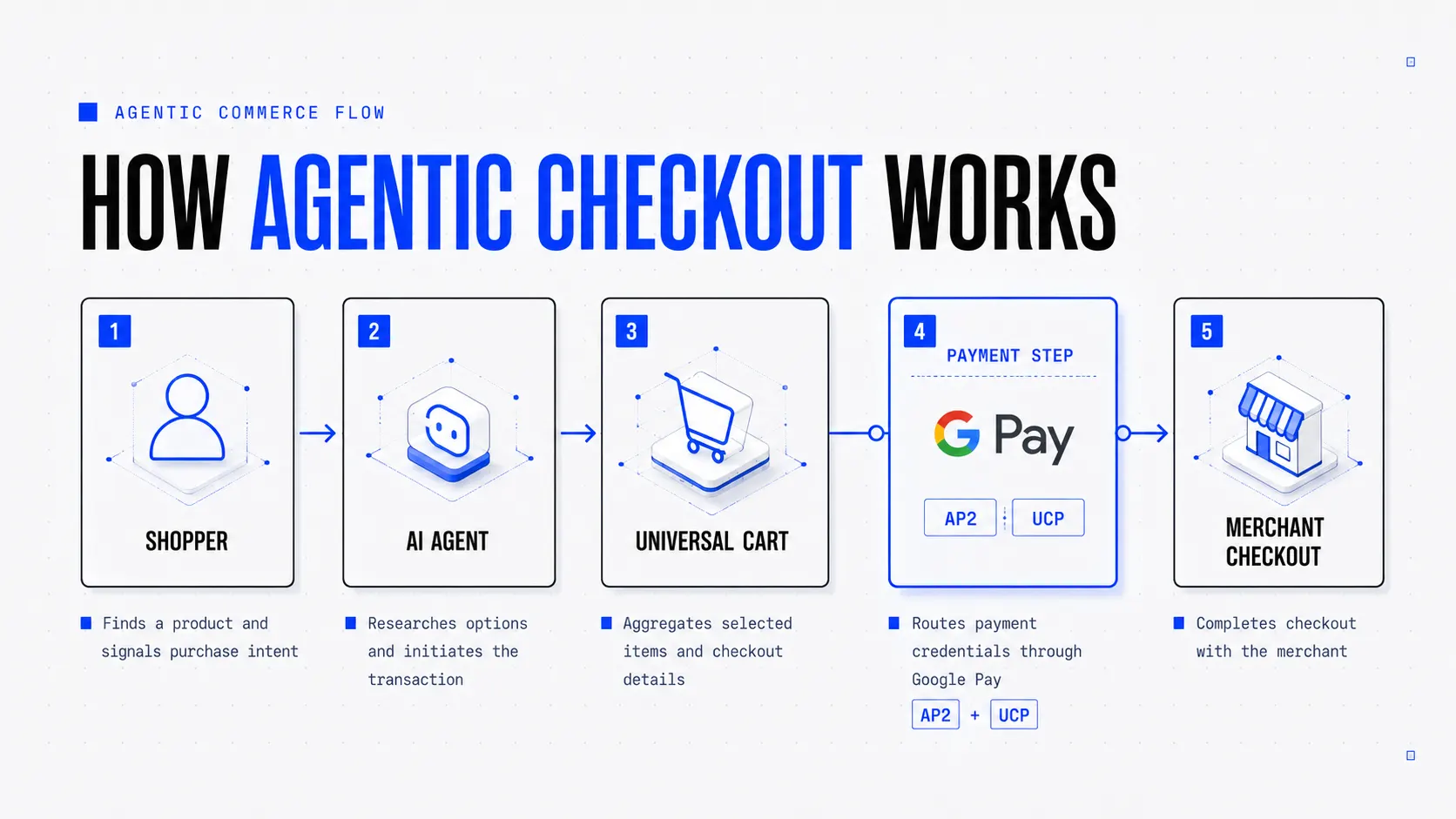
Then comes the part retailers need to watch. If a merchant is eligible, Google can finish the checkout for you, on the merchant’s site, with Google Pay, after you confirm the price and shipping.
Underneath sit two new standards. AP2, the Agent Payments Protocol, lets an agent pay on your behalf with hard limits you set on brands, products, and total spend. UCP, the Universal Commerce Protocol, is a shared language so any agent can talk to any store’s checkout.
Read that as Google trying to own the moment of purchase. If an agent handles the buy, the shopper may never see your product page, your reviews, or the upsell you spent months tuning. You stop competing for the click and start competing to be the product the agent picks, which comes down to your feed, your structured data, your price, and whether you are eligible at all.
It is rolling out in the US first, expanding to Canada and Australia, then the UK, with YouTube checkout close behind.
Agents that keep working while you sleep
The second theme was always-on. Three of the announcements only make sense once you notice they run while the user is away.
Gemini Spark is the flagship. It is a personal agent that runs in the cloud, so it keeps going even when your phone or laptop is off, and it works through long, multi-step tasks under your direction. It checks with you before anything major. Google put it in beta for AI Ultra subscribers in the US right after the keynote, with payment authorization and custom sub-agents coming over the summer.
Daily Brief is the gentlest version of the idea, and the one most people will meet first. Overnight, it reads your inbox, calendar, and tasks, then hands you a prioritized rundown of your day with suggested next steps. It is rolling out to all Google AI subscribers in the US.
Information Agents live inside Search. You can set up several, each watching something you care about, an apartment search, a price, a player’s next signing, and they report back when something moves. That one is a summer release for AI Pro and Ultra subscribers. (Update, 29 September 2026: it’s now free for everyone in the Google app.)
The pattern is the part to sit with. Engagement is shifting from “open the app and ask” to “the agent got some things done overnight.” Google wants to be working for the user even when the user is not looking.
Google will call local businesses for you
One announcement is easy to skim past, and if you run a local business it is the one to slow down on.
Search can now place a call to certain service businesses, home repair, beauty, pet care, and book the appointment for the customer. The person sets the criteria, Google does the calling.
If you run that kind of business, think about what the agent reads to decide whether to put you forward, and what happens when it calls. Your hours, your services, your reviews, and how easy you are to book in a machine-readable form start to matter more than the copy on your homepage.
What happened to Project Mariner and Astra
If you followed Google’s earlier agent demos, you might be waiting to hear these two names. Here is where they went.
Project Mariner, the experimental browser agent that clicked through websites and could juggle up to ten tasks at once, was wound down as a standalone product in May, according to reporting, and its technology was folded into the main Gemini agent line. Project Astra, the camera-and-microphone universal assistant, was not headlined by name. Spark is effectively where both of those threads landed for now.
What this changes if you run a website
Pull back and the through-line is clear. Across shopping, booking, and search, Google is placing an agent between the customer and the destination. The human visit does not disappear overnight, but it stops being a given.
For a long time, SEO meant winning the click. A growing part of the job now is winning the agent: being the source it reads, trusts, and acts on. If the acronyms are starting to blur together, I wrote about why most of AEO is still SEO with new labels.
In practice that means the unglamorous work. Content an AI can actually parse. Structured data that states your facts plainly. Clean product feeds. Accurate hours and services. Pages that load fast. The same readability that helps AI Overviews and ChatGPT cite you is what lets an agent use you.
None of this came out of nowhere, but the demos still moved faster than I expected. Worth getting ahead of while it is early.
What I would do about it this quarter
- Get your product or service data into a clean, structured feed, with prices, availability, and key specs a machine can read, not locked inside images or PDFs.
- Add or tighten your schema (Organization, Product, LocalBusiness, FAQ) so an agent reading your page gets the facts without guessing.
- Check that an AI can actually read your pages before you assume it can. The Agentic Readiness Check and the AI Summary Preview are both built for that.
- Fix your local presence where Google reads it: hours, services, booking links, and reviews, not just the version on your own site.
- Re-run the check in about 90 days. This is shipping in stages through 2026, so it works better as a habit than a one-time fix.
FAQ
So that is I/O 2026 in plain terms. Google did not just make Gemini smarter. It gave it hands.
The businesses that come out ahead are the ones an agent can read, trust, and act on. That is the same work I keep circling back to, only now it is a lot more literal.
If you want to see whether an AI agent can read and use your site as it stands today, the Agentic Readiness Check is built for exactly that.
See what ChatGPT is really searching
SubSeed captures the hidden Google queries ChatGPT runs behind every answer and enriches them with search volume, CPC, and keyword difficulty.
Related Posts


Read this post with an assistant
This is the whole prompt each button sends. Nothing hidden in it.
Read https://gridlok.co/blog/google-io-2026-ai-agents/ and give me the main points in a few sentences.
Make Gridlok a Preferred Source on Google
See Gridlok surfaced more often in your Top Stories, AI Overviews, and AI Mode. One click, applied across Google Search.