AEO Is Just SEO With New Acronyms (Here’s What Actually Changes)
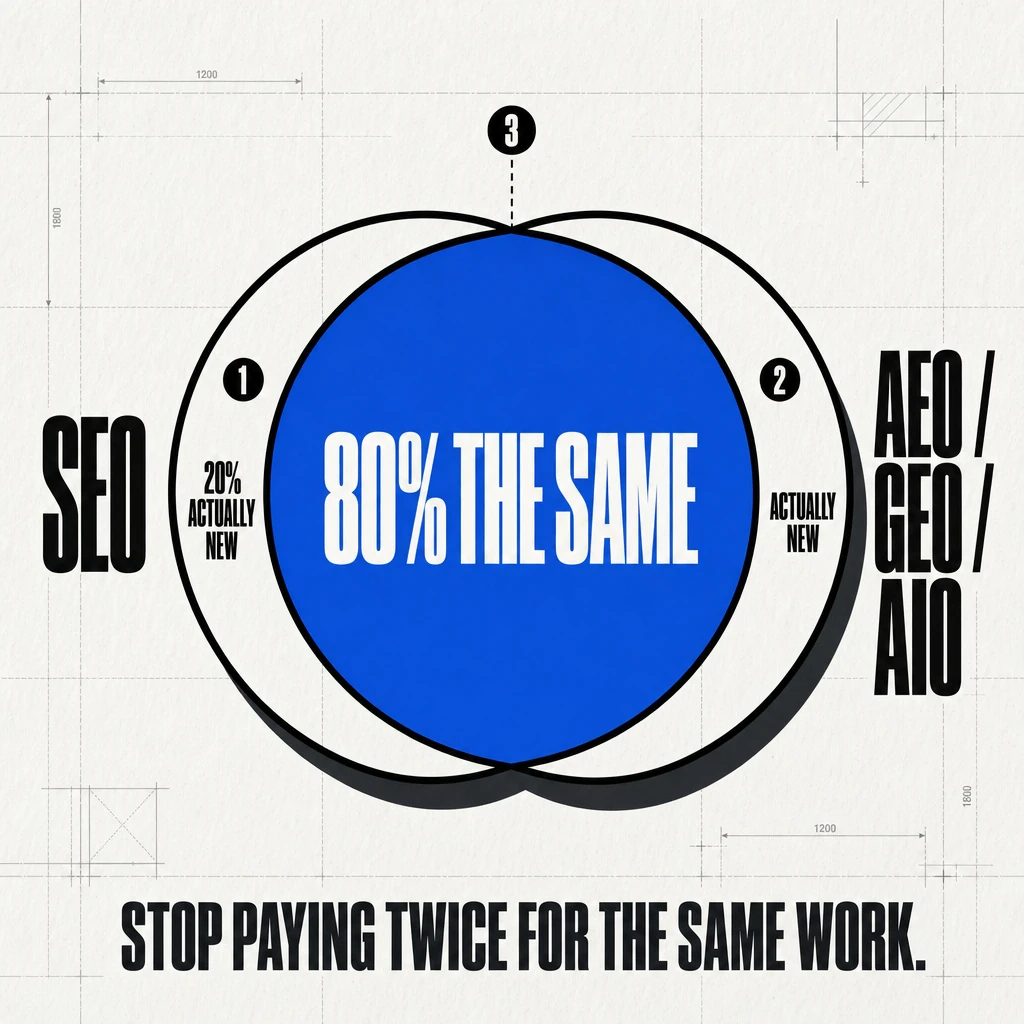
The vendor industry has spent eighteen months selling AEO, GEO, AIO, and a dozen lesser acronyms as new disciplines that need new tools, new budgets, and new specialists.
Google’s own Search Advocate, John Mueller, called that pattern out on Bluesky in August 2025. The quote is the cleanest summary I have seen of where the industry actually is right now:
The higher the urgency, and the stronger the push of new acronyms, the more likely they’re just making spam and scamming.
John Mueller, Google Search Advocate, Bluesky (August 14, 2025)
That quote is six months old and it has aged well. The acronym count has grown since he posted it. The fundamentals have not.
What follows is the version of the AEO/GEO conversation I wish more practitioners had read before spending budget on it: what is actually new, what got repackaged at a markup, and a simple test for sorting the difference.
Key Takeaways
- SEO and AEO overlap by roughly 80% on every credible third-party analysis. The remaining 20% is real and worth understanding. It is not a separate discipline.
- Mueller explicitly flagged the new-acronym push as a spam-and-scam signal in August 2025. He doubled down in January 2026 with “what you call it doesn’t matter.” Both statements remain Google’s public position.
- Some brands have paid more than $50,000 to AI optimization vendors for work that is indistinguishable from a competent SEO retainer.
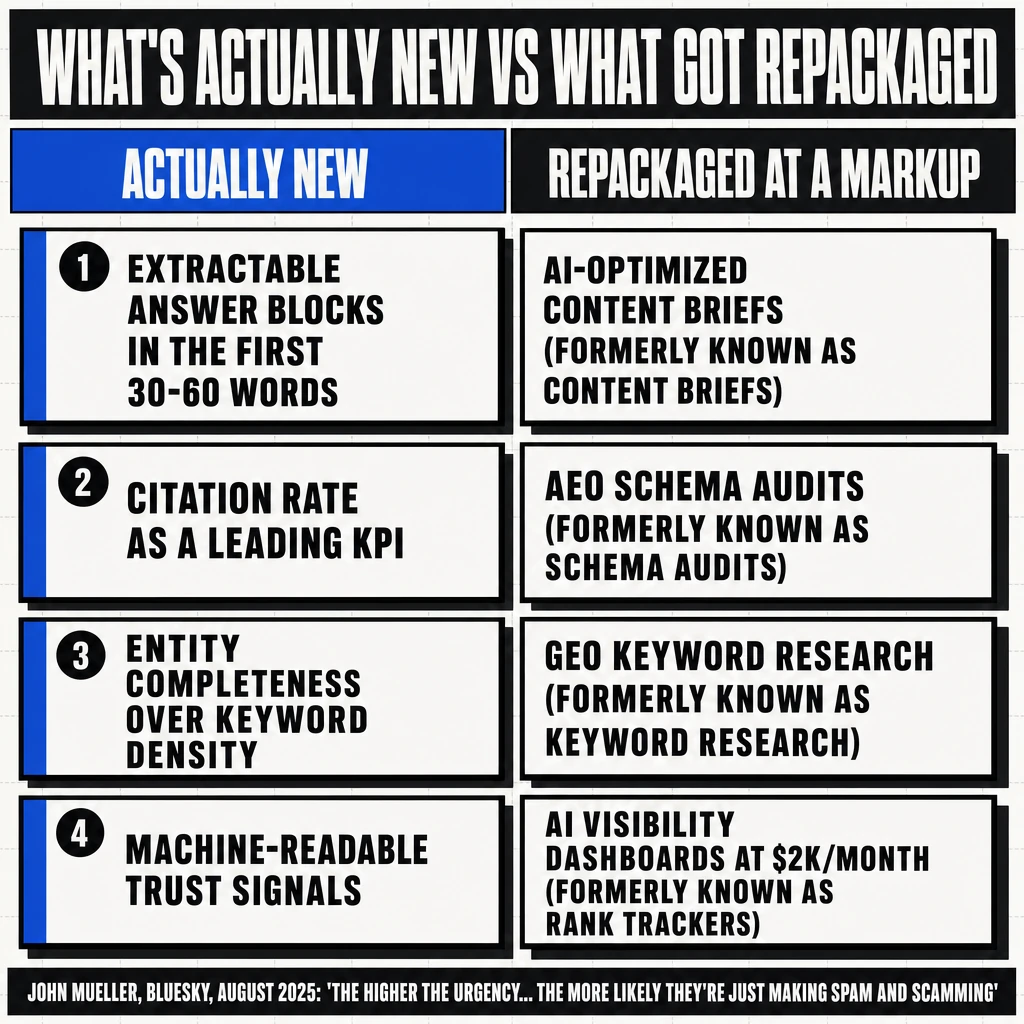
- What is genuinely new in the AI-search era is small and specific: extractable answer blocks, citation-rate as a KPI, entity completeness over keyword targeting, and machine-readable trust signals. The rest is the existing playbook.
- The practitioner test for any AI SEO claim: ask the vendor to name the specific signal, the measurable outcome, and the public source. If they cannot, you are paying for vibes.
- Cross-link to my prior pieces if you want the case studies: LLMs.txt and Google’s AI content rules.
What Google’s Own People Are Saying
Google’s public position on AEO/GEO/AIO over the last twelve months has been remarkably consistent.
Mueller’s August 2025 Bluesky thread named three acronyms specifically: GEO (Generative Engine Optimization), AIO (AI Optimization), and AEO (Answer Engine Optimization). His warning was not subtle. The aggressive marketing push behind these terms, he wrote, is itself the warning sign.
By January 2026, Mueller returned to the topic on Reddit with a calmer version of the same point.
What you call it doesn’t matter, but ‘AI’ is not going away. Thinking about how your site’s value works in a world where ‘AI’ is available is worth the time.
John Mueller, Reddit r/SEO, January 2026
That second framing is the operationally useful one. The acronym does not matter. The underlying question of whether your site is useful to readers who reach it through AI-mediated discovery does.
Danny Sullivan, Google’s Search Liaison, has supported the same position publicly. The “focus on audience” message is now the official Google line.
None of this means AI search is unimportant. It means the new-acronym frame for talking about it is mostly marketing.
The 80% Overlap That Everyone Knows But Nobody Sells
Read any honest third-party comparison of SEO, AEO, and GEO. The overlap estimate lands in the same range every time: around 80% (Searchable, 2026; eMarketer, 2026).
The 80% is the same things SEOs have been doing for fifteen years.
- Topical authority through depth and breadth of coverage
- Editorial quality that meets E-E-A-T (Experience, Expertise, Authoritativeness, Trust)
- Clean technical foundation (indexability, render mode, semantic HTML, structured data)
- Internal linking that helps both crawlers and reasoning models understand site structure
- Earned authority through credible external citations and links
- Page-level intent matching to actual user questions, not keyword tool outputs
If a site does these six things well, AI search citations come almost for free. If a site does not do them well, no amount of AEO-branded tooling fixes the underlying problem.
Vendors selling “AEO services” rarely lead with this list. They lead with the new acronym, because there is no markup on the existing playbook.
What Is Actually New (and Worth Doing)
The 20% that is genuinely different is small, specific, and worth understanding. None of it requires a new vendor relationship.
Extractable answer blocks
AI search synthesizes answers from sources. When a reasoning model decides which snippet to quote, it favors content that already reads like a clean, self-contained answer.
Write content so the answer to the page’s headline question lives in the first 30-60 words of the post body. Make it copy-paste-extractable. Then expand into the depth and analysis that justifies the citation.
That single change has done more for my citation rate than any vendor tool I have evaluated.
Citation rate as a KPI
Click-through rate is becoming a lagging indicator. AI Overviews compress the SERP, agents read pages without clicking through, and synthesized answers route users away from publisher sites entirely.
Citation rate (how often your domain is named as a source inside an AI answer) is the leading indicator that matters now. Brands cited inside AI Overviews earn roughly 35% more organic clicks than non-cited competitors (Wellows, 2026), so the metric also tracks toward outcomes that already mattered.
This is the most important measurement framework shift I have made in the last year.
Entity completeness over keyword targeting
Reasoning models do not match queries to pages by keyword density. They match entities (a product, a person, a service, an attribute) to whichever pages expose those entities most cleanly.
Every important product, person, location, and service on a site should have one canonical page where the entity is fully described. Three pages mentioning a product without a single page being the authoritative source is an entity-completeness failure.
This is structured-data discipline plus information architecture. Both are SEO basics that suddenly matter more.
Machine-readable trust signals
An AI agent reading a page cannot evaluate design polish, social proof badges, or review counts. It reads schema markup, named-author signals, source citations, and entity relationship cues.
The cosmetic layer of a site becomes invisible to the portion of the audience that comes through an agent. The signals that survive translation into machine-readable form are the ones that matter for AI visibility.
I unpacked this point in more detail in my piece on Information Agents, which covers the architectural shift in depth.
What Got Repackaged at a Markup
The other side of the table. These are the deliverables I see vendors selling under AEO/GEO labels that are indistinguishable from standard SEO retainer work at a 2-3x price.
- “AI-optimized content briefs.” Content briefs structured around target questions and entities. The pre-2023 version of this was called a content brief structured around target keywords. Same skill, new vocabulary.
- “AEO schema audits.” Structured data implementation audits. The pre-2023 version was a schema markup audit. Same deliverable, new acronym in the title.
- “GEO keyword research.” Surfacing the questions users ask AI assistants. The skill of identifying real user questions instead of phantom search-volume terms predates AI by a decade. The toolset is updated; the work is not new.
- “AI visibility monitoring dashboards.” Tracking your brand mentions and citations in AI answers is useful. Charging $2,000 a month for a tool that runs a list of prompts in ChatGPT and parses the output is the kind of margin that does not survive transparency.
None of these deliverables are bad. The complaint is the markup.
Hundreds of self-proclaimed “GEO experts” appeared in a market that has existed for less than two years (Search Engine Land, 2025). The supply of newly-minted specialists is what tells you the pricing has nothing to do with the underlying skill scarcity.
The Practitioner Test for Any AI SEO Claim
One filter I use before paying for anything that has “AI” in its product name. Ask three questions.
- Name the specific signal. Not “our AI optimization framework.” The literal signal: schema field, content pattern, structural element, anything I could explain to an engineer in one sentence.
- Name the measurable outcome. Not “improved AI visibility.” A measurable: citation rate in named AI answers, ranking changes in named SERPs, traffic from named sources, with a baseline I can verify before and after.
- Name the public source. A study, a Google documentation page, an independent log analysis. Anything I can read myself and verify. Not “our internal data.”
If a vendor cannot answer all three, the pitch is vibes. If they can, the work is probably worth doing, but you might also just do it in-house since they had to explain the actual mechanic to win the engagement.
I ran this filter against the AEO vendor pitches I saw in the last six months. Most failed at question one.
What I Would Do This Quarter
Treat AI search visibility as a finishing layer on top of the existing SEO foundation, not a parallel discipline. Here is the prioritization I would use.
- Audit entity completeness on the high-value pages. Every product, service, person, and location has one canonical page where the entity is fully described.
- Verify structured data coverage on the high-stakes templates. Product, LocalBusiness, Organization, Article, FAQPage (for understanding, not the dead visual rich result).
- Rewrite the first 30-60 words of every important post body as an extractable answer to the page’s headline question.
- Add citation rate as a KPI alongside click-through rate. Start tracking how often your domain appears as a source in AI answers for your target queries.
- Stop spending budget on anything labeled “AEO,” “GEO,” or “AIO” unless the vendor passes the three-question test above.
- Read Mueller and Sullivan when they post. Their public statements have been the most reliable signal about which AI search claims will hold up.
None of this is exciting. That is the point.
FAQ
Sources & References
- Mueller, John. Bluesky post on AI SEO acronyms and spam signals. August 14, 2025. Documented via PPC Land.
- Schwartz, Barry. “Google Suggests AI SEO Acronyms May Lead To Scams & Spam.” Search Engine Roundtable, August 2025. seroundtable.com
- Schwartz, Barry. “Google’s John Mueller on SEO vs. GEO: Focus on audience behavior.” Search Engine Land, January 2026. searchengineland.com
- Searchable. “GEO vs SEO vs AEO: The Honest Guide to What’s Real, What’s Hype, and What to Do About It.” 2026. searchable.com
- eMarketer. “FAQ on GEO and AEO: Where AI search and SEO overlap in 2026.” 2026. emarketer.com
- The Ad Spend. “The Great AI SEO Scam of Mid-2025.” 2025. theadspend.com
- Wellows. “Google AI Overviews Ranking Factors: 2026 Guide to Winning Citations.” 2026. wellows.com
- Hunt, Jim. “Why Nobody’s Using LLMs.txt.” LinkedIn, October 2025. linkedin.com
- Hunt, Jim. “Google’s AI Content Rules: What ‘Meet the Standards’ Actually Means.” Gridlok, May 2026. gridlok.co
- Hunt, Jim. “Information Agents: When the Searcher Is Software, Not a Human.” Gridlok, May 2026. gridlok.co
See what ChatGPT is really searching
SubSeed captures the hidden Google queries ChatGPT runs behind every answer and enriches them with search volume, CPC, and keyword difficulty.
Related Posts
Read this post with an assistant
This is the whole prompt each button sends. Nothing hidden in it.
Read https://gridlok.co/blog/aeo-is-seo-with-new-acronyms/ and give me the main points in a few sentences.
Make Gridlok a Preferred Source on Google
See Gridlok surfaced more often in your Top Stories, AI Overviews, and AI Mode. One click, applied across Google Search.