Google Gemini Spark, Explained: What It Does and What It Means for Your Business
Gemini Spark is Google’s new 24/7 personal AI agent, and it was the piece of I/O 2026 that got the most attention. If you have seen the name going around and want the plain version, here it is.
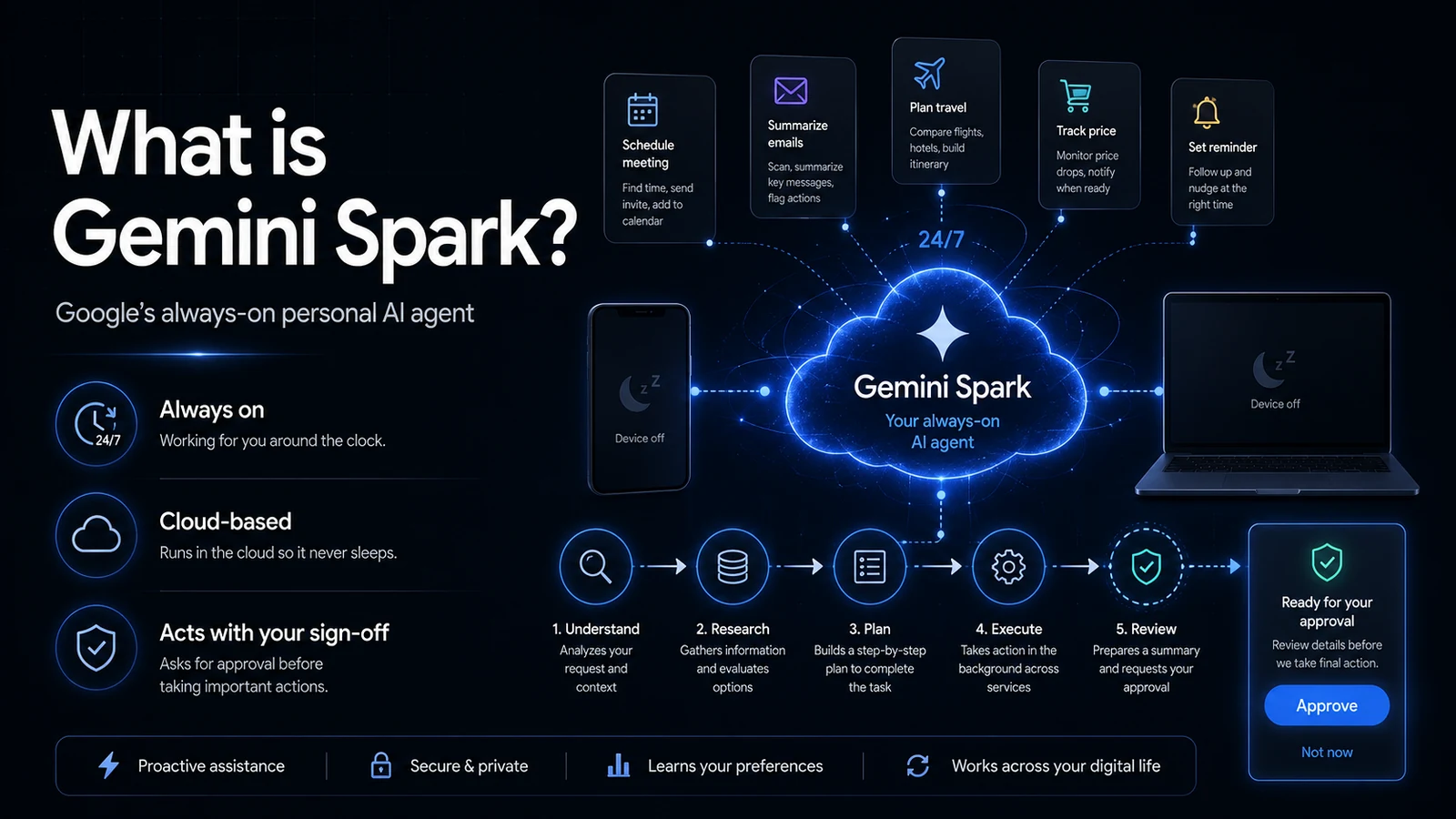
Spark is software that works on your behalf in the background, even when your phone and laptop are off. You give it a goal, it carries out the steps, and it checks in with you before anything major.
That is a real change from a chatbot you open and ask. This one keeps working when you are not looking. Below is what it does, what it costs, and what it means if you run a business.
Key takeaways
- Gemini Spark is a 24/7 personal agent that runs in the background, even when your devices are off, and acts under your direction.
- It connects to your Google apps (Gmail, Calendar, Drive, Docs, Maps, YouTube) and to outside tools like OpenTable, Instacart, and Canva through MCP.
- You shape it with Tasks, Skills, and Schedules, so it can repeat the things you do often and run them on a trigger.
- It’s paid and US-only for now. It launched on Google AI Ultra at $99.99 a month and came to Google AI Pro at $19.99 in July 2026.
- For businesses, the takeaway is simple: agents like Spark act for your customers, so your site and data need to be something an agent can read and use.
What is Gemini Spark?
Gemini Spark is Google’s always-on personal AI agent, announced at I/O 2026 and built on Gemini 3.5. It helps you handle your digital life, takes action for you, and runs in the background 24/7, even when your phone and laptop are turned off.
The difference from the regular Gemini app is that Spark does not wait for you to start a conversation. It runs on Google’s cloud, works through multi-step jobs on its own, and asks for your sign-off before doing anything significant.
What Gemini Spark can actually do
Most of Spark’s power comes from what it can reach.
It connects natively to your Google apps, Gmail, Calendar, Drive, Docs, Sheets, Slides, Maps, and YouTube, so it works from your real information instead of guessing.
It also reaches outside Google through MCP, the open standard the rest of the agent world is converging on. At launch that includes OpenTable, Instacart, and Canva, with Adobe, Spotify, GitHub, Notion, Slack, and Samsung lined up for summer 2026.
You shape how it works with three pieces. Tasks connect it to your Google workspace. Skills define how you want it to handle the things you do often. Schedules let it run on a timer or a trigger, so a job happens exactly when you need it.
Put together, that means you can hand Spark something like “every Monday, pull last week’s numbers from this sheet, draft the update, and hold it for my review,” and it will.
What Gemini Spark costs and who can use it
Spark is paid, and where you can get it changed a lot since launch.
It launched in May 2026 on Google AI Ultra at $99.99 a month. In late July it opened up to Google AI Pro at $19.99, which cut the price of entry by five times. You need to be 18 or over, and it runs in the Gemini mobile app and at gemini.google.com rather than inside Gmail or Docs.
Still US-only, with other countries coming. Google’s documentation rules out the EEA, the UK, Switzerland and Nigeria, so if you’re reading this from Europe there’s no date to wait for. Free accounts don’t get it, and neither do work or school accounts.
One requirement that’s easy to miss: you have to turn on Keep Activity for your Gemini history. An agent that works while you’re away needs a record of what it did, so the always-on part and the activity-logging part arrive together. Usage limits apply too.
At $99.99 this was a preview of where Google was heading. At $19.99 it’s a thing your customers can actually be using, which is a different situation for anyone running a website.
Why an always-on agent matters for your business
Here is the part that matters if you run a site or a store.
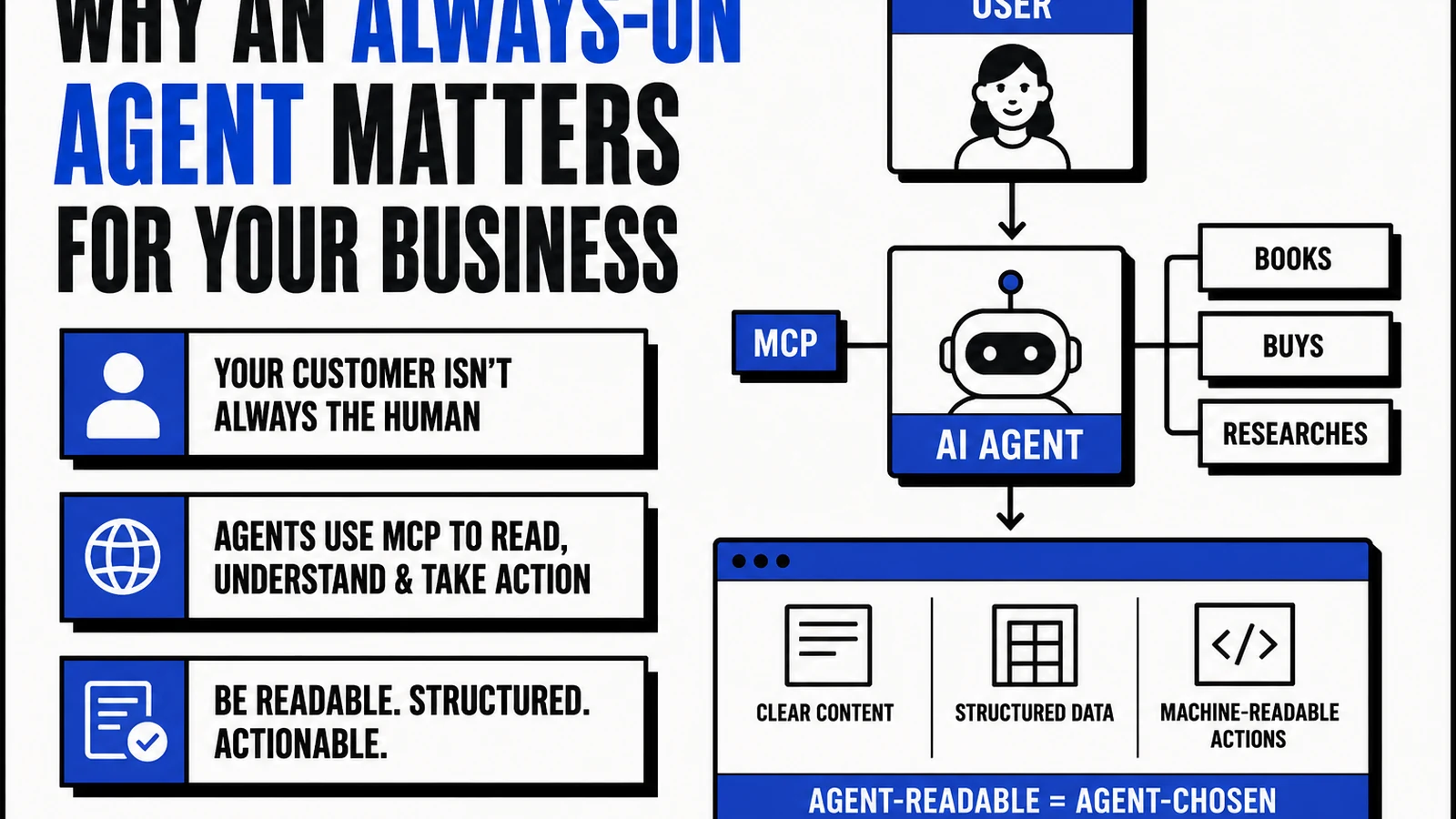
When millions of people have an agent that books, buys, and researches for them, your customer is not always the human anymore. Sometimes it is the software acting on their behalf, and that software decides what to read and what to recommend.
Spark reaches the outside world through MCP, a structured way for an agent to use a tool or a site. The businesses that show up well here are the ones an agent can actually read: clear content, clean structured data, and machine-readable actions, not information locked inside images or buried in a layout built only for human eyes.
It is the same readability work that helps AI Overviews and ChatGPT cite you, now pointed at agents that take action. You can check how an AI reads your pages with the AI Summary Preview, and whether an agent can use your site with the Agentic Readiness Check.
Where Spark fits in Google’s bigger agent push
Spark did not arrive alone. It was the flagship in a much wider set of agent announcements at I/O 2026, from agentic checkout to agents that monitor topics for you in Search.
Updated 29 September 2026. Those Search monitoring agents are now free. Google opened them to everyone globally in the Google app on September 28, while Spark itself is still paid. I covered what that changes in the post on information agents.
If you want the full map of what Google launched and what it means for your business, I put it all in one place: Google I/O 2026: What Its AI Agents Actually Do.
FAQ
Spark is early, paid, and US-only, so most businesses will not feel it directly this month. The reason to track it is what it signals: Google is betting that a lot of everyday tasks move to an agent working quietly in the background.
When that agent goes looking on your customer’s behalf, you want to be something it can read and act on. If you want to see whether your site is there yet, the Agentic Readiness Check is built for exactly that.
See what ChatGPT is really searching
SubSeed captures the hidden Google queries ChatGPT runs behind every answer and enriches them with search volume, CPC, and keyword difficulty.
Related Posts

Read this post with an assistant
This is the whole prompt each button sends. Nothing hidden in it.
Read https://gridlok.co/blog/gemini-spark/ and give me the main points in a few sentences.
Make Gridlok a Preferred Source on Google
See Gridlok surfaced more often in your Top Stories, AI Overviews, and AI Mode. One click, applied across Google Search.