Zero-Click Searches: The Numbers Behind the Panic
Key Takeaways
- Zero-click searches stabilized at approximately 24.5% in the US and 22.5% in the EU/UK
- Organic clicks to non-Google sites remain steady at 42-45% of all searches
- AI Overviews did not cause the dramatic zero-click increase many predicted
- Much of the 24% zero-click rate represents legitimate “answer found” scenarios like weather and calculations
- The strategic focus should be capturing available clicks effectively, not mourning theoretical lost traffic
What Zero-Click Actually Means
Before examining the numbers, it’s worth clarifying what “zero-click” captures.
A zero-click search is any Google search session where the user doesn’t click on any result. They search, see the results page, and either leave Google entirely or start a new search without clicking anything.
The term often gets framed as “Google stealing traffic.” But not all zero-click searches represent stolen opportunities.
Natural zero-click scenarios:
Someone searches “weather detroit” and sees the temperature in Google’s widget. They got what they needed. There was never going to be a click to weather.com because the answer was complete.
Someone searches “2+2” and sees the calculator result. Same dynamic. The query was answered. No website could have provided additional value.
Someone searches “time in tokyo” and sees the current time. Again, complete answer, no click needed, no theft involved.
Legitimately concerning zero-click:
Someone searches “best project management software comparison” and Google shows an AI Overview summarizing the top options. They read the summary and leave without visiting any of the sites that created the comparison content. This is traffic that could have gone to a website but didn’t.
The zero-click number combines both categories. When you see “24.5% zero-click,” that includes weather checks and calculator uses alongside potentially diverted comparison shopping queries.
This matters for interpretation. A 24.5% zero-click rate doesn’t mean Google is intercepting a quarter of all potential website traffic. Some portion of that was never clickable traffic to begin with.
The Stabilization Story
The Q4 2025 State of Search report from Datos and SparkToro shows zero-click rates that would have seemed unremarkable if not for years of alarming commentary.
US numbers (Q4 2025):
- Zero-click: approximately 24.5% in December
- This represents stabilization, not growth
EU/UK numbers (Q4 2025):
- Zero-click: approximately 22.5%
- Slightly lower than US, but following similar stable patterns
What’s notable is what didn’t happen. AI Overviews rolling out more broadly throughout 2025, fears that AI-generated summaries would crater click-through rates, the zero-click percentage held relatively flat.
The industry expected AI Overviews to trigger a zero-click explosion. The data suggests that either AI Overviews aren’t appearing on as many queries as feared, users are clicking through AI Overviews, or the effect is smaller than the panic implied.
This doesn’t mean AI Overviews have no impact. Individual sites may have seen traffic declines for specific query types. But at the macro level, the zero-click rate hasn’t dramatically shifted.
Where Clicks Actually Go
Zero-click gets the attention, but the click distribution tells a more complete story.
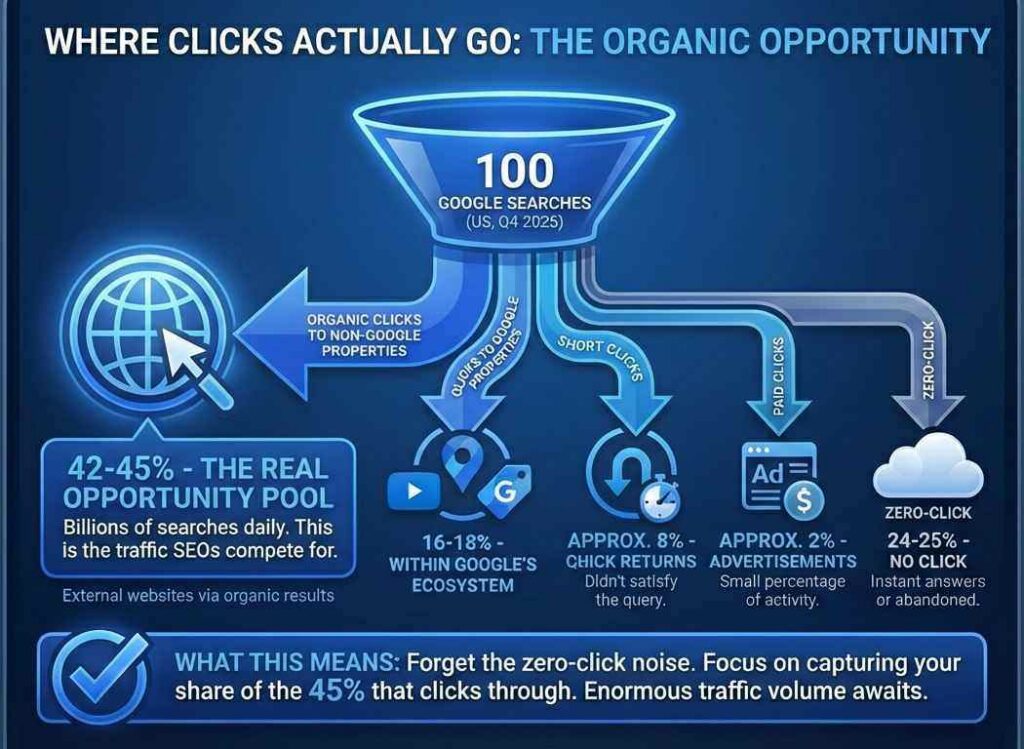
The breakdown (US, Q4 2025):
Organic clicks to non-Google properties: 42-45%
These are clicks to external websites through organic (non-paid) search results. This is what most SEOs are finally optimizing for.
Clicks to Google properties: 16-18%
Clicks to YouTube, Google Maps, Google Images, Google Shopping, and other Google-owned destinations. These are “clicks” in the technical sense but traffic stays within Google’s ecosystem.
Short clicks: approximately 8%
Clicks where the user quickly returns to the search results page. This suggests the clicked result didn’t satisfy the query, so the user came back to try another option.
Paid clicks: approximately 2%
Clicks on advertisements. A relatively small percentage of overall search activity.
Zero-click: 24-25%
No click on any result.
What this means:
The 42-45% figure is the one that matters most for organic SEO. That represents a substantial opportunity. Billions of searches happen daily. Even if 55% don’t result in organic non-Google clicks, the remaining 45% represents enormous traffic volume.
Framing it differently: for every 100 Google searches, roughly 42-45 result in someone clicking through to an external website via organic results. That’s the traffic pool you’re competing for.
The question isn’t whether zero-click is problematic (some of it is). The question is whether you’re effectively capturing your share of the 42-45% that does click through.
Why the Panic Narrative Persists
If the data shows stabilization, why does the SEO industry keep treating zero-click as an existential crisis?
Industry incentives favor alarming content. Articles about “Google stealing your traffic” generate more engagement than articles about “click rates holding steady.” Conferences need compelling narratives. Consultants need problems to solve. The incentive structure rewards fear.
Conflation muddies the analysis. “Zero-click” gets treated as synonymous with “Google stealing traffic,” but as discussed, those aren’t the same thing. Weather queries and calculator searches inflate the zero-click number without representing lost opportunity.
Individual site experience varies. Macro data showing stabilization doesn’t mean every site’s traffic is stable. Some sites have been hit hard by AI Overviews or featured snippets. Those real experiences get amplified into industry-wide narratives, even when they don’t represent the aggregate reality.
The AI Overviews fear factor. Google’s aggressive rollout of AI-generated summaries created reasonable concern. The concern was valid. The catastrophic predictions, so far, haven’t materialized at the macro level.
None of this means zero-click is a non-issue. Google clearly wants to keep users in its ecosystem through features like AI Mode, which wants to keep users in its ecosystem and answer more queries directly. That long-term direction is real. But the pace of change has been slower than the panic suggested.
What Marketers Should Actually Do
Rather than mourning zero-click, focus on capturing the traffic that is available.
Target queries that result in clicks.
Not all queries are equal. Informational queries with simple answers (definitions, quick facts, calculations) have always had lower click-through potential. Complex queries, comparison shopping, product research, and how-to searches tend to generate more clicks because the SERP can’t fully answer them.
Analyze which query types actually drive clicks for your site. Double down on those rather than chasing queries that are unlikely to click through regardless of ranking.
Optimize for the 42%.
If 42-45% of searches result in organic clicks, your job is to win your share of that pool. This means:
Strong title tags that earn the click even when competing with AI summaries. Compelling meta descriptions that give users a reason to visit your page. Content that delivers on the promise so users don’t bounce back to search results.
Create content that earns the click.
AI Overviews and featured snippets can summarize basic information. They’re less effective at providing nuanced analysis, step-by-step guidance with visual aids, proprietary research, expert commentary, or interactive tools.
Create content that offers value beyond what a summary can capture. Give users a reason to click through even if they’ve seen a preview of the answer.
Stop chasing queries that were never going to click.
Some queries have near-zero click potential regardless of what you do. Ranking #1 for “time in tokyo” won’t send you traffic because Google answers it completely. Recognize which queries fall into this category and allocate effort accordingly.
This isn’t about giving up on informational content. It’s about being realistic about which informational queries have click potential and which don’t.
Is Google getting more zero-click over time?
The long-term trend shows some increase in zero-click rates over the past several years. But the rate of increase has slowed significantly. Q4 2025 data shows stabilization rather than continued growth. Whether this represents a permanent plateau or a temporary pause before further increases is unknown.
Did AI Overviews increase zero-click rates?
Less than expected. the rollout of AI Overviews across more query types in 2025, the macro zero-click rate didn’t spike dramatically. Individual sites may have seen declines for specific queries where AI Overviews now appear, but the aggregate effect has been muted.
Possible explanations: AI Overviews may not trigger for as many queries as assumed. Users may still click through to learn more seeing summaries. The queries most affected may have already had low click potential.
Should I stop targeting informational queries?
No, but be strategic about which ones. Informational queries with complex answers, those requiring step-by-step guidance, nuanced analysis, or visual demonstration, still generate clicks. Simple factual queries that Google can answer in a snippet are lower priority.
Informational content also serves purposes beyond direct traffic: building topical authority, earning backlinks, supporting conversion content through internal linking, and providing material for AI systems to cite.
What about featured snippets? Aren’t those zero-click?
Featured snippets can reduce clicks. See our Google AI Mode guide for related strategies for some queries, but they can also increase clicks for others. Winning a featured snippet puts your brand in the most prominent position on the page. Some users click through to learn more; others don’t.
The net effect depends on the query type. For complex queries, featured snippets can drive significant traffic. For simple queries, they may satisfy users without a click. Evaluate on a case-by-case basis rather than treating all featured snippets as traffic killers.
Is 24% zero-click good or bad?
It depends on your baseline expectation. If you believed Google answered 5% of queries directly, 24% seems alarming. If you believed Google was on track to answer 50% of queries directly, 24% seems manageable.
The more useful framing: 42-45% of searches result in organic clicks to external sites. Is that enough opportunity for your business? For most sites, yes. Billions of searches mean even a fraction of that traffic can be substantial.
The Bottom Line
Zero-click searches are real. Google does answer some queries directly. But the panic has exceeded the data.
The Q4 2025 numbers show stabilization around 24.5% in the US. Organic clicks to external sites hold at 42-45%. AI Overviews didn’t trigger the catastrophic click-through collapse many predicted.
The strategic response isn’t to panic about the 24% Google keeps. It’s to focus on winning the 42-45% that clicks through to organic results. Create content that earns the click. Target queries with click potential. Deliver value that summaries can’t capture.
Zero-click will likely continue evolving. Google will keep trying to answer more queries directly. But the trajectory has been slower than feared, and the opportunity pool remains substantial.
Work with the reality of the data, not the anxiety of the narrative.
Data source: Datos/SparkToro State of Search Q4 2025 Report, covering October-December 2025 desktop user behavior across the US, EU, and UK.
See what ChatGPT is really searching
SubSeed captures the hidden Google queries ChatGPT runs behind every answer and enriches them with search volume, CPC, and keyword difficulty.
Related Intelligence


Make Gridlok a Preferred Source on Google
See Gridlok surfaced more often in your Top Stories, AI Overviews, and AI Mode. One click, applied across Google Search.