The Search Engines Google Left Behind: Follow the Family Tree
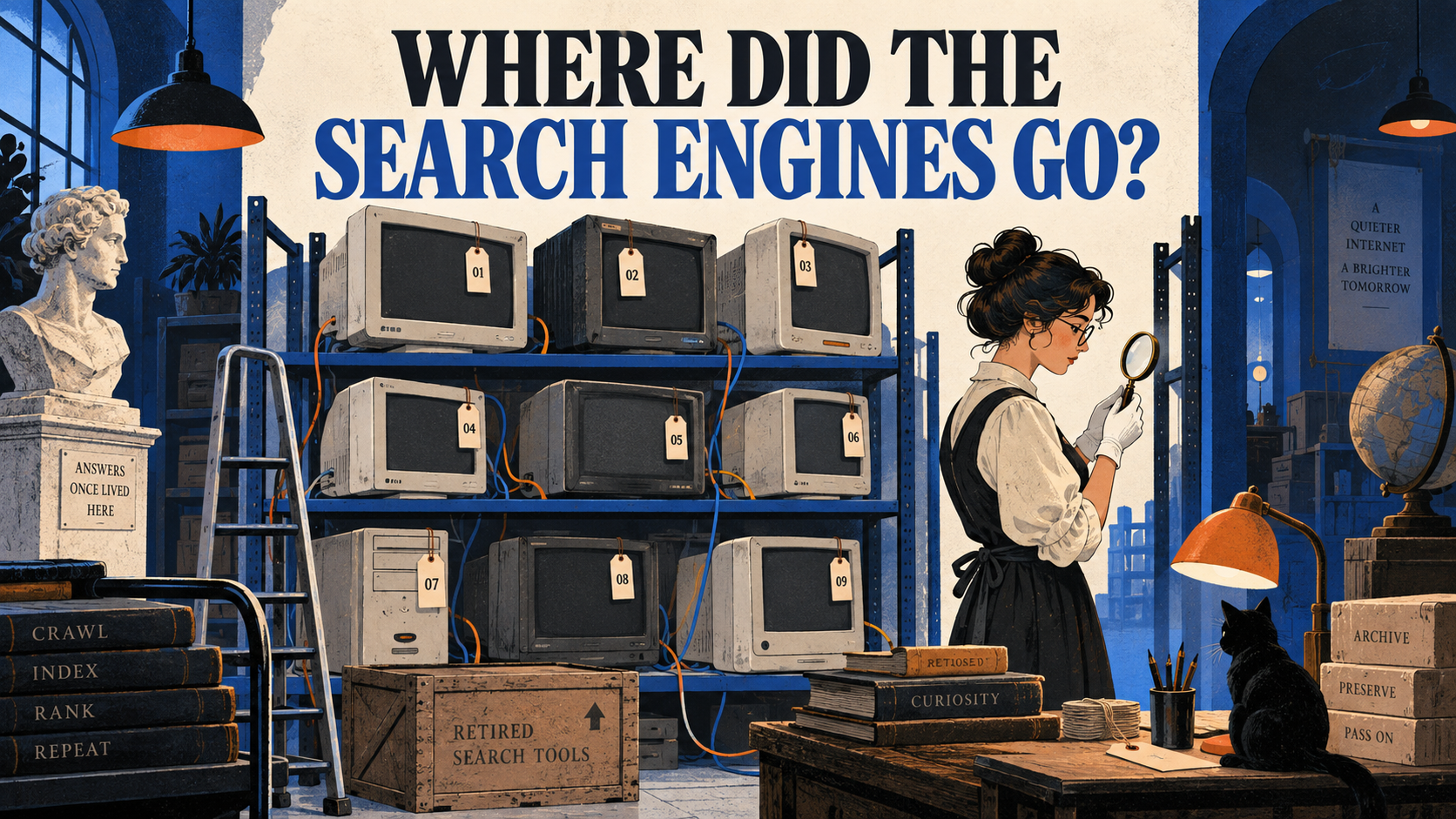
The old search-engine logos make a good reunion photo. The company history looks more like a seating chart after several divorces.
Yahoo used Google’s search results. AltaVista’s search business went to Overture, which then became part of Yahoo. Inktomi also ended up at Yahoo. Later, Yahoo agreed to use Microsoft’s search platform.
Following those connections explains what happened to old search engines more clearly than treating every logo as a product Google switched off.
Old search engines had different jobs
W3Catalog assembled information from existing web resource lists. Its creator’s history records operation from September 2, 1993 to November 8, 1996. The closure message pointed visitors toward larger alternatives, including AltaVista and HotBot. Oscar Nierstrasz, W3Catalog history.
A 1994 Lycos announcement described a catalog of 634,000 documents. That number measures material in an index at a particular moment. It says nothing by itself about monthly users or how satisfied a searcher was. Michael Mauldin, Lycos announcement, 1994.
Some companies built search technology to supply other websites. Others concentrated on the destination visitors recognized. Inktomi is a useful example of how much could happen behind another brand’s search box.
| Thing being counted | What it describes | What to ask |
|---|---|---|
| Indexed documents | Material stored or represented by an engine | When was the count taken, and what counts as a document? |
| Search queries | Requests submitted to a service | Does the total include partner sites? |
| Visitors | People or browser identities using a destination | Which population and measurement method? |
| Referrals | Clicks sent to websites | Which receiving sites are in the measurement network? |
Follow the search-engine family tree
Choose a branch. Each connection below is labeled as a supply agreement, an acquisition, or a closure, because those events have different consequences for the visitor.
Ownership: AltaVista’s search business
- AltaVista
- April 2003 purchaseOverture
- Q4 2003 acquisitionYahoo
Ownership: Inktomi
- Inktomi
- 2003 acquisitionYahoo
Search supply: June 2000 agreement
- Google results
- Default provider forYahoo search
Search supply: July 2009 agreement
- Microsoft / Bing
- To powerYahoo search
Where did the engine go?
June 2000: Yahoo chooses Google as its default search-results provider. Yahoo retains its directory and branded destination. This is a provider agreement.
Yahoo and Google · search supply
June 2000: Yahoo chooses Google as its default search-results provider. Yahoo retains its directory and branded destination. This is a provider agreement.
AltaVista → Overture → Yahoo · acquisitions
April 25, 2003: Overture completes its purchase of AltaVista’s business. Yahoo completes the Overture acquisition in the fourth quarter of 2003. These are ownership changes.
Inktomi → Yahoo · acquisition
UC Berkeley dates Inktomi’s founding to 1996 and Yahoo’s acquisition to 2003. This branch follows a search-technology company into a larger portal.
Yahoo and Microsoft · search supply
July 29, 2009: the companies announce an agreement under which Bing will power Yahoo search. Yahoo continues to control its visitor experience.
Lycos and Daum · ownership
Daum announces its plan to buy Lycos from Terra in August 2004. The agreement concerns the company and its assets, beyond the search box.
Ask.com · closure
Ask.com’s farewell notice records the service closing on May 1, 2026. A closure date belongs to that service, rather than every technology associated with its earlier history.
Sources for the branches: Google and Yahoo, search agreement, 2000, Yahoo and Overture, SEC merger filing, 2003, Yahoo, 2003 financial results and acquisition notes, UC Berkeley IPIRA, Inktomi history, Microsoft and Yahoo, search agreement, 2009, Daum, proposed Lycos acquisition, August 2004, Ask.com, farewell notice, May 2026.
Why Yahoo keeps appearing in the middle
Yahoo could buy search technology while continuing to operate as a recognizable destination with many other services. Its acquisition history and its visitor-facing product history need separate columns.
UC Berkeley records Inktomi’s founding in 1996 and its acquisition by Yahoo in 2003. Overture’s filing records the completed AltaVista transaction in April 2003. Yahoo’s financial records place its Overture acquisition in the fourth quarter of that year. UC Berkeley IPIRA, Inktomi history; Yahoo and Overture, SEC merger filing, 2003; Yahoo, 2003 financial results and acquisition notes.
That sequence is why a chart with separate AltaVista, Inktomi, Overture, and Yahoo logos can be misleading without dates. At some points the chart is displaying pieces of the same corporate structure.
| Date | Connection | Type |
|---|---|---|
| June 26, 2000 | Google supplies Yahoo search results | Provider agreement |
| 2003 | Yahoo acquires Inktomi | Acquisition |
| April 25, 2003 | Overture completes AltaVista business purchase | Acquisition |
| Q4 2003 | Yahoo completes Overture acquisition | Acquisition |
| July 29, 2009 | Microsoft and Yahoo announce search agreement | Provider and technology agreement |
The 2009 agreement kept Yahoo in charge of the experience on its own properties while assigning algorithmic search to Bing. A person could remain a Yahoo user and receive Microsoft-powered results. Microsoft and Yahoo, search agreement, 2009.
Ask Jim to review a change in your search referrals.
A vanished logo can mean several things
A brand can close, change owners, license another company’s index, or keep operating with a different purpose. “What happened to it?” needs a date and a description of which part of the business you mean.
Daum’s August 2004 announcement put a proposed $95 million price on Lycos. That number belongs to a specific transaction involving specific assets. Comparing it with another deal years earlier requires checking what each sale included. Daum, proposed Lycos acquisition, August 2004.
Ask.com gives us a clearer endpoint: its own farewell records May 1, 2026 as the closure date. Ask.com, farewell notice, May 2026.
A dated record prevents a common error in internet-history articles: describing a service as alive because an old article said it was, or describing it as dead because its logo stopped appearing in a favorite browser.
How to read a search-engine chart without mixing everything together
Start with the unit. Indexed documents, queries, visitors, and referral clicks answer different questions. A chart needs one of those names on the axis, together with its source and period.
Next, check the organization behind each series. A consumer brand may rely on another company’s search technology. The two names can both appear in a history while representing different parts of the same request.
Finally, keep announcements and completed transactions separate. An acquisition press release often describes a plan subject to approvals. A later filing can establish when it closed.
Those distinctions also help site owners interpret traffic. Record the referring service you can observe, then investigate its relationship with other providers when that helps explain a change. Avoid turning an uncertain provider relationship into a precise audience claim.
For the longer chronology, Gridlok’s search-engine history starts with earlier information retrieval and follows the development of web search. This family tree follows the deals behind the familiar names.
Sources and calculations
The family tree uses university histories, contemporary announcements, an SEC filing, company financial records, and a service closure notice. Each branch identifies the relationship type. Index counts retain their original date and unit.
Trying to explain a change in search referrals?
Send Jim the engines, dates, and pages involved. We can review the traffic patterns and identify which pages need attention.
Talk to Jim about search referralsFrequently asked questions
The June 2000 announcement was a search-provider agreement. Google supplied default search results for Yahoo.
Overture completed its purchase of AltaVista’s business in April 2003. Yahoo then acquired Overture later that year.
Inktomi developed search technology. Its importance includes the technology supplied behind other websites, as well as the company’s own history.
Index size counts documents. A market-share chart needs a defined audience or activity measure, such as queries or referrals, with a dated source.
Keep reading
References
- Oscar Nierstrasz, W3Catalog history
- Michael Mauldin, Lycos announcement, 1994
- UC Berkeley IPIRA, Inktomi history
- Google and Yahoo, search agreement, 2000
- Yahoo and Overture, SEC merger filing, 2003
- Yahoo, 2003 financial results and acquisition notes
- Daum, proposed Lycos acquisition, August 2004
- Microsoft and Yahoo, search agreement, 2009
- Ask.com, farewell notice, May 2026
See what ChatGPT is really searching
SubSeed captures the hidden Google queries ChatGPT runs behind every answer and enriches them with search volume, CPC, and keyword difficulty.
Related Posts

Read this post with an assistant
This is the whole prompt each button sends. Nothing hidden in it.
Read https://gridlok.co/blog/forgotten-search-engines/ and give me the main points in a few sentences.
Make Gridlok a Preferred Source on Google
See Gridlok surfaced more often in your Top Stories, AI Overviews, and AI Mode. One click, applied across Google Search.