AP2 and UCP: The Protocols Behind AI Agent Payments, Explained
When Google showed an AI agent buying something for you at I/O 2026, two new acronyms did the quiet work underneath: AP2 and UCP. They are the plumbing that lets an agent pay and check out without a human clicking through a website.
They are worth understanding if you sell anything, because they decide how an agent transacts with your store. Here is what each one is, in plain terms.
Key takeaways
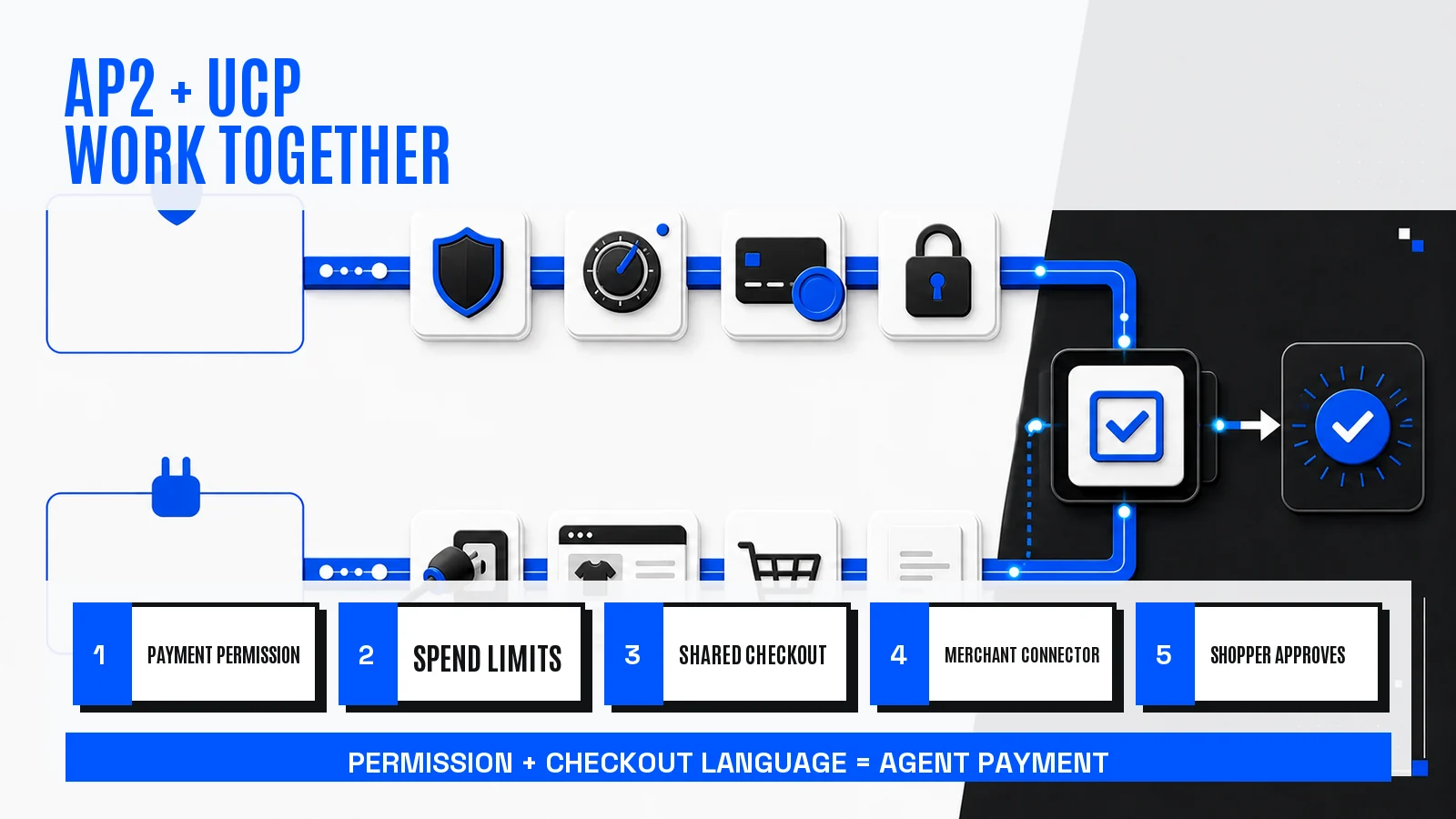
- AP2, the Agent Payments Protocol, is about money: it lets an AI agent pay on your behalf within limits you set on brands, products, and total spend.
- UCP, the Universal Commerce Protocol, is about language: it gives agents and merchant checkouts a shared way to talk, so one agent can buy at any participating store.
- Together they let an agent complete a real purchase, with Google Pay as one way to settle it, after the shopper approves.
- For merchants, supporting these standards is how you stay buyable in a world where agents, not just people, reach your checkout.
Why agent payments need new rules
An agent buying for you sounds simple until you ask the obvious questions. How does the store know the agent is allowed to spend your money? How does it talk to a checkout it has never seen? What stops it from buying the wrong thing?
Regular checkouts assume a human is clicking. Agents break that assumption, so the industry is building standards that let software pay safely and talk to any store. AP2 and UCP are Google’s answer.
What is AP2 (Agent Payments Protocol)?
AP2 is about authorization and payment. It is a way for an agent to pay on your behalf with guardrails you control.
You set the limits, which brands, which products, and how much the agent can spend, and AP2 only lets a purchase go through when those conditions are met. The point is to make an agent paying for you safe and bounded, not a blank check.
What is UCP (Universal Commerce Protocol)?
UCP is about communication. It gives agents and store checkouts a shared language so they can complete a transaction without a custom integration for every site.
Without something like UCP, every agent would need to learn every store’s checkout by hand. With it, one agent can buy at any participating merchant the same way. It is the difference between a private deal and a common standard.
How they work together
In a real purchase, the two play different roles.
UCP lets the agent and your checkout understand each other: the products, the options, the steps. AP2 handles the money, paying within the shopper’s limits, often settled through Google Pay. The shopper confirms the final details, and the purchase completes.
So UCP gets the agent to the checkout, and AP2 gets it through the checkout, safely.
What it means for merchants
You do not need to implement a protocol this afternoon. You do need to know where this is going.
As agents start doing more of the buying, supporting these standards, through your platform or payment provider, is how you stay reachable. A store an agent cannot transact with simply will not get the sale, no matter how good the product page looks to a human.
The groundwork is the same as for any agent: clean product data, accurate pricing and stock, and a checkout that is not a maze. For the wider merchant playbook, see how AI agents will buy from your store.
The bigger picture
AP2 and UCP are two pieces of a much larger agent rollout. For the full set of what Google launched at I/O 2026 and what it means, see Google I/O 2026: What Its AI Agents Actually Do.
FAQ
AP2 and UCP are not the exciting part of agentic shopping, but they are the part that makes it real. One lets an agent pay safely, the other lets it talk to any store.
The merchants that stay buyable will be the ones an agent can both understand and transact with. To see whether an agent can even read your store today, run the Agentic Readiness Check.
See what ChatGPT is really searching
SubSeed captures the hidden Google queries ChatGPT runs behind every answer and enriches them with search volume, CPC, and keyword difficulty.
Related Posts
Read this post with an assistant
This is the whole prompt each button sends. Nothing hidden in it.
Read https://gridlok.co/blog/agent-payment-protocols/ and give me the main points in a few sentences.
Make Gridlok a Preferred Source on Google
See Gridlok surfaced more often in your Top Stories, AI Overviews, and AI Mode. One click, applied across Google Search.