AI Shopping Assistants: How to Get Your Products Recommended in 2026
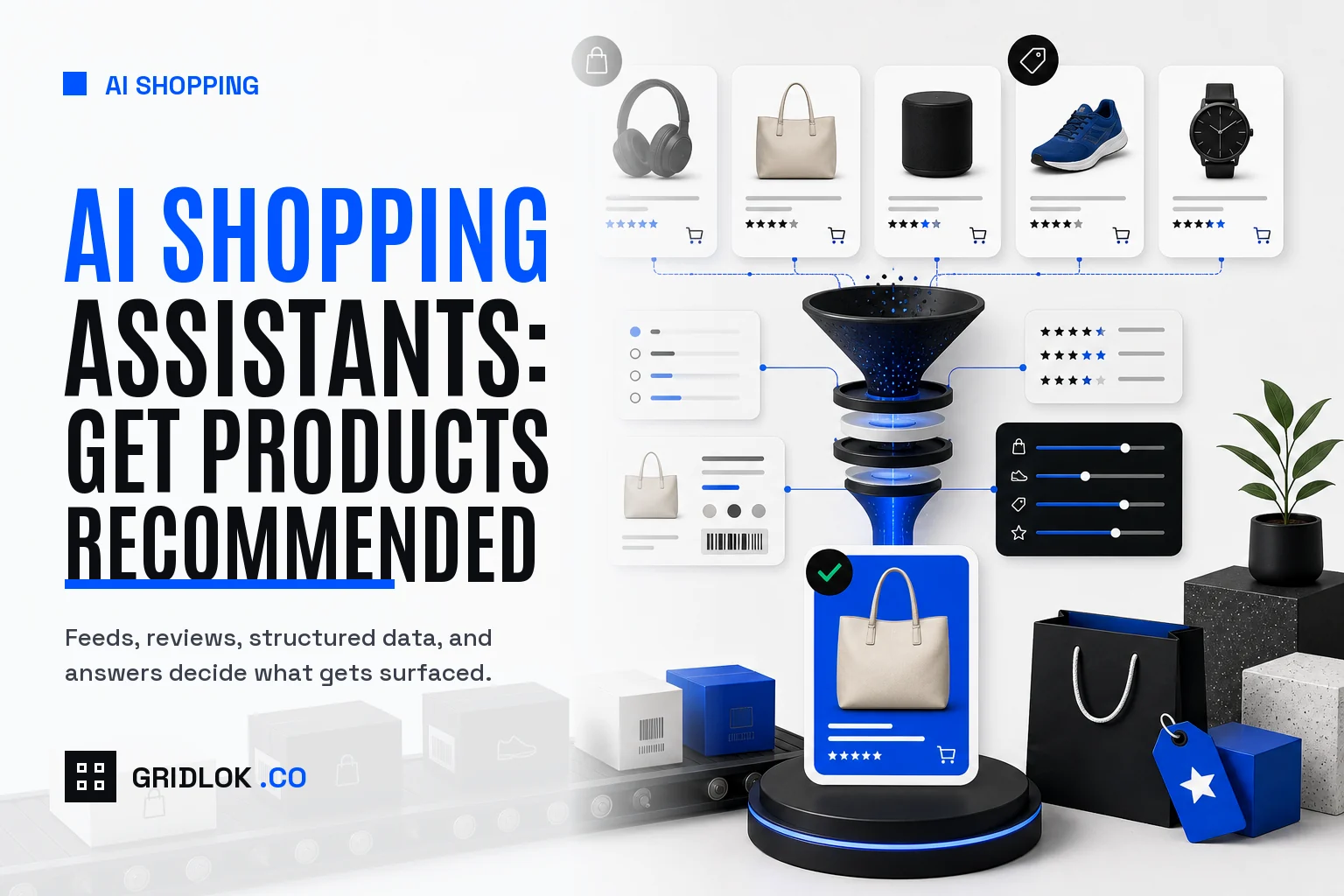
An AI shopping assistant is the tool that answers “find me the best one of these under $X” with a short list instead of ten blue links. More shoppers are starting there, and the assistant, not your homepage, is making the first cut.
These now live inside Google, ChatGPT, Perplexity, and Amazon, and they work in roughly the same way. If you sell anything online, it is worth knowing how they pick, and how to be picked.
Key takeaways
- An AI shopping assistant researches products for a buyer and returns a recommendation, often before the person visits any store.
- They pull from product feeds, structured data, reviews, and the open web, so your data quality decides whether you show up.
- Google, ChatGPT, Perplexity, and Amazon each run their own version, but the inputs that get you recommended are largely the same.
- Being recommended comes down to clean feeds, accurate structured data, genuine reviews, and content that answers the buyer’s real question.
What is an AI shopping assistant?
An AI shopping assistant is software that does product research for a shopper and hands back a recommendation. You describe what you want in plain language, and it returns specific products with reasons, instead of a page of links to sort through yourself.
The point is fewer steps. The assistant reads the options, weighs them against what you asked, and narrows it down. You decide from a short list it built.
Where they live now
These assistants are not one product. The main ones in 2026:
- Google: a Universal Cart plus agentic checkout, with the assistant built into Search and the Gemini app.
- ChatGPT: product research and recommendations inside the chat, with shopping results and links.
- Perplexity: answer-style shopping with sources, aimed at quick comparisons.
- Amazon: Rufus, an in-store assistant that answers questions and suggests products while you shop.
Different front doors, same basic job: read the options, recommend a few.
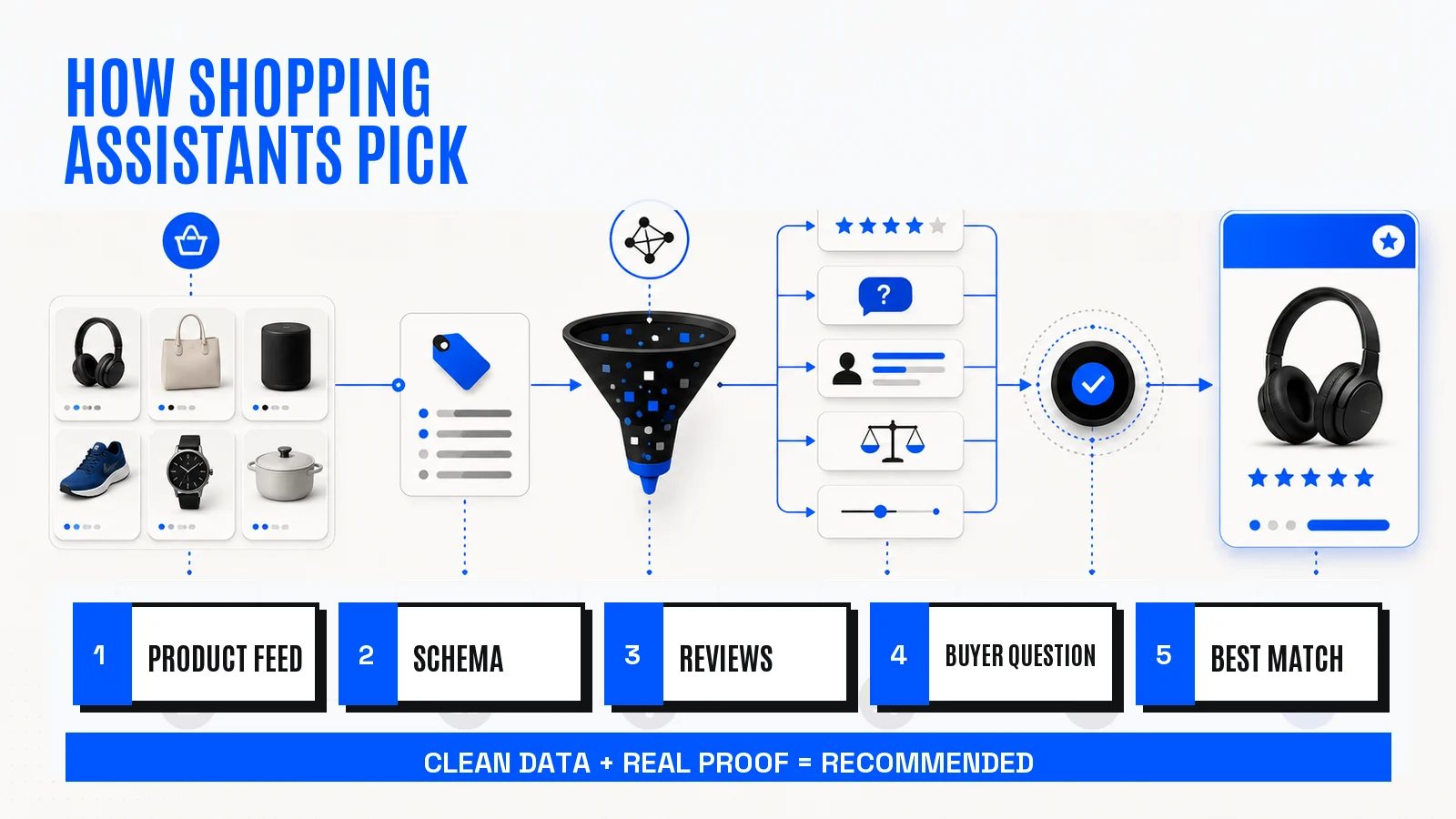
How they decide what to recommend
Each assistant has its own recipe, but the ingredients overlap a lot.
- Product feeds: the structured catalog you submit, with titles, prices, availability, and attributes.
- On-page structured data: Product, Offer, and Review schema that states your facts so software can read them.
- Reviews and ratings: real quality signals the assistant can weigh, on your site and off it.
- Content that answers the question: pages that address the buyer’s actual need, not just a spec sheet.
- Freshness and accuracy: current pricing and stock, since a wrong detail gets you dropped.
How to get your products recommended
None of this is exotic. It is the same data hygiene that already helps you in search, done well.
- Submit a complete, accurate product feed wherever your buyers’ assistants look, starting with Google Merchant Center.
- Mark up your product pages with Product, Offer, and Review structured data.
- Earn and show real reviews. Assistants lean on them, and so do buyers.
- Write for the question, not the keyword. Cover sizing, comparisons, compatibility, and the things people actually ask.
- Keep it accurate. A wrong price or stock status is the fastest way to lose the recommendation.
The bigger picture
Shopping assistants are one face of a broader move toward agents that act for people. When the assistant also checks out for the buyer, you are into agentic commerce, which has its own playbook.
For the whole picture of Google’s agent push, see Google I/O 2026: What Its AI Agents Actually Do.
FAQ
AI shopping assistants are changing the first step of buying, from a search you scan to a recommendation you are handed. The way to stay in it is unglamorous and familiar: accurate feeds, readable pages, and real reviews.
If you want to see how an AI reads one of your product pages right now, the AI Summary Preview shows you.
See what ChatGPT is really searching
SubSeed captures the hidden Google queries ChatGPT runs behind every answer and enriches them with search volume, CPC, and keyword difficulty.
Related Posts

Read this post with an assistant
This is the whole prompt each button sends. Nothing hidden in it.
Read https://gridlok.co/blog/ai-shopping-assistant/ and give me the main points in a few sentences.
Make Gridlok a Preferred Source on Google
See Gridlok surfaced more often in your Top Stories, AI Overviews, and AI Mode. One click, applied across Google Search.