Agentic Commerce: How AI Agents Will Buy From Your Store (and How to Be Ready)
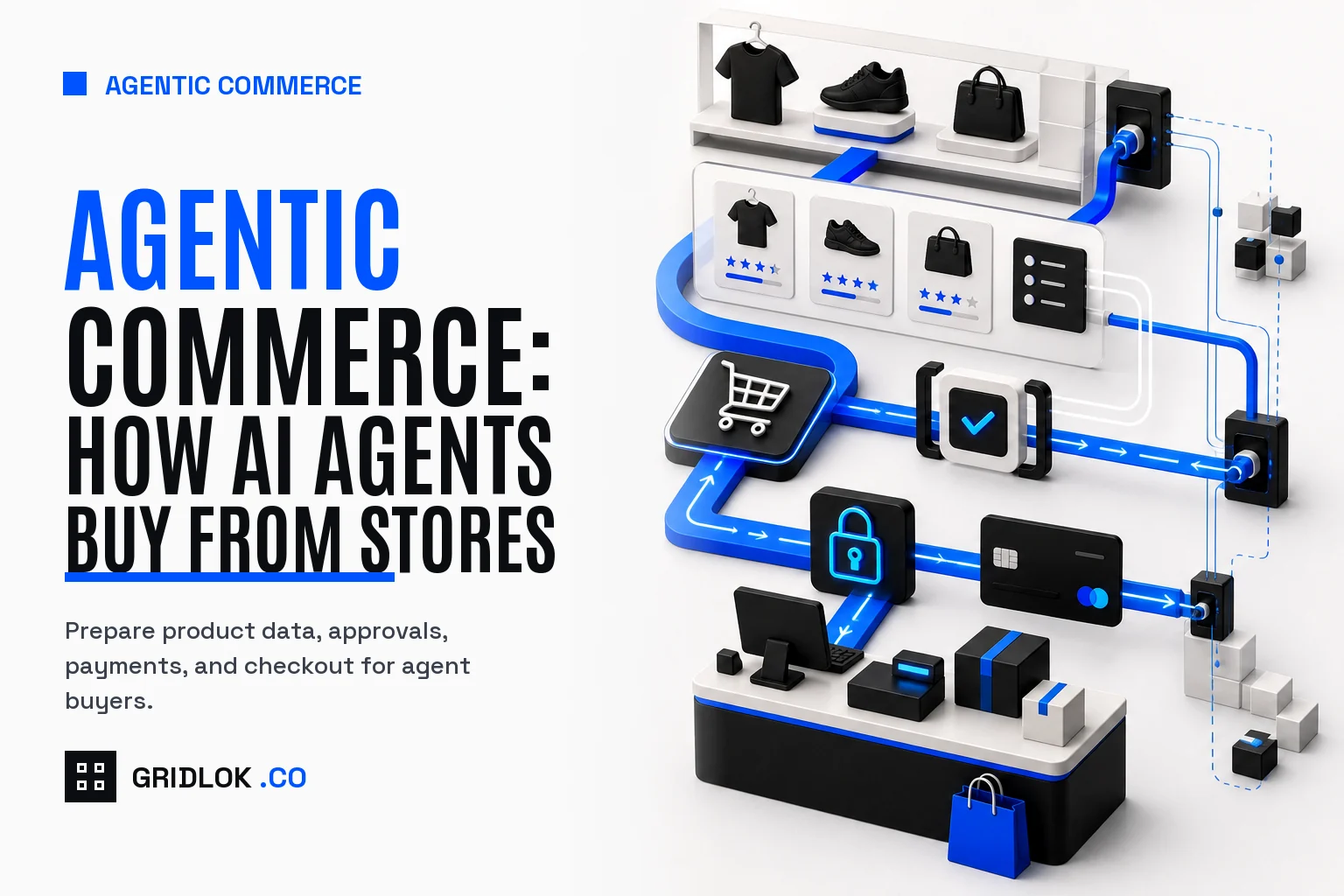
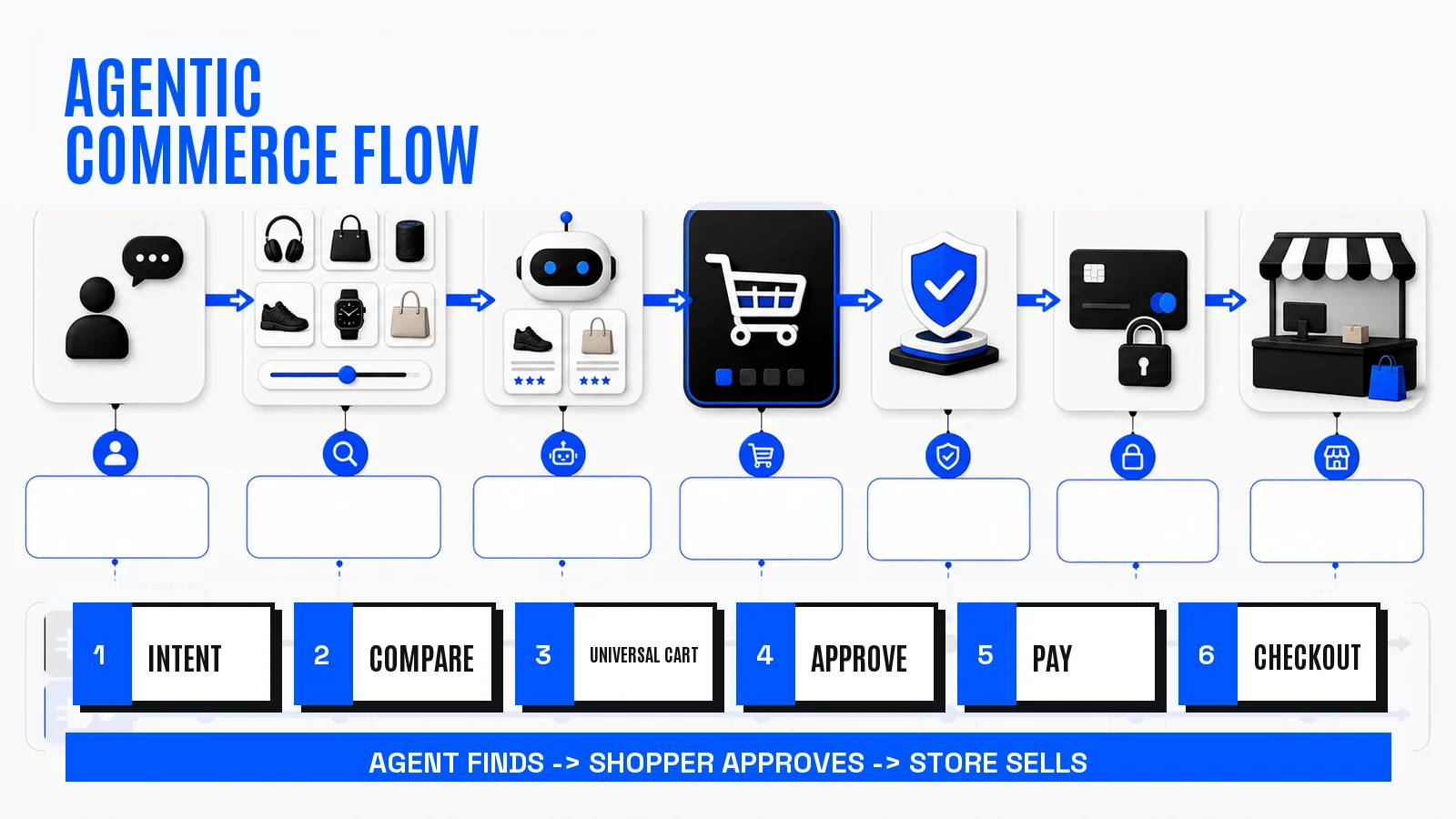
Agentic commerce is a clean name for a messy shift: people are starting to let AI agents do their shopping. The agent finds the product, compares the options, and increasingly completes the purchase, while the person just approves it.
Google made this concrete at I/O 2026 with a Universal Cart and an agent that can check out for you. So it is worth understanding how it works and what it asks of your store.
Here is the plain version, and the parts a merchant actually needs to act on.
Key takeaways
- Agentic commerce means an AI agent handles the search, the comparison, and often the checkout, with the shopper approving rather than clicking through every step.
- Google’s Universal Cart follows the shopper across Search, Gemini, YouTube, and Gmail, and can complete a purchase on your site with Google Pay.
- Two new standards sit underneath: AP2 (Agent Payments Protocol) for secure agent payments with spend limits, and UCP (Universal Commerce Protocol) so agents can talk to any merchant’s checkout.
- If an agent makes the purchase, your product page, reviews, and upsells may never get seen, so the win moves from the click to being the product the agent picks.
- Getting picked comes down to clean product data: an accurate feed, structured data, truthful availability and pricing, and eligibility for the new checkout flows.
What is agentic commerce?
Agentic commerce is shopping carried out by an AI agent on a person’s behalf. Instead of browsing and buying themselves, the shopper gives an agent a goal, find the right one of these under this price, and the agent does the searching, the comparing, and, when allowed, the buying.
The human stays in control by setting the rules and approving the final purchase. The agent handles the legwork in between.
How Google’s version works: Universal Cart, AP2, and UCP
Google’s I/O 2026 launch is the clearest example so far, and it has three parts.
The Universal Cart is one cart that travels with the shopper across Search, the Gemini app, YouTube, and Gmail. It tracks price history, flags restocks, and warns about products that will not work together.
If your store is eligible, Google can finish the checkout on your own site with Google Pay, after the shopper confirms price and shipping. The agent handles the steps, the person signs off.
Underneath, AP2, the Agent Payments Protocol, lets an agent pay within hard limits the shopper sets on brands, products, and total spend. UCP, the Universal Commerce Protocol, gives agents and store checkouts a shared language, so one agent can complete a purchase at any participating merchant.
It is rolling out in the US first, then Canada and Australia, then the UK, with YouTube checkout close behind.
What this changes for merchants
Here is the uncomfortable part. If an agent does the buying, a lot of what you optimized for stops mattering.
The shopper may never land on your product page, never read the reviews you collected, never see the related-items upsell. The decision happens a layer above your site, inside the agent.
So the contest moves. You stop competing only for the click and start competing to be the product the agent selects and can actually transact with.
How to get your store ready
- Get your product feed clean and complete. Accurate titles, prices, availability, GTINs, and attributes in Google Merchant Center are what an agent reads first.
- Add Product structured data on your pages (price, availability, reviews, shipping) so the facts are machine-readable, not trapped in images.
- Keep availability and pricing truthful in real time. An agent that hits a wrong price or an out-of-stock surprise drops you fast.
- Make sure you are eligible for the new checkout flows where they fit, so an agent can complete a purchase with you, not just window-shop.
- Check that an AI can read your product pages at all. The Agentic Readiness Check is built for that.
Where this fits in Google’s bigger agent push
Agentic commerce is one slice of a much wider set of agent announcements at I/O 2026. For the full map, see Google I/O 2026: What Its AI Agents Actually Do.
And if you sell products, the companion question is how shoppers find you in the first place: AI shopping assistants and how to get your products recommended.
FAQ
Agentic commerce is early, but the direction is set. More of the buying moves to an agent, and your job shifts from winning the click to being the product it can find and trust.
The unglamorous work, clean feeds and readable pages, is what gets you there. To see whether an agent can read and use your store today, run the Agentic Readiness Check.
See what ChatGPT is really searching
SubSeed captures the hidden Google queries ChatGPT runs behind every answer and enriches them with search volume, CPC, and keyword difficulty.
Related Posts
Read this post with an assistant
This is the whole prompt each button sends. Nothing hidden in it.
Read https://gridlok.co/blog/agentic-commerce/ and give me the main points in a few sentences.
Make Gridlok a Preferred Source on Google
See Gridlok surfaced more often in your Top Stories, AI Overviews, and AI Mode. One click, applied across Google Search.