How to Get Recommended by Gemini Spark: A DeWalt Test
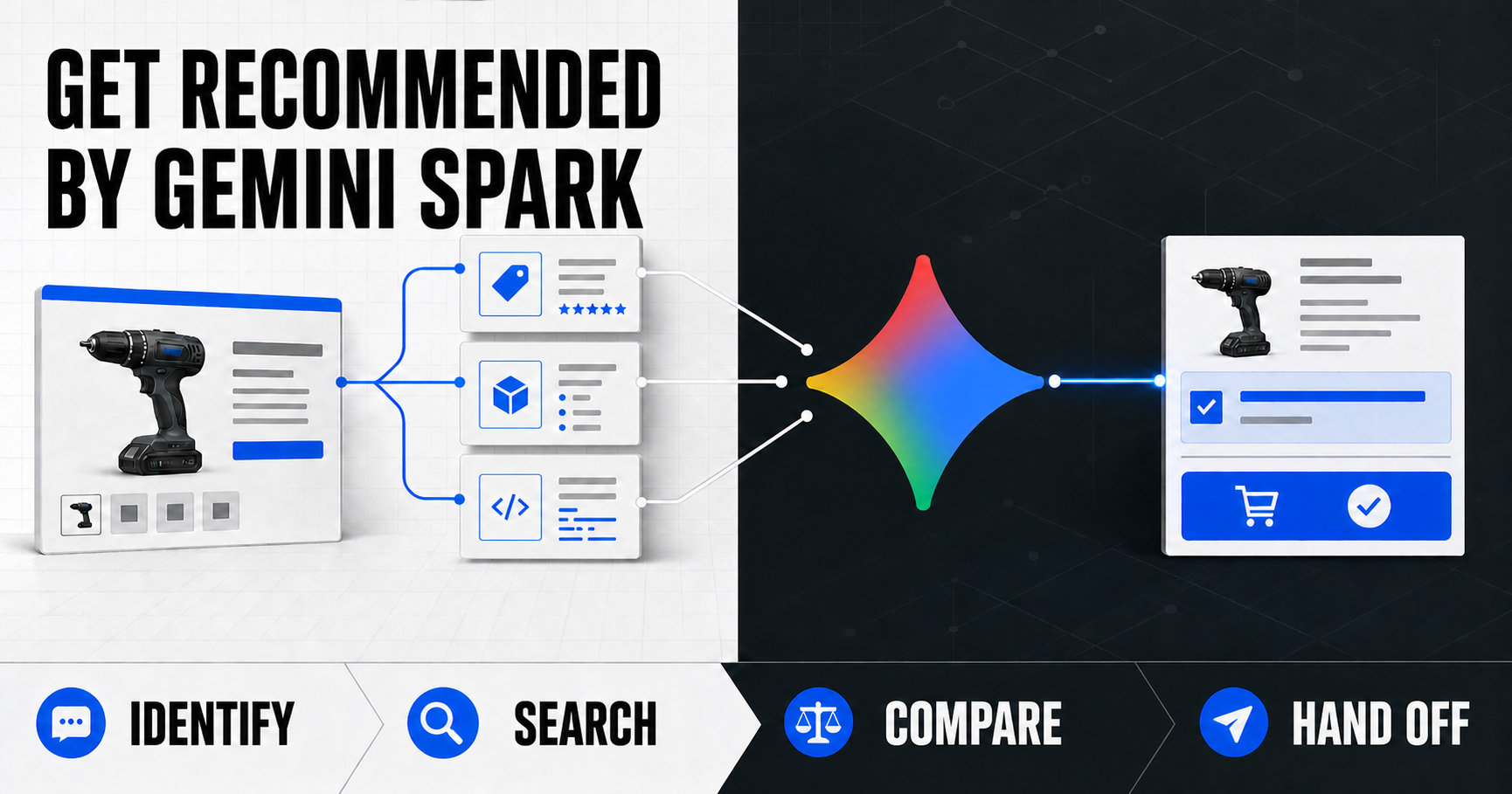
I gave Gemini Spark a five-word task: “Cheapest DeWalt DCD800, check daily.”
Spark turned that prompt into a recurring price watch. Before it compared offers, it expanded DCD800 into separate configurations, including the DCD800B bare tool and the DCD800D2 kit.
For the DCD800D2, Spark returned linked offers from Bomgaars, Town and Country Hardware, and The Tool Nut. Home Depot appeared in the search plan but not in the visible offer list.
This was a known-product search, so Spark was comparing offers for a model family. A query such as “best compact drill for cabinet installation” would add a separate product-selection step that this test did not measure.
The reasoning trace shows Google Search and Schedules, but not which structured-data fields, Merchant Center records, or other Google systems supplied a result. Google documents how to expose product facts to Search and merchant surfaces. It does not publish a Spark ranking formula.
Key takeaways
Exact product identity comes first
Spark separated the DCD800B bare tool from the DCD800D2 kit before comparing offers. Retailer pages need to state the exact configuration and package contents.
Spark used Google Search to find sellers
The trace shows Spark using Google Search to research sellers. Crawlable, indexable product URLs are the documented foundation for visibility in Google Search.
The source and seller can differ
Spark described DeWalt as a technical reference while retailer pages supplied live offers. A product source does not have to be the seller.
The retailer still has to close the sale
The visible test stopped at linked offers. The retailer must preserve the configuration, price, stock, condition, currency, and disclosed terms through checkout.
Spark turned five words into a recurring price watch
Spark described three core jobs: resolve the exact product and configuration, search several types of sellers, then check condition and availability before comparing prices. Its completed task also saved direct links and scheduled the search to run again.
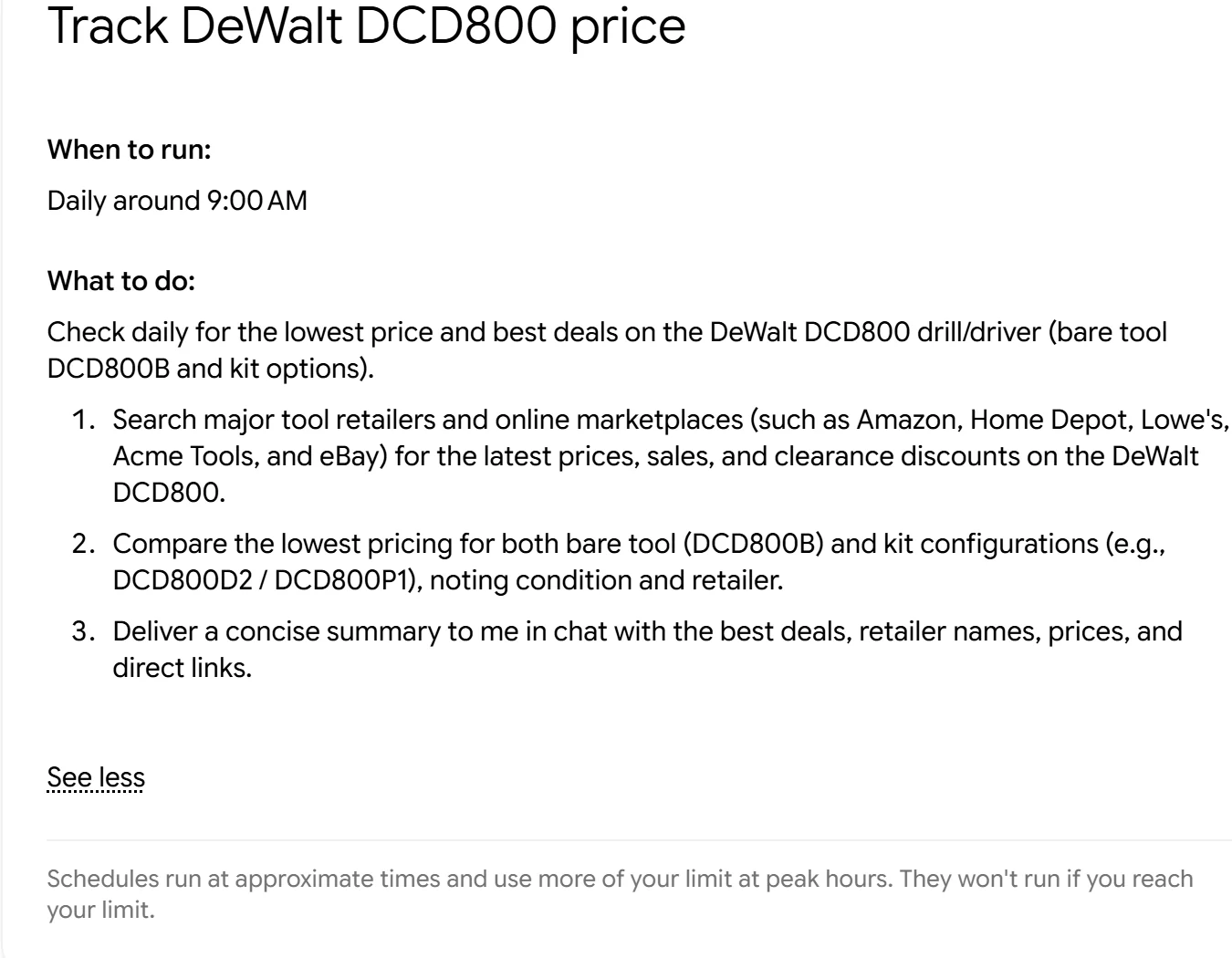
Identify
Turn the prompt into a recurring task and separate the bare tool from each kit.
Search
Use Google Search to look across several seller types.
Check and compare
Record the configuration, condition, retailer, availability, price, and direct link.
Return and repeat
Return linked retailer offers and run the saved task again on schedule.
Reconstructed from one task’s saved instructions, visible result, reasoning trace, and later explanation in August 2026. The landing page and checkout are the retailer’s responsibility after Spark returns the offer link.
Spark separated the bare tool from the kit
“DCD800” is a model family, not one purchasable item. Spark separated the DCD800B bare tool from the DCD800D2 kit before it compared prices.
The DCD800D2 kit includes batteries, a charger, and a bag; the DCD800B does not. A retailer page labeled only “DCD800” would hide the same distinction Spark made, leaving the configuration unresolved on the seller page.
Make the configuration explicit in the title tag, H1, opening description, and product details. Include the full brand and model number, then state what comes in the box in visible text. Product photos can support those details, but they should not carry information missing from the page copy.
Use the manufacturer-assigned gtin, the correct mpn, and your own stable sku. Do not reuse the bare-tool identifiers for a kit or invent an identifier that the manufacturer did not assign.
Each purchasable configuration needs a URL that opens with the correct image, price, availability, and Add to Cart state already selected. A parameterized URL is fine when it reliably opens that state.
Use ProductGroup only for genuine variants that fit Google’s supported implementation. A bare tool and a kit have different contents and identifiers, so they should not be grouped automatically as variants.
Merchant Center’s variant_option attribute is explicitly intended for conversational AI and traditional Search. Use it with item_group_id and item_group_title when the products are true variants, and make every value match the landing page.
Spark used Google Search to find sellers
The reasoning trace shows Spark calling Google Search for price research and Schedules for the repeat task. Spark later said it searched big-box retailers, authorized distributors, specialty stores, and marketplaces.
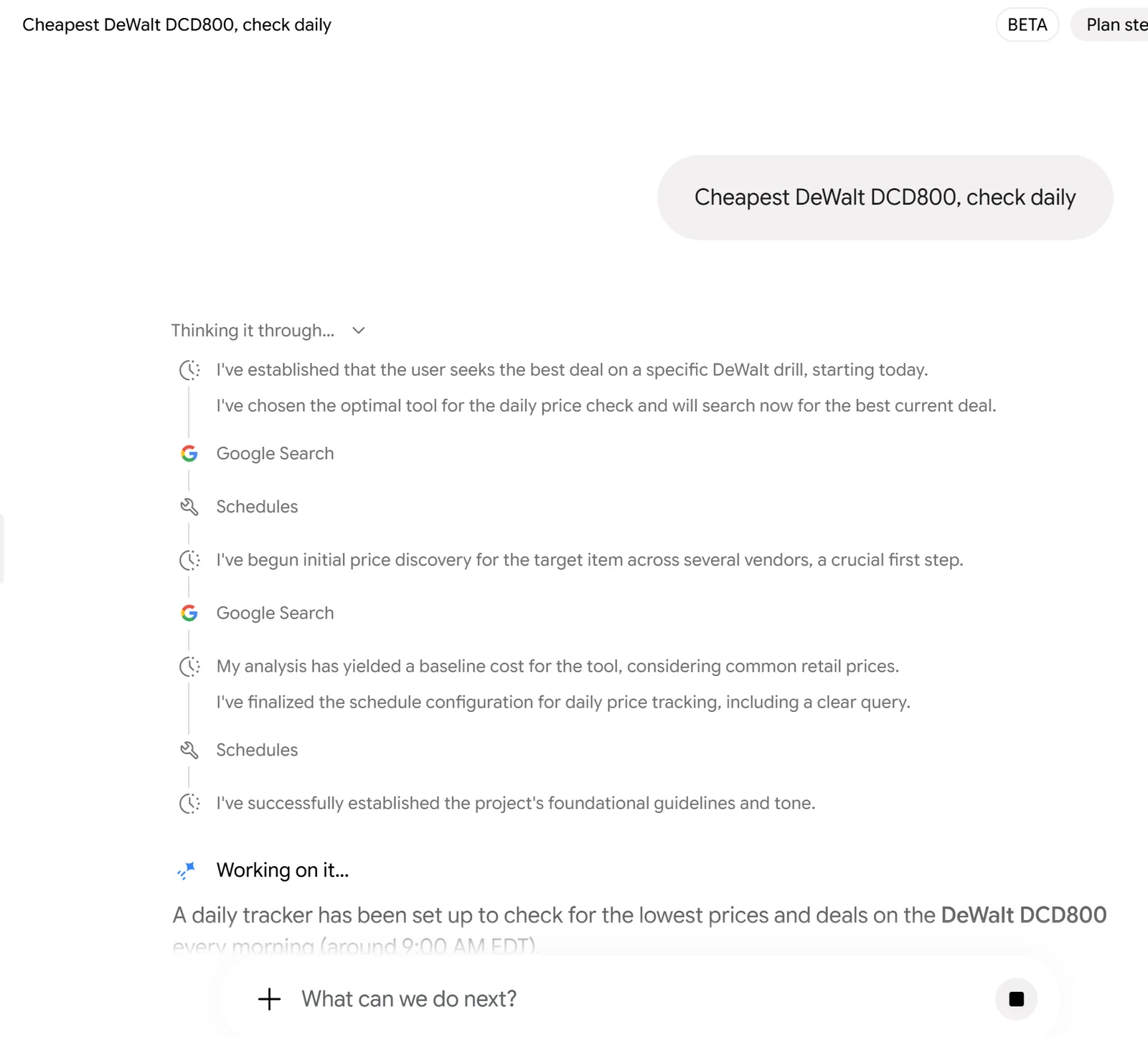
Google Search was Spark’s route into seller research. A retailer page that Google cannot crawl or index cannot enter that route through its own URL.
Return a 200 response and point canonical signals to the preferred product URL. To appear as a supporting link in Google’s generative Search features, the page must also be eligible to show a snippet.
Link priority products from crawlable category, brand, buying-guide, and related-product pages. Do not leave a product reachable only through an internal search box, a zip-code selector, or an infinite-scroll interaction. Add the canonical product URL to the XML sitemap.
Use anchor text that names the product or product type. “DeWalt DCD800 drill kits” gives Google more context than “view item.”
Google says Merchant Center free listings can appear in Gemini. The trace does not reveal whether a feed supplied the offers in this Spark task.
Submit the catalog to Merchant Center and add matching product structured data so Google has a current inventory record beside the product page. Google recommends using both because the feed supplies a direct inventory list and gives the merchant more control over update timing.
Spark recorded a retailer beside every offer. On the seller page, keep that identity consistent and easy to verify through the business name, About page, contact information, shipping policy, return policy, warranty terms, and accurate authorized-dealer status.
Spark checked whether each offer could be used
Spark’s task instructions told it to record the configuration, condition, retailer, price, and direct link. Spark also described an availability check before the price comparison.
In a later explanation, Spark said it checked those facts before it compared prices. Show the current price, currency, stock status, condition, and purchase button for the selected configuration without making the shopper choose a store or add the item to a cart first.
“In stock” should mean that the exact item can be added to the cart and fulfilled. Preorders and backorders need the correct availability value and a visible availability date. Store-specific, regional, member, and promotional prices need their conditions beside the price.
Google can encounter the same offer on the page, in structured data, and in Merchant Center. Conflicting values make the product identity, price, or stock state ambiguous.
Google documents corresponding fields for product identity, URL, image, price, stock, condition, and variants across Search and merchant surfaces. The test does not show Spark reading any one field directly.
| Journey step | Visible page | Structured data | Merchant Center |
|---|---|---|---|
| Identify the item | Full model, configuration, package contents | name, sku, mpn, gtin, brand | title, id, mpn, gtin, brand |
| Open the configuration | Preselected URL, image, cart state | Offer.url, Product.image | link, image_link, canonical_link |
| Compare the price | Current price and currency | Offer.price, priceCurrency | price |
| Check availability | Stock message and applicable date | Offer.availability | availability, availability_date |
| Check condition | New, used, open-box, or refurbished | Offer.itemCondition | condition |
| Relate true variants | Consistent variant names and values | ProductGroup, variesBy | item_group_id, item_group_title, variant_option |
These are documented Google product-data fields. They are implementation guidance, not disclosed Spark ranking signals.
Put the core offer data and markup in the initial HTML when practical, especially price and availability. Google warns that JavaScript-generated product markup can make Shopping crawls less frequent and less reliable.
Use the same inventory and pricing source for the page, feed, cart, and checkout. Fast-moving catalogs need scheduled feed uploads or the Merchant API rather than waiting for a recrawl.
Spark compared the DCD800D2 offers
Spark returned three DCD800D2 offers: Bomgaars at $119.99, Town and Country Hardware at $179.25, and The Tool Nut at $203.15.
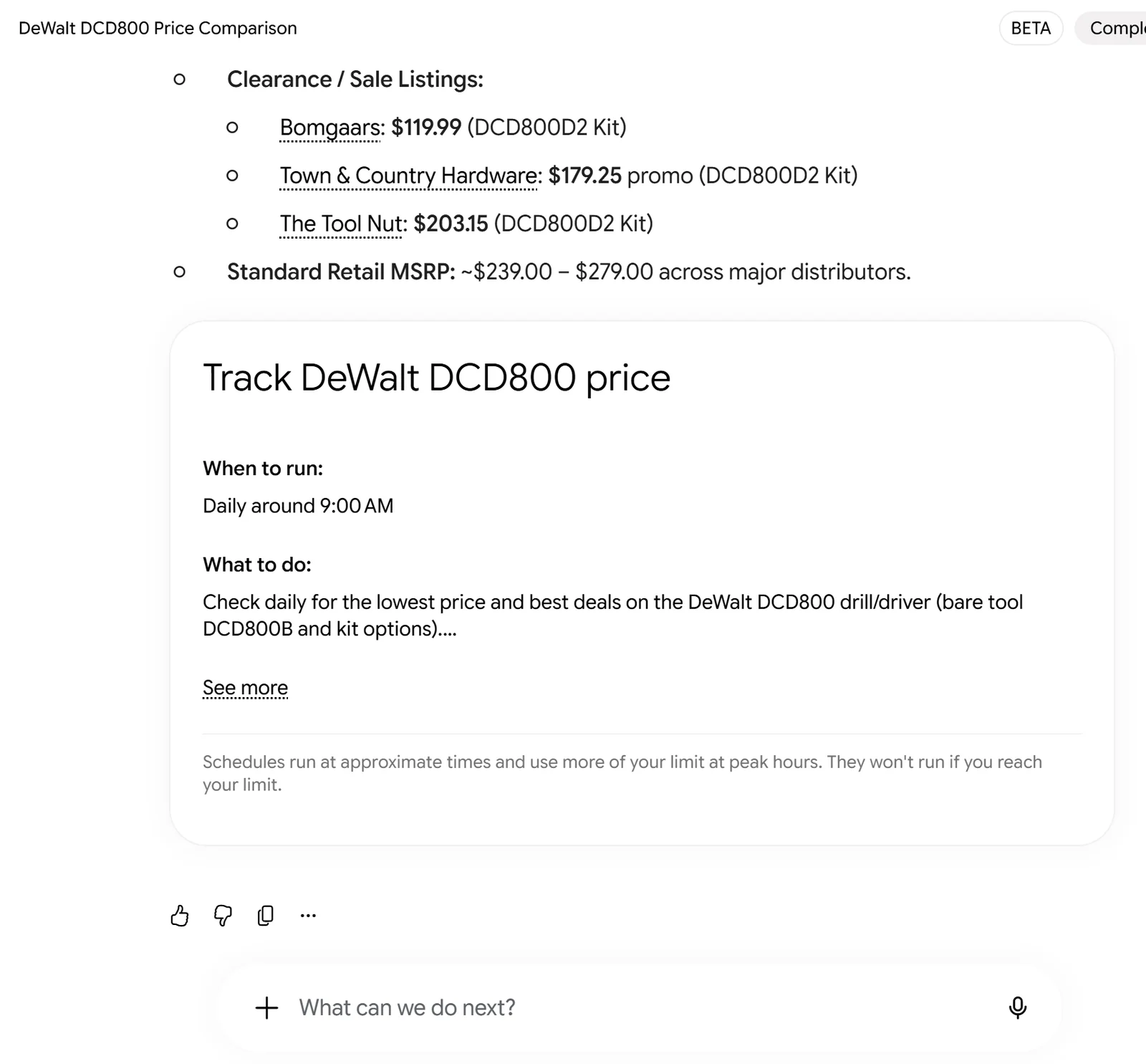
Home Depot was named in Spark’s search plan but did not appear in the visible offer list. In a follow-up, Spark attributed the omission to a $239 price and an out-of-stock result. It did not say how much weight it gave either factor.
Returned offer
Returned offer
Returned offer
Follow-up: not returned
Source: Gridlok first-hand Gemini Spark test, August 2026. The three blue bars are visible linked results. The Home Depot price and stock explanation came from a follow-up response.
Spark said it normalized offers before comparing them. It displayed free delivery for one seller and a delivery date for another, but the test does not show whether either detail changed the order.
The results put a regional farm-supply seller beside specialist tool retailers. One run cannot establish why those sellers were retrieved or how retailer size affected the result.
Spark displayed price and delivery details before the shopper opened a retailer page. The seller page should make the same terms available before checkout.
Show the current item price and currency beside the offer. Put shipping cost or its calculation, delivery timing, pickup limits, quantity rules, membership requirements, and promotion restrictions where the shopper can find them.
Publish the standard shipping policy at the organization level. Use offer-level shipping details only when a specific product differs from the standard policy.
Spark used DeWalt as a source and retailers as sellers
Spark can use one page for product facts and another page for the purchase. Spark described DeWalt’s non-transactional product page as a technical reference while the retailer pages supplied live prices and checkout.
Support the answer
Publish exact specifications, compatibility, package contents, manuals, warranty terms, original tests, and a clear method for first-hand claims.
Earn the retailer link
Sell the exact configuration with a visible price, current stock, direct URL, working purchase button, disclosed conditions, and usable checkout.
A page can fill both roles when it contains authoritative product information and a live offer that the page owner sells directly.
DeWalt filled the source role with technical product information rather than a checkout. Manufacturers seeking the same role should publish exact specifications, model identity, package contents, compatibility data, manuals, warranty details, and answers to real product questions.
If the manufacturer also sells direct, it can compete for the retailer link by publishing current inventory, a visible price, and a working checkout. A manufacturer that sends buyers to dealers instead should keep its authorized-retailer links visible and crawlable.
The visible Spark output in this test was a linked offer list, not a conventional citation panel. Track a source citation, a retailer link, and a completed sale as separate outcomes.
The retailer page has to preserve Spark’s offer
The test stopped at the linked offers, so it did not record the landing-page state, cart, checkout, or purchase. Spark returned linked offers, and each URL should preserve the exact offer it represented.
The purchase URL should open the exact configuration Spark named. The image, price, currency, availability, condition, and purchase button should be correct before the shopper changes a setting.
If Spark quotes $119.99 and the page opens at $179, the shopper cannot buy the offer Spark found. The same failure occurs when a kit link opens the bare tool, an in-stock result opens an unavailable item, or a pickup-only restriction stays hidden until checkout.
Keep newsletter pop-ups, location prompts, and app banners away from the product name, price, stock message, and purchase button. Avoid redirects that reset the selected variant or currency.
A page can preserve the right offer and still block a browser agent if its controls cannot be identified or operated. Use real <button> and <a> elements, connect labels to form fields, and make interface changes visible in the accessibility tree.
Checkout has to carry the same offer to payment
The landing page preserves the offer only until Add to Cart. Checkout has to carry the same product state through payment.
The cart must keep the same SKU, quantity, condition, currency, and disclosed terms. The quoted product price must not increase after Add to Cart. A valid promotion may lower it.
- Disclose shipping charges, delivery timing, mandatory fees, minimum-order rules, pickup limits, and membership requirements before payment.
- Publish the standard return policy at the organization level, attach product-specific exceptions to the offer, and keep the terms easy to reach.
- If account creation is required, keep signup free and straightforward.
- Use HTTPS throughout checkout and payment handling.
Test your product pages with Spark
Updated 29 September 2026. A price watch no longer needs a Spark subscription. On September 28, Google opened AI Mode’s info monitoring to everyone, free, in the Google app, and back-in-stock and price-drop alerts were among Google’s own examples. It checks Google’s Shopping Graph of more than 60 billion products alongside live web sources, so any shopper can now set up the kind of daily watch this test gave Spark. AI Mode may choose sellers differently than Spark did here, so run the steps below through both.
Run the same known-product task for a small group of priority products. Name the brand and model family, then keep the prompt, location, and timing as stable as possible. Prices, inventory, Search results, and Spark itself can still change between runs.
Record how Spark separates models, kits, quantities, and conditions. Save every returned seller, direct link, price, stock message, shipping detail, and delivery estimate.
Open each retailer link in signed-out mobile and desktop browsers. Confirm that it loads the exact configuration Spark named, then carry the item through the cart and checkout.
When a seller is missing or unexpected, ask Spark why it was included or left out. Treat the response as a clue for that run, fix one product-data or landing-page issue, and rerun the same task.
Track source citations, retailer links, product views, Add to Cart events, checkout starts, errors, and purchases as separate outcomes. A Spark rerun shows which links it returned, but it cannot diagnose Search retrieval, feed errors, or conversion by itself.
Use Search Console and Merchant Center to diagnose Search and product-data problems. Use site analytics to determine whether a retailer link produced a sale. Call the data Spark performance only when it identifies Spark traffic directly.
FAQ
Sources
- First-hand Gemini Spark test, August 2026, covering the task instructions, reasoning trace, visible results, and later explanations about methodology, DeWalt’s source role, and the missing Home Depot offer.
- Google Gemini, Gemini Spark overview, for Spark’s agent and scheduling capabilities.
- Google Search Central, Optimizing your website for generative AI features on Google Search, for the connection between ordinary Search eligibility and Google’s generative features.
- Google Search Central, Help Google understand your ecommerce site structure, for crawlable navigation and product-page visibility.
- Google Search Central, Share your product data with Google, for using product structured data and Merchant Center together.
- Google Search Central, Merchant listing structured data, for
Product,Offer, price, availability, condition, shipping, and return-policy fields. - Google Search Central, Product variant structured data, for distinct variant URLs and supported
ProductGrouprelationships. - Google Merchant Center, Variant option, for
variant_option,item_group_id, anditem_group_titlein conversational AI and traditional Search. - Google Merchant Center, Free listings for products, for product eligibility across Google surfaces including Gemini.
- Google Merchant Center, Landing page requirements and Checkout requirements and best practices, for variant, price, availability, fees, currency, and checkout consistency.
- web.dev, Build agent-friendly websites, for semantic controls, accessible labels, and stable browser-agent interactions.
See what ChatGPT is really searching
SubSeed captures the hidden Google queries ChatGPT runs behind every answer and enriches them with search volume, CPC, and keyword difficulty.
Related Posts


Read this post with an assistant
This is the whole prompt each button sends. Nothing hidden in it.
Read https://gridlok.co/blog/spark-dewalt-price-test/ and give me the main points in a few sentences.
Make Gridlok a Preferred Source on Google
See Gridlok surfaced more often in your Top Stories, AI Overviews, and AI Mode. One click, applied across Google Search.