What Google’s New AI Optimization Guide Actually Says (and What It Leaves Out)
Google’s new AI Optimization Guide landed in Search Central on May 15, 2026, and it’s the first official, vendor-neutral document the company has published on how to show up in AI Overviews and AI Mode. It also debunks five popular tactics the AEO and GEO industry has been selling for the past 18 months. That’s the part that’s going to dominate SEO Twitter for the next week.
What’s getting less attention is the list of topics Google chose not to address at all. EEAT, author markup, passage optimization, freshness signals, and citation mechanics, all of which dominate the current GEO conversation, are absent from the guide. Their absence is itself a signal.
This is the complete breakdown: what the guide says, what it explicitly debunks, what it quietly leaves out, and what to actually do this week.
Key Takeaways
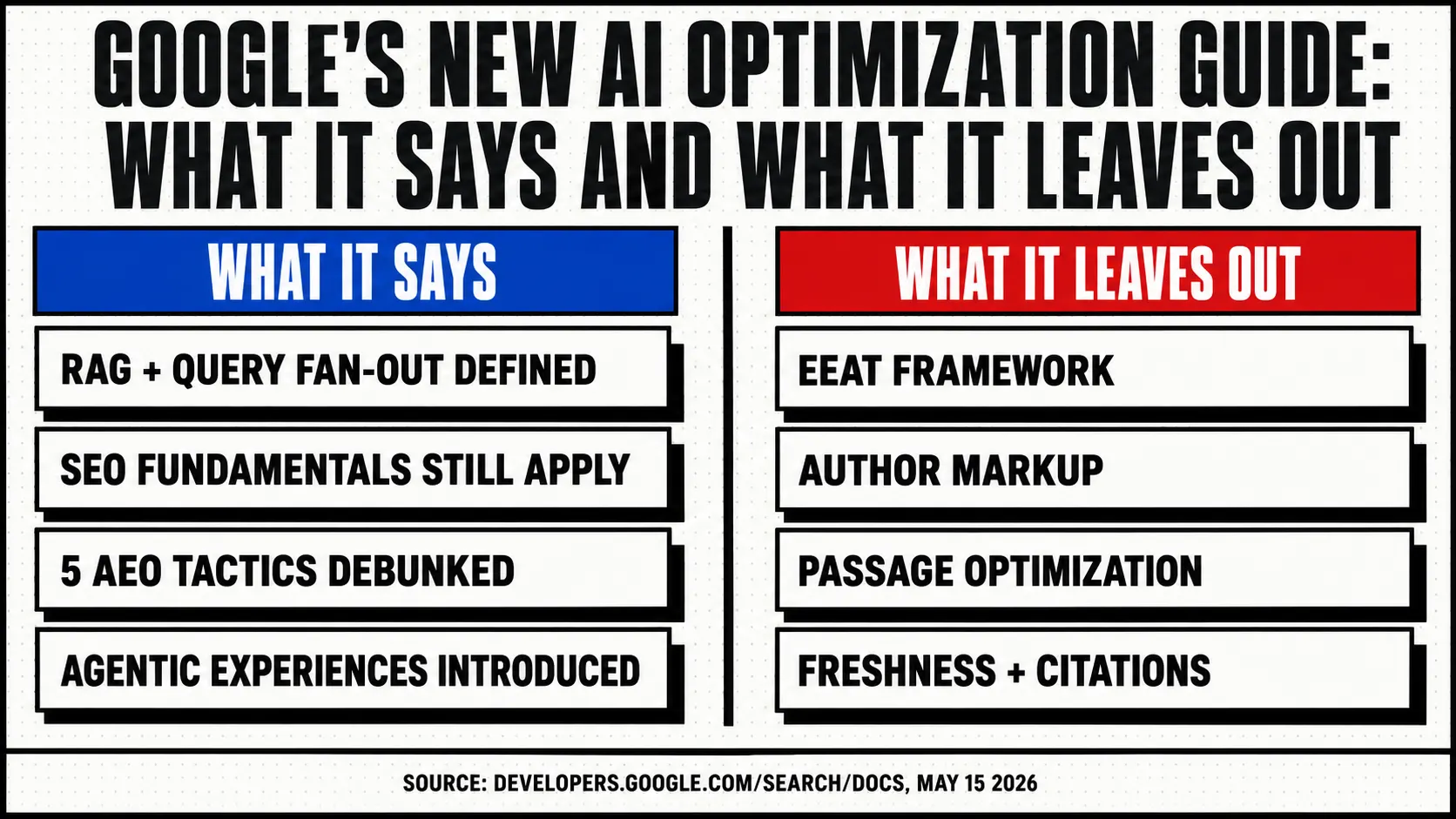
- Google says AI Overviews and AI Mode rely on the same core Search ranking systems through retrieval-augmented generation (RAG) and query fan-out, so the foundational SEO playbook still applies
- The guide explicitly debunks LLMs.txt files, content chunking, AI-specific rewriting, inauthentic brand mentions, and over-focusing on structured data as AEO tactics
- EEAT, author markup, passage optimization, freshness, citation mechanics, and entity SEO are not addressed in the guide, which is its own form of guidance
- Google introduced a new section on agentic experiences and the emerging Universal Commerce Protocol, signalling where the company expects the next 18 months of search optimization to go
What the Guide Actually Says
The opening section confirms that SEO is still relevant for generative AI search and gives the industry two official terms it had not previously defined.
Retrieval-augmented generation (RAG) is now defined by Google as “a technique (also known as grounding) used to improve the quality, accuracy, and freshness of AI responses by relying on core Search ranking systems to retrieve relevant, up-to-date web pages.” Translation: Google’s AI features pull from the same index as classic search. Rank still gates citation.
Query fan-out is officially “a set of concurrent, related queries generated by the model to request more information and fetch additional relevant search results.” This is the mechanic SEOs have been calling “fan-out” for a year, finally named by Google.
Google’s definition matches the mechanic but stops short of the practitioner question: which fan-out queries does ChatGPT actually generate for a given prompt? That’s the gap I built SubSeed to close. The Chrome extension surfaces the hidden fan-out queries, reasoning steps, and source citations from real ChatGPT sessions, then turns each query into a ranked keyword opportunity instead of an abstract concept.
From there the guide splits into two parts: foundational SEO and a “mythbusting” section. The foundational guidance is the same advice Google has given for a decade with AI-specific framing.
Content recommendations
The guide names four content priorities: provide a unique point of view, create non-commodity content, organize for readability with clear heading structure, and add high-quality images and video where appropriate. The “unique point of view” line is the load-bearing one. Google says directly: “Don’t just recycle what others on the internet have already said.”
Technical structure recommendations
Six technical priorities: meet Search technical requirements, follow crawling best practices, use semantic HTML, follow JavaScript SEO best practices, provide good page experience, and reduce duplicate content. None of these are new. The JavaScript line is the most relevant for sites built on Lovable, Bolt, v0, or other vibe coding tools that ship client-side React by default. I covered that gap in detail in Vibe Coding and SEO: What Google’s John Mueller Just Confirmed.
Local and ecommerce
For local businesses Google points to Google Business Profile, for ecommerce to Merchant Center, and for conversational commerce to the new Business Agent. The Business Agent mention is the most forward-looking item in this section. Google is positioning agentic commerce as a first-party channel.
The Five Things Google Explicitly Tells You to Stop Doing
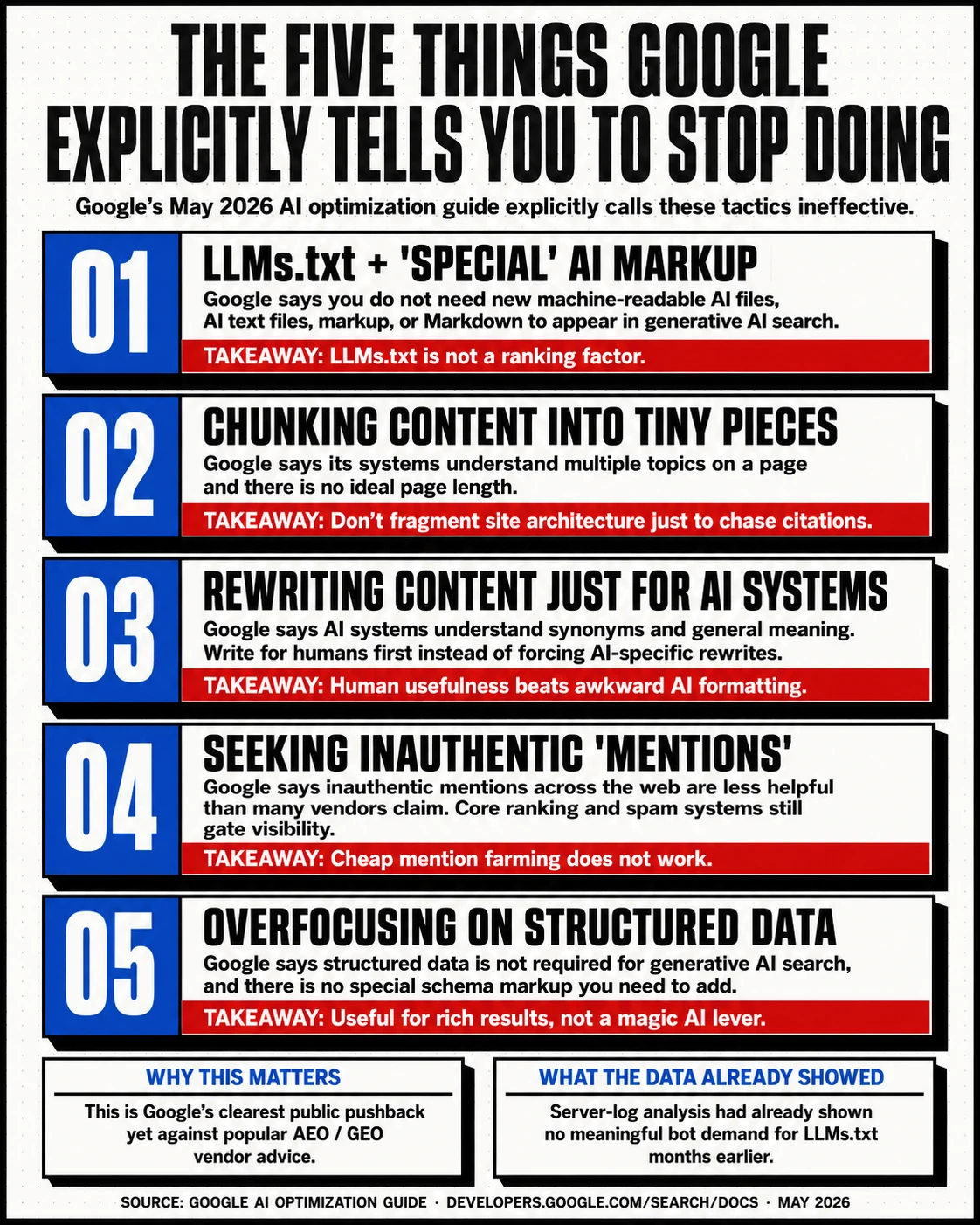
The mythbusting section is where the guide gets interesting, and where the SEO industry will spend most of the next week. Google names five popular tactics as ineffective. This is the most direct pushback Google has given on AEO/GEO advice from any vendor since the practice began.
- LLMs.txt files and other “special” markup. Google’s exact line: “You don’t need to create new machine readable files, AI text files, markup, or Markdown to appear in generative AI search.” This kills a whole sub-industry that has been selling LLMs.txt as a ranking factor. Gary Illyes had already said Google “doesn’t support LLMs.txt and isn’t planning to” in earlier comments. This is now official documentation.
- “Chunking” content into tiny pieces. Google: “Google systems are able to understand the nuance of multiple topics on a page and show the relevant piece to users. There’s no ideal page length.” The pushback here is against the AEO advice that says break every concept into its own short page. Note the nuance: the guide isn’t saying don’t write self-contained answers within a page (which I still recommend in How to Get Cited by ChatGPT). It’s saying don’t fragment your site architecture in pursuit of citation.
- Rewriting content just for AI systems. “AI systems can understand synonyms and general meanings of what someone is seeking.” This pushes back on the long-tail-keyword obsession and the practice of restructuring evergreen content into AI-specific Q&A formats. Write for humans first.
- Seeking inauthentic “mentions.” Google: “Seeking inauthentic ‘mentions’ across the web isn’t as helpful as it might seem.” This is the line that contradicts a popular GEO talking point that brand mentions across multiple sites lift citation odds. Google says the core ranking and spam systems still gate it. Cheap mention farming doesn’t work.
- Overfocusing on structured data. “Structured data isn’t required for generative AI search, and there’s no special schema.org markup you need to add.” Google still recommends it for traditional rich results, but says it’s not the AI lever a lot of vendors are selling it as.
Practitioners who tracked the actual crawler data were already saying this. I covered the gap between vendor hype and observed bot behaviour on LinkedIn last October in Why Nobody’s Using LLMs.txt, which surfaced server-log analysis showing zero requests from GPTBot, ClaudeBot, or PerplexityBot for the files. Google’s May 2026 documentation is the official version of an argument the data had already settled six months earlier.
“Google’s May 2026 documentation is the official version of an argument the data had already settled six months earlier.”
The Reddit reaction to the new guide was immediate. The most upvoted thread on r/SEO at the time of writing summarised the mythbusting list with the line: “Google Have released the first, official AI SEO Guide and the ONLY guide for AI SEO, GEO, AEO of any of the LLM/AI Vendors.” The thread had 81 upvotes and 27 comments within hours of publication.
How to Read Google’s Documentation
One thing to keep in mind reading this guide, or any Search documentation Google publishes: the company has a documented history of public statements that didn’t match internal practice. The 2024 Search ranking system leak, surfaced and analysed by Mike King and Rand Fishkin among others, exposed multiple signals Google had publicly downplayed for years. Click data through NavBoost, site-level authority scores, Chrome browser data, and a host of quality classifiers all turned out to play larger roles than the public documentation had ever suggested.
This isn’t a reason to ignore the guide. It’s a reason to read it as what Google wants you to do, not as a complete description of how the systems work.
“The mythbusting section tells you what Google considers ineffective. It doesn’t tell you what Google actually weights.”
The practical implication: take the explicit “don’t do this” list seriously, because Google rarely names tactics unless the public position will hold. Take the absences in the rest of the document as silence rather than dismissal. Most of what’s missing still matters. The guide just chose not to make any of it official.
What the Guide Doesn’t Address
The absences are as informative as the content. Six topics that dominate current GEO conversation are missing from the guide entirely.
EEAT. Author markup. Passages. Freshness. Citations. Entity SEO. All absent from the guide.
EEAT is not mentioned
Google’s Experience, Expertise, Authoritativeness, and Trustworthiness framework gets zero direct references. The guide uses the phrase “helpful, reliable, people-first content” and links out to the separate helpful-content documentation, but the EEAT acronym never appears. Read in isolation, that’s odd. Read in context with the rest of Google’s documentation, it suggests EEAT is being absorbed into the broader content-quality framework rather than treated as a separate AI optimization lever.
Author markup and authorship are not addressed
No mention of author schema, Person markup, or the byline-as-citation-signal patterns Cyrus Shepard documented in his recent meta-analysis. This is notable because Author schema is one of the strongest practitioner-recommended levers for AI citation. The omission isn’t an endorsement of skipping it. It just means Google chose not to position it as AI-specific.
Passage optimization is not endorsed (or contradicted)
This is where the guide gets the most pushback from practitioners. Google says don’t chunk pages, but doesn’t address whether to structure self-contained answer blocks within a page. The Cyrus Shepard meta-analysis of 54 studies ranks “Answer Near the Top” and “Self-Contained Passages” as the 8th and 13th strongest correlating factors for AI citation. Google’s silence isn’t a contradiction. It’s an absence of guidance on a tactic many studies show works.
Freshness signals are not addressed
RAG retrieves “up-to-date web pages,” per the guide’s own definition, which implies freshness matters. The body of the guide doesn’t discuss it. Sistrix’s citation drift data shows 40 to 60% monthly turnover in cited sources. Practitioners need to keep refreshing.
Citation mechanics are not addressed
How an LLM picks which sources to cite from the retrieved set, why some queries cite three URLs and others cite ten, how citation positions persist or rotate, all of this is absent. The Yext analysis of 17.2 million citations and Ahrefs’ tracking of AI Overview rotation rates remain the only consolidated practitioner data.
Entity SEO and knowledge graph signals are not addressed
Brand and entity consistency, knowledge panel optimization, sameAs linking, and the entity disambiguation work that drives a lot of B2B SEO get no mention. For multi-channel brands trying to consolidate their entity, this is the biggest practical gap in the guide.
The New Section: Agentic Experiences
The guide adds a section that has no precedent in earlier Google documentation: agentic experiences. Google defines AI agents as “autonomous systems that can perform tasks on behalf of people, such as booking a reservation or comparing product specifications.” It links to a new external resource on agent-friendly website design and mentions the emerging Universal Commerce Protocol (UCP).
This is the forward-looking signal. Google is telling site owners that the next 18 months of optimization work will increasingly include making sites navigable by agents that aren’t human users and don’t click in human patterns. The UCP reference is the most concrete acknowledgement Google has made that agentic commerce protocols are real and they expect site owners to participate.
What Practitioners Are Saying
Reaction split along predictable lines within hours of publication. Practitioners who had been sceptical of LLMs.txt and AI-specific markup felt vindicated. Vendors who had been selling those tactics quickly pivoted to “Google doesn’t endorse it but it still helps.” The strongest practitioner read came from r/SEO:
Google Have released the first, official AI SEO Guide and the ONLY guide for AI SEO, GEO, AEO of any of the LLM/AI Vendors. Critically important – as Google is the main search engine for RAG/QFO and Gemini is the 2nd biggest and fastest growing AI/LLM in the public domain.
u/WebLinkr, r/SEO, May 2026 (81 upvotes)
A related thread surfaced the spam-policy expansion Google quietly pushed the same day. The Search spam policies were updated to explicitly cover AI Overviews and AI Mode responses, which closes a previously ambiguous gap: any tactic that manipulates AI responses can trigger the same penalties as classic search manipulation. I covered that policy thread in the Google AI Mode SEO guide.
What to Actually Do This Week
The guide is a do-less document more than a do-more one.
The action list that comes out of it is short and specific.
- Stop treating your LLMs.txt file as a ranking asset. According to Google’s documentation it does nothing for AI search visibility, and Anthropic, OpenAI, and Meta haven’t endorsed it either. Server-log analysis confirmed zero bot requests for these files months before Google made the position official. You don’t have to delete it (the file isn’t harmful), but it isn’t the lever some vendors sold. If you’d rather leave it as a low-cost hedge in case a future crawler starts reading it, that’s not unreasonable either.
- Stop fragmenting your site architecture in pursuit of AI citation. Self-contained answer blocks within a page are still good practice. Splitting one topic across twelve thin pages is not.
- Audit your render mode. Google’s foundational JavaScript SEO guidance still applies, and the guide explicitly says content must be “publicly accessible, crawlable.” Sites built on default Lovable, Bolt, or v0 outputs need server-side rendering or a prerendering layer before any of the AI optimization conversation matters.
- Build for the gaps. Author markup, freshness, citation tracking, and entity SEO weren’t addressed in Google’s guide, which means they remain practitioner-led levers. If you want a starting checklist, reach out and I can point you to the highest-leverage ones for your category.
FAQ
Sources & References
- Google Search Central (2026, May 15). “Optimizing your website for generative AI features on Google Search.” https://developers.google.com/search/docs/fundamentals/ai-optimization-guide
- Google Search Central (2026, May). “Search spam policies updated to cover generative AI responses.” https://developers.google.com/search/docs/essentials/spam-policies
- u/WebLinkr (2026). “Google’s Guide to Optimizing for Generative AI Features on Google Search.” r/SEO. https://www.reddit.com/r/SEO/comments/1te4t71/
- Hunt, J. (2025, October 29). “Why Nobody’s Using LLMs.txt.” LinkedIn. linkedin.com
- King, M. (2024). “Secrets from the Algorithm: Google Search’s Internal Engineering Documentation Has Leaked.” iPullRank. ipullrank.com
- Fishkin, R. (2024). “An Anonymous Source Shared Thousands of Leaked Google Search API Documents.” SparkToro. sparktoro.com
- Search Engine Land (2025). “Google says normal SEO works for ranking in AI Overviews and LLMS.txt won’t be used.” searchengineland.com
- Search Engine Roundtable (2026). “Google Search Team Does Not Endorse LLMs.txt Files.” seroundtable.com
- Cyrus Shepard / Zyppy Signal (2026, May 7). “AI Citation Ranking Factors.” signal.zyppy.com
- Sistrix (2026). “AI Citation Drift: How Stable Are Sources in AI Search Results?” sistrix.com
- Yext (2026). “AI Citation Behavior Across Models: Evidence from 17.2 Million Citations.” yext.com
- Ahrefs (2026). “AI Overviews Change Every 2 Days (But Never Change Their Mind).” ahrefs.com
- Universal Commerce Protocol (2026). ucp.dev
See what ChatGPT is really searching
SubSeed captures the hidden Google queries ChatGPT runs behind every answer and enriches them with search volume, CPC, and keyword difficulty.
Related Posts
Read this post with an assistant
This is the whole prompt each button sends. Nothing hidden in it.
Read https://gridlok.co/blog/google-ai-optimization-guide/ and give me the main points in a few sentences.
Make Gridlok a Preferred Source on Google
See Gridlok surfaced more often in your Top Stories, AI Overviews, and AI Mode. One click, applied across Google Search.