ChatGPT Intelligent UI: How to Get Cited and Mentioned
OpenAI started rolling out ChatGPT Intelligent UI on October 7. With GPT-6, an answer can now be a chart you can adjust, road trip stops on a map, a side-by-side product comparison, or a small calculator ChatGPT builds on request. Free accounts started getting it on October 8.
Every one of those pieces is made from something: a web page, a product feed, a business listing, or what the model already knows. That’s the part a business can work on. So on October 8 I ran 48 questions through ChatGPT, twice each, and took all 96 answers apart: every citation, product card, local listing, and search query.
I also grabbed screenshots of two answers in the new layout, including a clothing search I compared with Google.
Key takeaways
- Intelligent UI changes the layout of an answer. The parts still come from familiar places: text cites pages found through ChatGPT search (OpenAI’s crawler plus partner search providers), most product cards come from merchant feeds, and local results come from business listings. OpenAI hasn’t said how sources will show inside charts and generated tools.
- Who gets the link depends on the question. Software answers cited the vendors’ own sites 78% of the time, shopping answers cited review publishers every time, and local answers split between directories (55%) and the businesses’ own sites (45%).
- Getting mentioned and getting cited are separate jobs. Every search ChatGPT ran for the software questions already named vendors, and only 41% of the brand mentions in those answers came with a citation to the brand’s own page.
- Run the same prompt twice and brand names mostly hold (86% overlap in software answers), while cited sites overlap 54% and product cards about a third. One screenshot isn’t a ranking.
What is ChatGPT Intelligent UI?
Intelligent UI is GPT-6’s ability to build an answer out of text, visuals, and interactive elements, picking the format to fit the question. In OpenAI’s announcement, responses can include graphics, tappable buttons, forms, charts, and interactive experiences. A comparison might come back side by side. An explanation might come back as a diagram you can play with. A simple question still gets plain text.
OpenAI’s examples are everyday ones: the timing for a Sunday roast next to the recipe, road trip stops on a map with notes on which ones deserve a detour, and tools you ask for in the moment, like a retirement savings calculator or a bill splitter. Under the hood it’s a library of ready-made components plus a compiler that draws the interface while the model is still writing.
Some of it isn’t new. ChatGPT added interactive charts in June and interactive modules for more than 70 math and science topics in March, as Search Engine Journal noted from OpenAI’s release notes. What changed is that GPT-6 now decides on its own when an answer should be visual. No special prompt is needed.
Who gets it, according to OpenAI’s announcement and its GPT-6 help page:
- Plus, Pro, Business, and Enterprise: rolling out from October 7, running on GPT-6 Sol. Enterprise access depends on admin settings.
- Free and Go: rolling out from October 8, running on GPT-6 Luna, per the announcement. The help page still listed GPT-5.6 Luna for these plans that day.
- It works in the Chat tab on the web and in updated mobile apps, at every thinking level except Pro. The older ChatGPT desktop apps for Mac and Windows don’t support it.
- Turning off Layout and visuals in Settings on the web cuts down the visuals, though OpenAI says some may still appear.
OpenAI also says GPT-6 makes better decisions about when to search the web, and that GPT-6 Instant starts answering search questions 44% sooner on average than GPT-5.6 Instant. The first claim matters more than the speed. In my test, whether ChatGPT searched at all decided whether anybody got cited.
The audience is big: OpenAI puts ChatGPT at more than 1.2 billion weekly users. It isn’t the whole market, though. In the Datos numbers I went through in the Q2 market share post, ChatGPT held a mid-30% share of US desktop AI assistant users.
Where each Intelligent UI component gets its content
Each component in an Intelligent UI answer draws on a source you can name, and most come with something you control. This map comes from OpenAI’s help pages, its crawler and merchant documentation, and the 96 answers.
| Component | What it’s built from | How the source shows | What you control |
|---|---|---|---|
| Text with citations | Web search: pages crawled by OAI-SearchBot, plus partner search providers. OpenAI’s help page names Microsoft and Shopify. | Inline citation links and a Sources button | Letting OAI-SearchBot crawl you, and letting its IP ranges through your CDN |
| Images | Images from web pages. In my test they showed up in an answer that ran no search at all | Tapping an image opens its source page | Original images on crawlable pages, with descriptive alt text |
| Maps and local places | Business listings from third-party providers OpenAI doesn’t name, matched to an approximate location from the user’s IP or a shared device location | A listing with rating, review count, address, phone, and website | Complete listings, reviews, and a site that answers the specific question |
| Product cards and comparisons | Mostly merchant product feeds sent through the Agentic Commerce Protocol, including Shopify Catalog and large retailers | A card that links to the merchant’s product page | A feed (direct, through Shopify or Etsy, or through a retailer) with every field filled in |
| Restaurant reservations | Availability from OpenTable, Resy, or Yelp. OpenAI documents this for GPT-5.6, so it predates Intelligent UI | A Reserve button when a provider has times | Being bookable on one of the three |
| Charts, diagrams, and generated tools | The model’s own knowledge plus anything it searched | Not stated in OpenAI’s announcement | Original numbers and methods, published where the search can find them |
The search and location details come from OpenAI’s help page on web search, which also says plainly that placement isn’t guaranteed. Ads sit outside all of this. OpenAI’s October 5 ads post says advertising doesn’t influence the answers ChatGPT gives, and none of the 96 answers in my study carried an ad.
What an Intelligent UI answer looks like
Here’s one of the study prompts, “best robot vacuum under $500,” asked in ChatGPT on October 8. It worked for two minutes and came back as a short intro, four product cards, and a form.
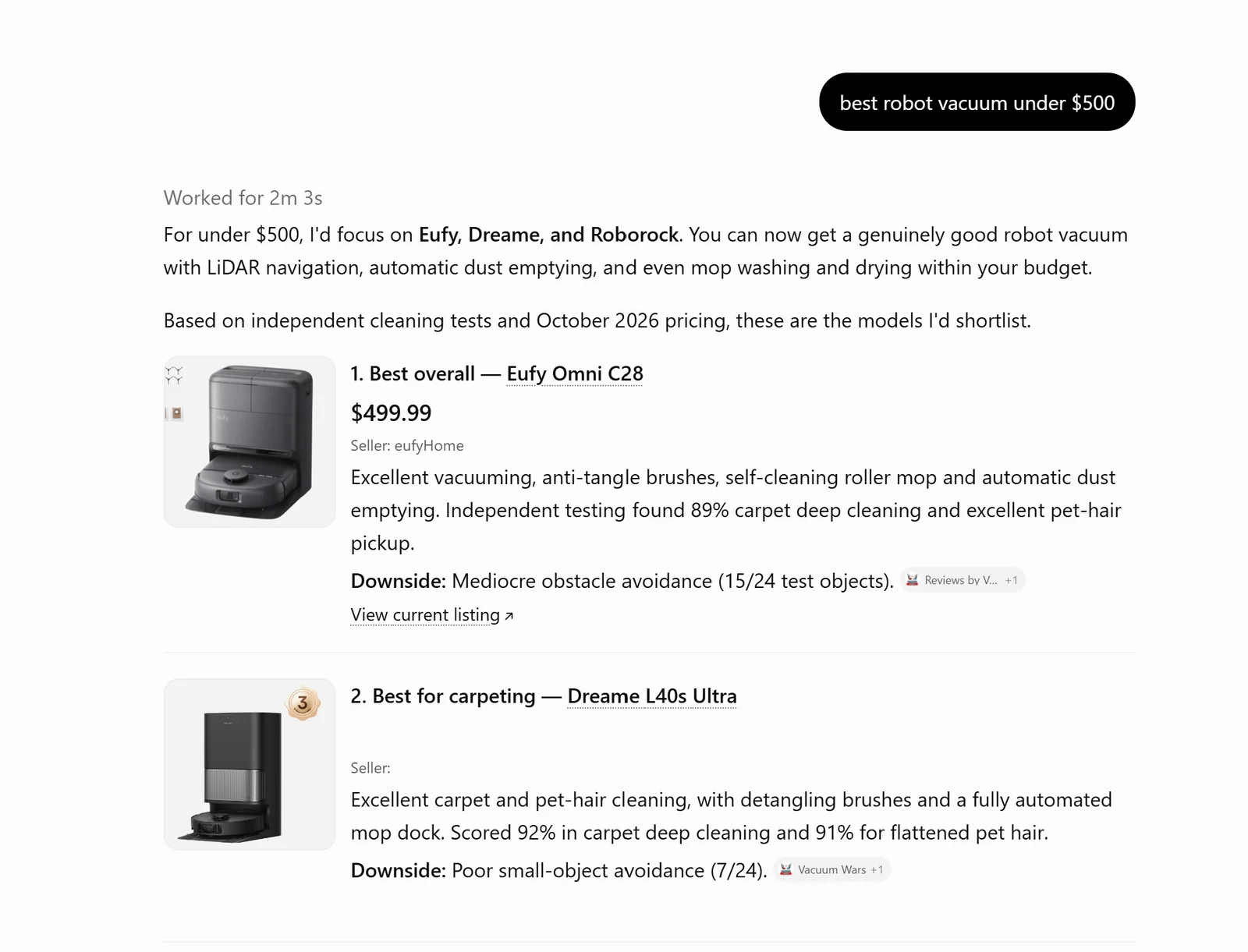
The intro named Eufy, Dreame, and Roborock, the same three brands that filled the product cards when I ran this prompt for the study below.
Only the first card, the Eufy Omni C28, showed a price, a seller, and a “View current listing” link: $499.99 from eufyHome. That’s the same seller and price as a feed card for the eufy C28 in my first study run, which linked to Lowe’s. The other three cards showed an empty “Seller:” line and no price.
The citations went to a reviewer. Three of the four picks carried a Vacuum Wars citation chip, a site neither study run cited.
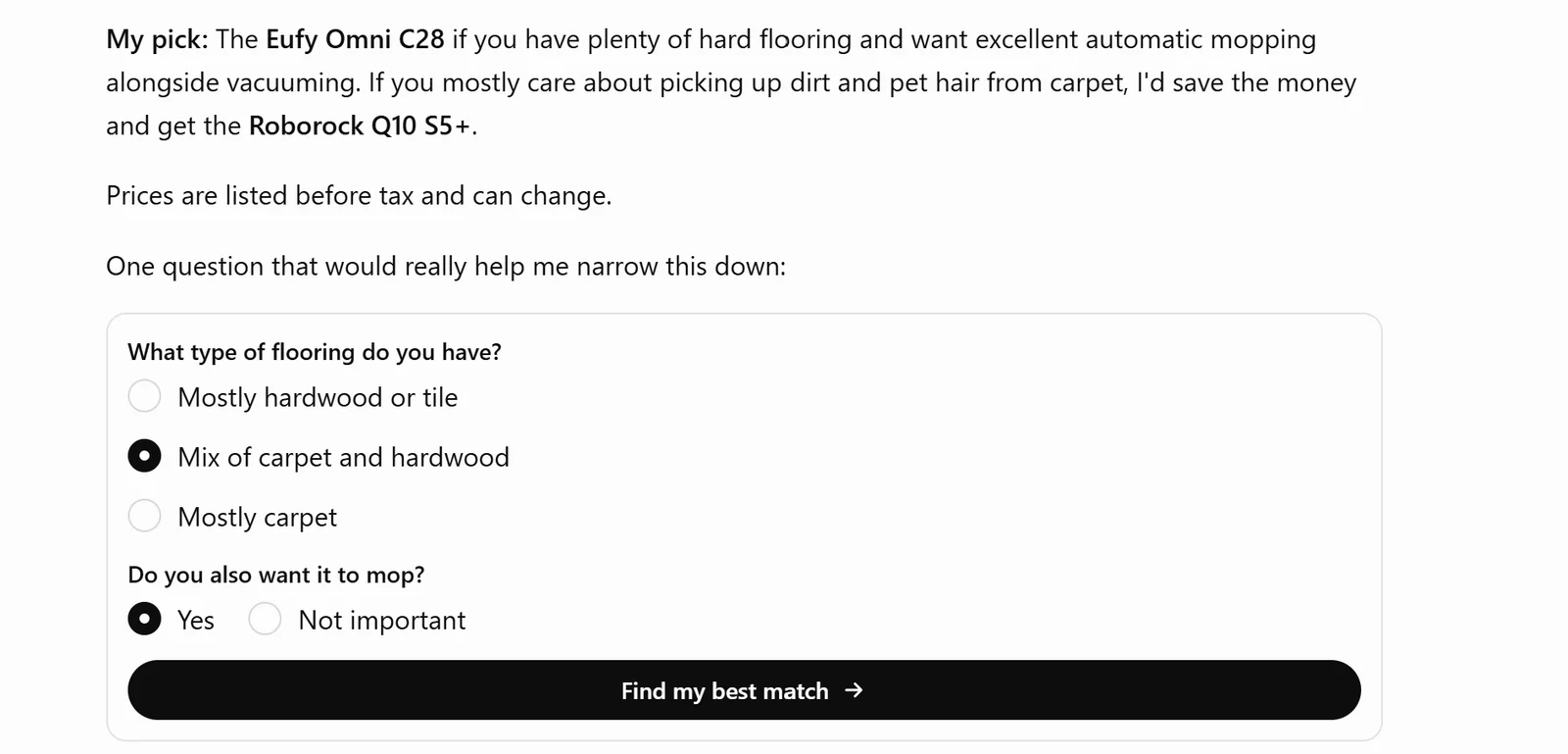
It finished with a form: two questions about flooring and mopping, with radio buttons and a “Find my best match” button. Those are the forms and tappable buttons from OpenAI’s announcement, used here to narrow down a shopping answer.
How I tested what ChatGPT cites
I wrote 48 prompts, six each across eight kinds of questions: shopping, local services, software, comparisons, explainers, planning, calculations, and brand checks like “is Thumbtack legit for hiring a handyman.” The full list is at the end of this post. On October 8, 2026, I ran every prompt twice, a few minutes apart, through DataForSEO’s ChatGPT scraper with US English settings.
The scraper returns each answer split into its parts (text, tables, product cards, local listings, and images) along with the sources ChatGPT cited, a partial list of the search results it pulled, and the searches it ran.
Across the 96 answers there were 186 citations, 135 of them unique URLs, and I sorted every one by who owns the site. Software answers also linked 25 brand names straight to vendor homepages, which I kept separate from citations. It’s the same approach as my Google AI Overviews citation study, pointed at ChatGPT.
The scraper reported GPT-5.6 for every answer. GPT-6 only began rolling out to free accounts that day, so these answers show what the components are built from rather than how GPT-6 lays them out. The sample is 12 answers per question type, on one day, in one country.
What ChatGPT built each answer from
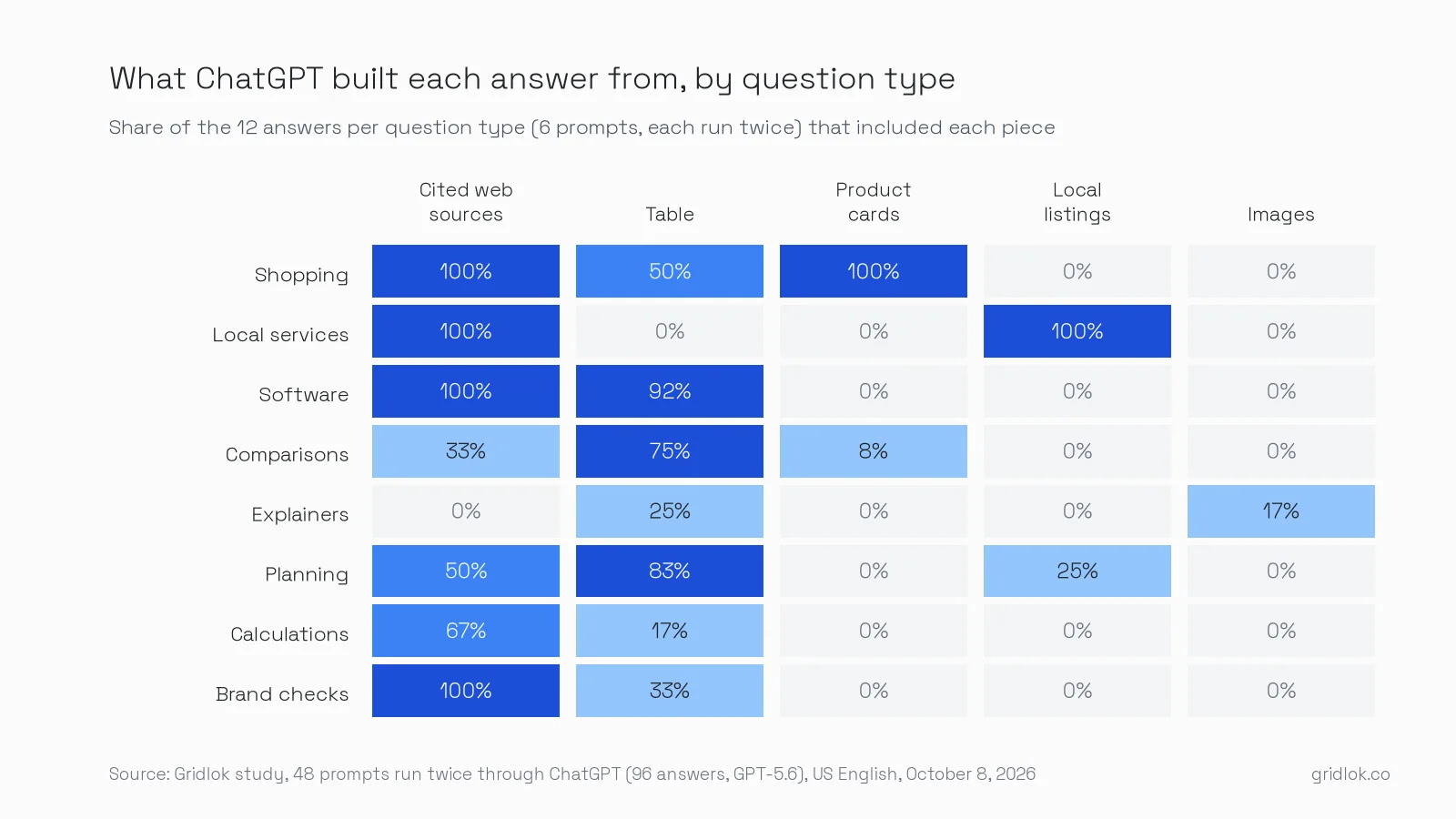
The biggest split was whether ChatGPT searched. Every shopping, local, software, and brand-check answer cited web sources. None of the 12 explainer answers did. “How does a heat pump work” and “explain the central limit theorem simply” came straight from the model, with no sources and no links.
That call was consistent. For all 48 prompts, both runs agreed on whether to cite anything. Comparisons cited sources a third of the time, planning questions half the time, and calculations two thirds.
For a business that lives on explainer questions, this is the hard part. No search means no citation, whatever the page says. OpenAI says GPT-6 decides better when to look things up, so this is the first number I’ll re-check when GPT-6 answers come through.
Product cards appeared in every shopping answer, and local listings in every local one. Tables showed up in nearly half of all answers.
Images were rare: they appeared only in the noise-cancelling headphones explainer, in both runs, and that answer didn’t search at all. It cited nothing in its text, but each of its five images linked to the page it came from, a Samsung community thread among them. In an answer with no citations, the images were the only links out.
Who gets cited depends on the question
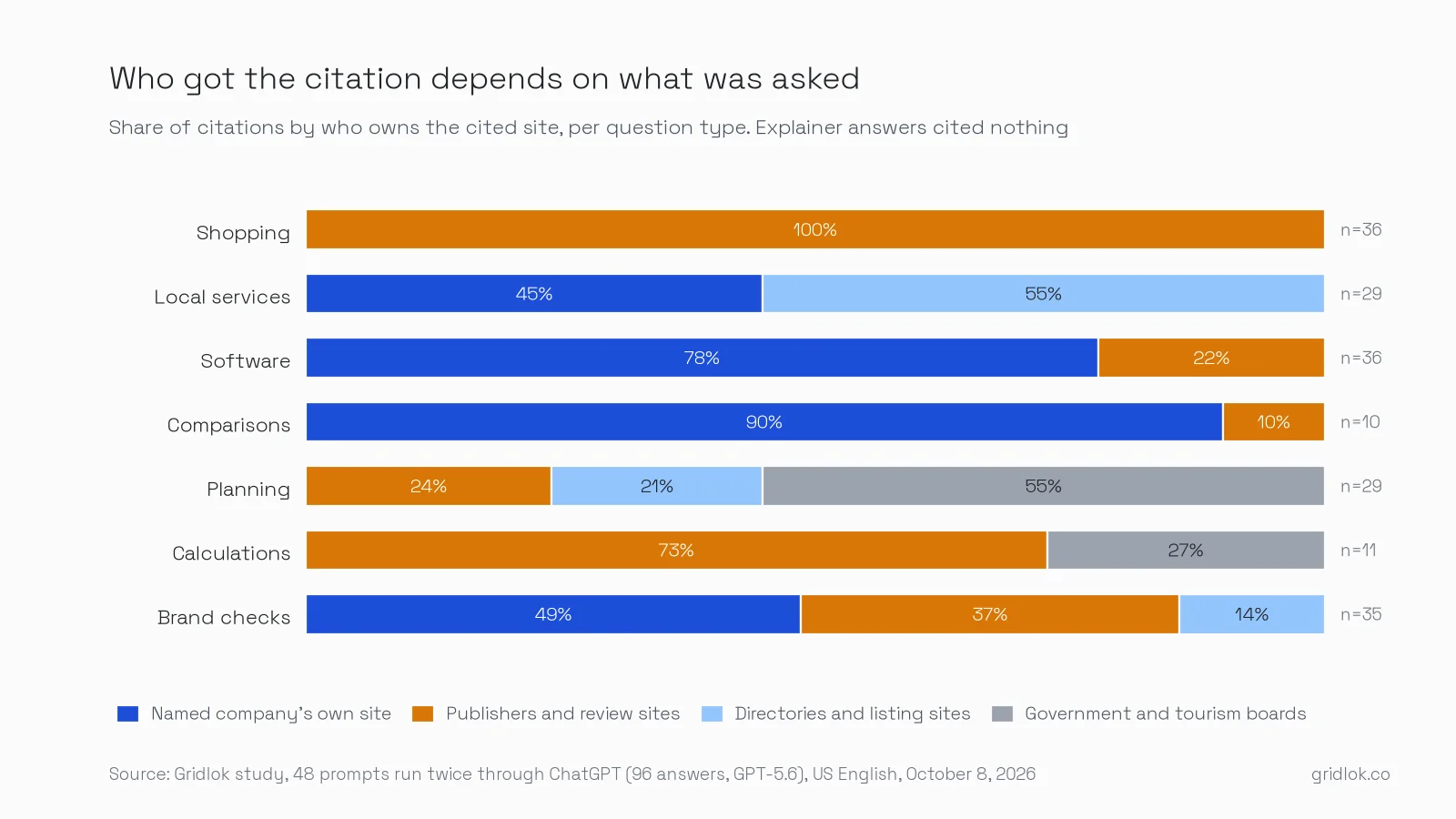
Across all 186 citations, 39% went to publishers and review sites, 36% to the own site of a company the answer named, 15% to directories, and 10% to government sites and tourism boards. Split by question type, each one had a different winner.
Shopping: reviewers get the citations
All 36 citations in shopping answers went to publishers and review sites, spread across 20 different sites. RTINGS was cited in four of the 12 shopping answers and Good Housekeeping in three, alongside niche sites like The Espresso Report, HomeCoffeeStack, and Podiatrist Tested. No shopping citation went to a brand’s own site.
The brands were still there, as product cards. In one run of “best mattress for side sleepers with back pain,” Nolah, Helix, and WinkBeds appeared as cards linking to their own stores, while the text cited Healthline, the Sleep Foundation, RTINGS, and AARP.
Software: the vendor’s own pricing page
Software flipped it. 28 of the 36 citations (78%) went to the vendors’ own sites, and 26 of those 28 were pricing, product, or help pages. The searches show why. In 10 of the 12 software answers, ChatGPT ran at least one search aimed at an official page, like “site:hubspot.com pricing CRM small business free CRM” or “FreshBooks pricing features official freelancers.”
Local services: directories or the business’s own site
Local answers split 55% directories and listing sites (ConsumerAffairs, OpenTable, Carfax, Birdeye, and a long tail of local “best of” sites) and 45% the businesses’ own websites.
The question decided which. “Family dentist in Ann Arbor accepting new patients” cited only dental practices’ own sites in both runs, five in one and three in the other. That makes sense, because whether a practice takes new patients is a detail its own site carries. “Best plumber in Detroit” cited directories both times.
Planning and brand checks
Planning answers leaned on official sources: the National Park Service for the Yellowstone trip, and Pure Michigan, a state byways guide, and the Saugatuck/Douglas visitors bureau for the Detroit to Chicago drive, alongside travel blogs.
Brand checks mixed the brand’s own pages (49%) with review publishers (37%), and the Better Business Bureau came up for the two marketplace questions. “Is Angi a good way to find contractors” cited Angi and the BBB in both runs.
Mentioned vs cited: ChatGPT picks the shortlist first
The software answers also showed where mentions come from. Every one of the 42 searches ChatGPT ran for the six software questions already named at least one vendor, and both runs of each question ran the same searches.
For “best CRM for a small business,” one of them was “best CRM small business 2026 HubSpot Zoho Pipedrive Freshsales pricing features.” None was a plain “best CRM” search. The names went into the searches rather than coming out of them.
Across the 12 answers, ChatGPT named a software brand 59 times, and 41 of those mentions were brands it had searched for by name. Only 24 of the 59 (41%) came with a citation to the brand’s own page, usually pricing or features. Another 12 had the brand’s name linked to its homepage, and 23 got no link at all.
In one run, the CRM answer recommended HubSpot, Zoho, Pipedrive, Freshsales, and Less Annoying CRM and cited only HubSpot. In the other run, it cited HubSpot and linked the other four names to their homepages. The shortlist looks like it came from what the model already knew. The citation went to whichever page confirmed a price or a feature.
So a mention depends on what the model already connects with your category: the reviews, comparison posts, forum threads, and press that name you. A citation depends on having the page it checks, with the price, plan, or policy written plainly. I covered that second part in How to Get Cited by ChatGPT.
Those checks are dated, too. ChatGPT put “2026” in 57 of its 110 searches, and 84% of the dated citations were from this year.
Most product cards come from merchant feeds
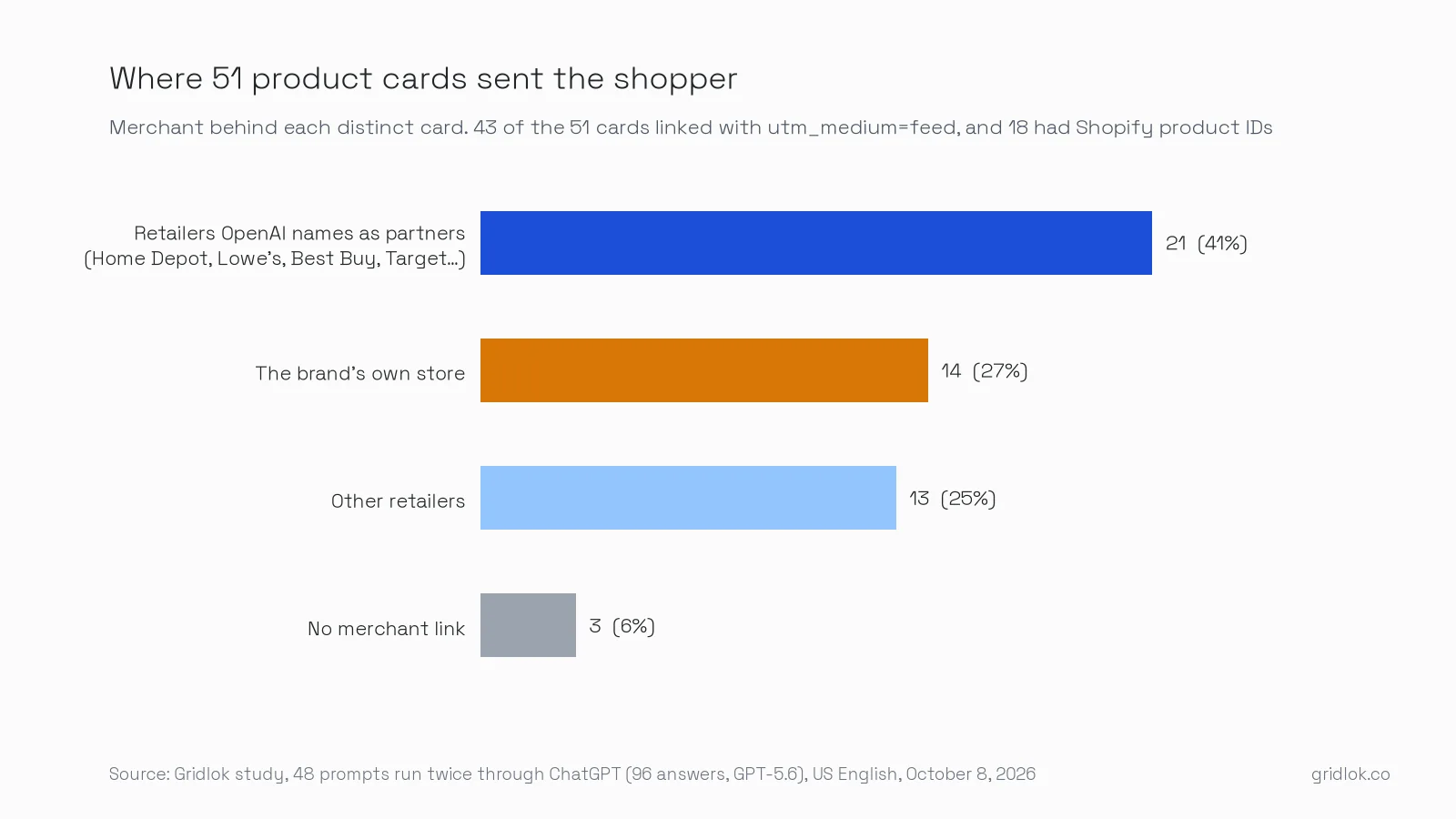
The 13 answers with product cards held 51 distinct cards, 57 counting repeats inside some answers. 43 of the 51 linked to the merchant with utm_medium=feed in the URL, and 18 were Shopify products, with Shopify product IDs and utm_campaign=openai_catalog. The other eight were tagged differently or not at all: a Nordstrom card used utm_medium=organic, a Wayfair card used OpenAIFeeds, three carried only utm_source=chatgpt.com, and three had no merchant link.
That matches OpenAI’s March post on product discovery. Merchants share product feeds through the Agentic Commerce Protocol, retailers including Target, Best Buy, Lowe’s, and The Home Depot have integrated, and Shopify merchants are already included through Shopify Catalog. OpenAI’s merchant FAQ adds that a feed isn’t required if ChatGPT already crawls your site, though a feed gives you more control over how your products appear.
If you make the product, who gets the click matters. Retailers OpenAI names as partners took 21 of the 51 cards (41%), five each for The Home Depot, Lowe’s, and Best Buy. The brand’s own store got 14 (27%). Dreame and Roborock were linked to their own stores in both runs and Sony in one, while every eufy card went to Lowe’s or Best Buy.
Cards also changed more than anything else between runs, overlapping only about a third (32%) when the same prompt ran twice. A feed gets your products into the pool, and the pool reshuffles every time someone asks.
What a ChatGPT product feed needs
OpenAI’s product feed spec requires nine fields for discovery. It asks for real brand and seller names, titles of about 150 characters at most, and plain-text descriptions of up to 5,000.
| Field | What goes in it |
|---|---|
| item_id | A stable ID for each item or variant, never reused for a different product |
| title | The product name, including the variant when relevant |
| description | A factual, plain-text description of the item |
| url | The product page, with the variant selected when possible |
| brand | The brand as it appears on the product page |
| seller_name | The seller supplying the offer |
| image_url | A direct link to the main image for this variant |
| availability | in_stock, out_of_stock, pre_order, backorder, or unknown |
| price | The regular price with currency, like 79.99 USD |
Ratings go in two optional fields, review_count and star_rating, which should count product reviews only, leaving out store and seller reviews. OpenAI suggests uploading the full feed once a day and sending updates through its API during the day. A Google Merchant Center style feed is accepted once OpenAI confirms it for your account, and standard uploads target the US.
How products get in
Shopify and Etsy sellers are already connected, according to OpenAI’s merchant page. Everyone else applies there and may land on a waitlist. Shopping is live for US ChatGPT users, purchases completed on your own site carry no fees, and OpenAI says a self-serve merchant platform is coming later this year.
Products sold through a partner retailer can also show up through that retailer’s feed, which is how eufy got its cards. The agentic commerce guide covers the protocol, and the AI shopping assistant post covers the other assistants doing the same job.
One tracking note. Text citations link with utm_source=chatgpt.com. Most product cards add utm_medium=feed, and Shopify cards add utm_campaign=openai_catalog. That separates most product card clicks from cited-link clicks in GA4, though not all of them: three cards in my sample carried only utm_source=chatgpt.com, the same as a citation.
If you sell clothing
For clothing, I asked ChatGPT “best men’s flannel shirts under $80” on October 8 and searched the same thing on Google.
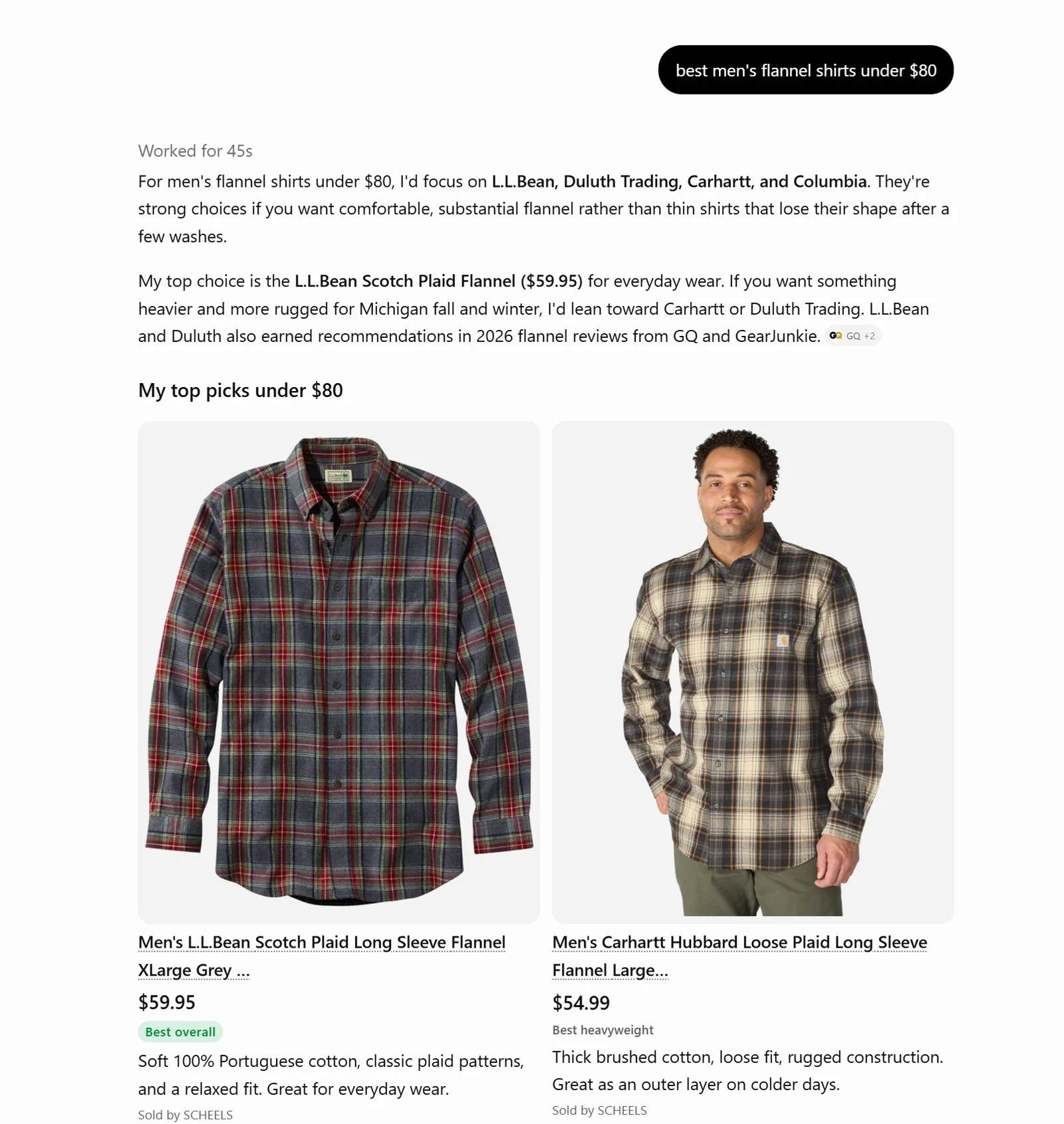
ChatGPT named four brands up front: L.L.Bean, Duluth Trading, Carhartt, and Columbia. Its top pick was the L.L.Bean Scotch Plaid Flannel at $59.95, backed by a citation to GQ.
None of the four product cards linked to a brand’s own store. Scheels sold the L.L.Bean and the Carhartt, Backcountry sold the Columbia, and Walmart sold a $17.98 Wrangler shirt that made the grid as the cheap option. Running shoes, the closest category in my 48 prompts, worked the same way: running stores on Shopify, like Fleet Feet and Marathon Sports, won cards for ASICS and Saucony shoes.
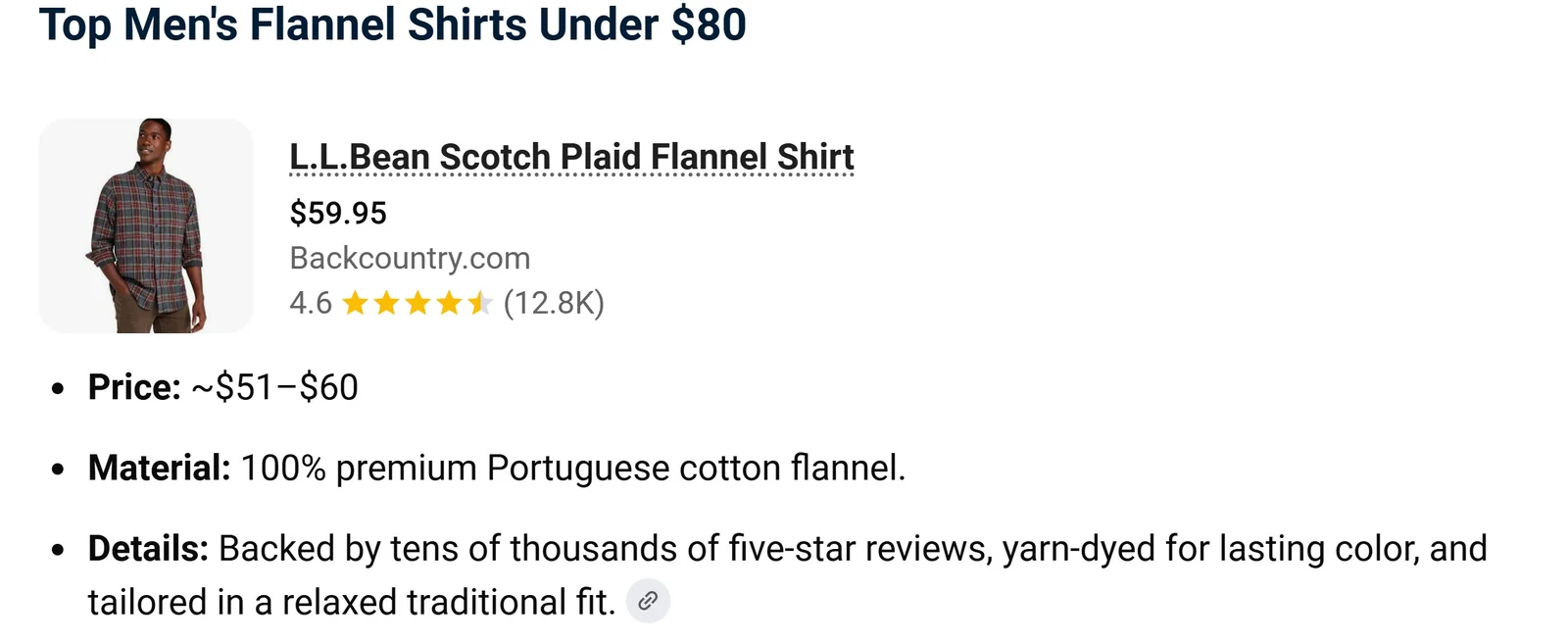
Google’s AI Overview called the same shirt “the best overall men’s flannel shirt under $80,” at the same $59.95, but its card pointed to Backcountry instead of Scheels.
Five of ChatGPT’s six brands showed up in Google’s overview too, and three of the exact products did: the L.L.Bean Scotch Plaid, Duluth’s Free Swingin’ Flannel, and the Legendary Whitetails Buck Camp Flannel. GQ and GearJunkie, the reviewers ChatGPT leaned on, both ranked in Google’s results for the query.
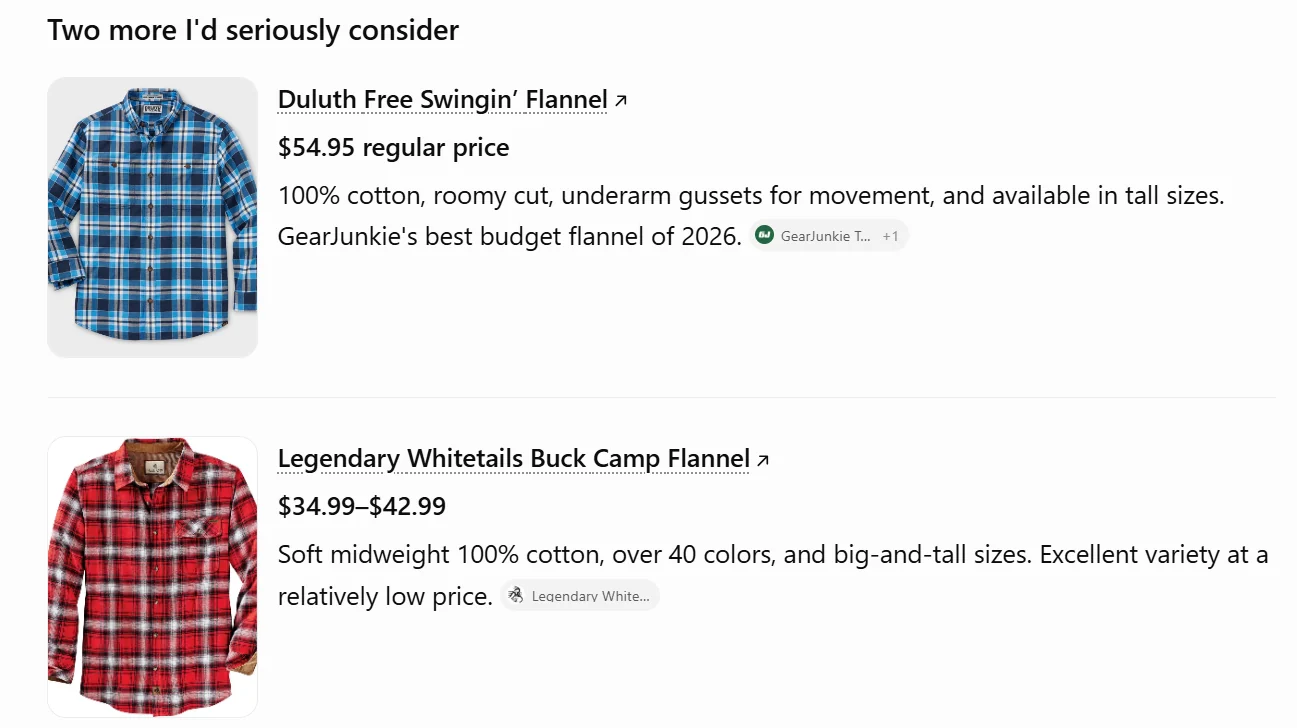
One brand got cited from its own site on both platforms: Legendary Whitetails. ChatGPT’s card for its Buck Camp Flannel cited the brand’s site for the colors and big-and-tall sizes, and Google’s overview cited the brand for the same details.
It also ran Google ads above the results and ranked with its own “Best Flannel Shirts For Men” page. Dixxon Flannel Co. ran ads too and didn’t appear in either AI answer.
If I ran a clothing brand, this is what I’d take from it:
- Your product can win a card through someone else’s store. Shopify and Etsy brands are already connected, and every card here went to a retailer that carried the product, so your listings at every retailer matter.
- Put the details shoppers compare in plain text: fabric, weight, fit, colors, and size range. Both AI answers quoted exactly those, and OpenAI’s feed spec has fields for material, color, size, gender, and variants.
- Earn the roundups. ChatGPT cited GQ and GearJunkie, and Google ranked them alongside Outside, The Inertia, and a Reddit BuyItForLife thread.
- Publish your own buying guide with real specs. Legendary Whitetails ranked with one and got cited from its own site by both AIs.
Local listings: ratings everywhere, few links home
The 15 answers with local listings held 66 listings, including a handful of parks and beaches from the trip-planning answers. Every listing showed a star rating and an address, 64 showed a phone number, and 64 linked a website. Review counts ran from 3 to 2,660, with a median around 68.
A listing rarely came with a citation. Of the 64 listings with a website, 11 had that site cited in the same answer, and eight of those were the Ann Arbor dentists. Most of the other local-service citations, 16 of 18, went to directories.
Listings were the steadiest part of a local answer, with a 79% overlap in businesses between runs. OpenAI doesn’t name its listing providers. It does name Microsoft as a search partner, so a complete Bing Places profile is cheap insurance, along with the directories that turned up here. Restaurants get one more lever, since reservations come from OpenTable, Resy, or Yelp.
Calculator pages: ChatGPT mostly did the math
Matt G. Southern at Search Engine Journal noted that calculator and converter pages could be challenged by tools ChatGPT builds on request. In my sample, ChatGPT did the math itself in 10 of the 12 calculation answers. The two retirement answers presented their savings figures as Investor.gov estimates. It cited a source in 8 of the 12 calculation answers, and only 3 of the 11 pages it cited were calculators.
The other eight were guides and reference pages: two guides to calculating a mortgage payment, AmortizeCalc’s methodology page, Investor.gov’s introduction to investing (in both runs), LG’s support page on convection cooking, and two oven temperature conversion guides. For a calculator site, the page that explains how the numbers work looks like the one to invest in.
Same prompt twice: brand names held, links moved
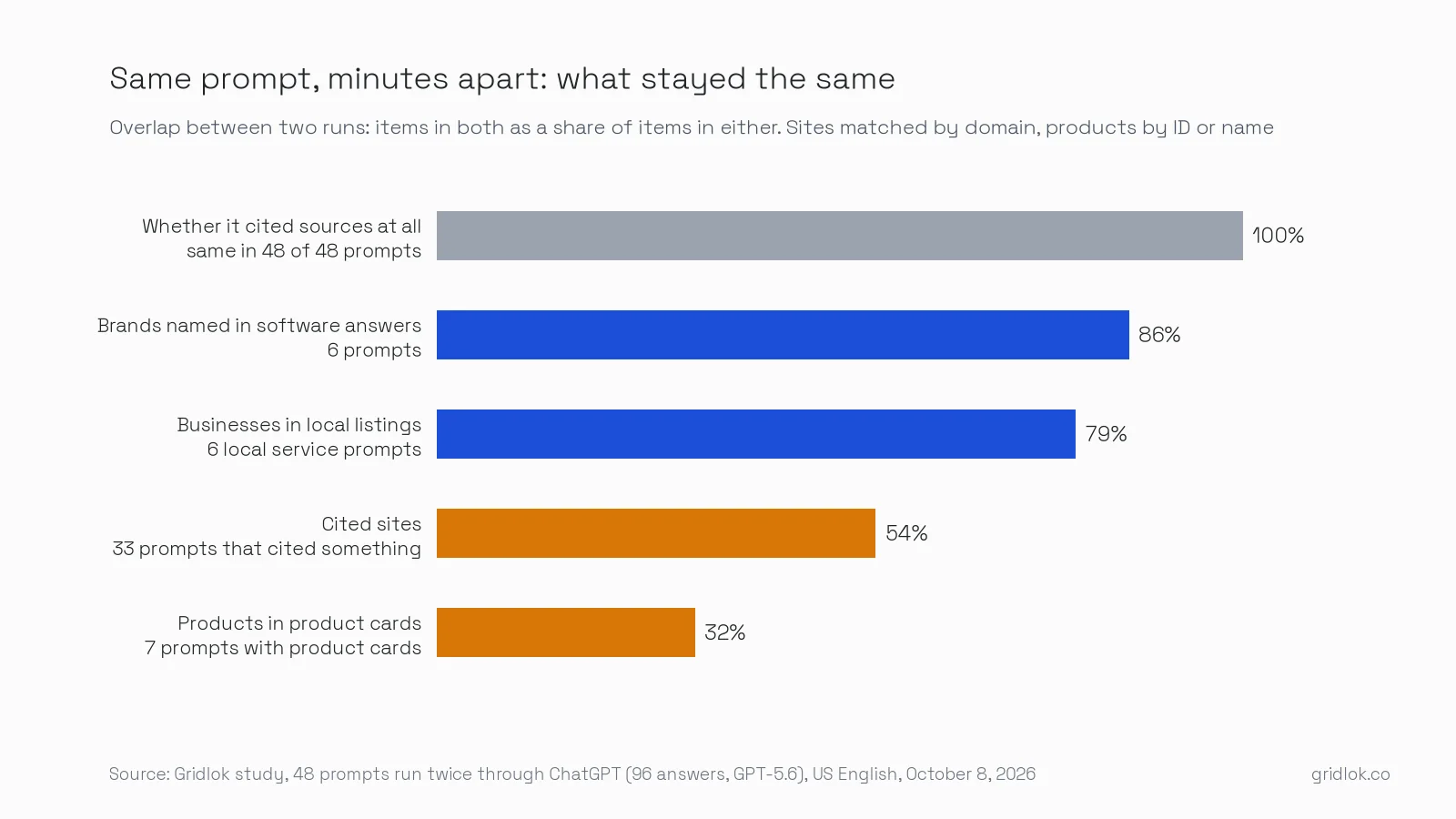
Running every prompt twice, minutes apart, shows what a single check is worth. The decision to search held every time. Brand names held well, with 86% overlap in software answers, and local listings held at 79%.
The links moved. Cited sites overlapped 54% on average, and for 5 of the 33 prompts that cited anything, the two runs shared no cited site at all. Product cards overlapped about a third (32%).
So a tool that checks each prompt once and reports “cited” or “not cited” is reporting one draw. I’d run each prompt three or four times and track mentions alongside links, since mentions held up better. The manual version is in how to check whether AI cites your site.
How to get cited in ChatGPT Intelligent UI answers
This is the order I’d work in.
- OAI-SearchBot access. It’s the crawler behind ChatGPT search, so it needs to be allowed in robots.txt, and your CDN or firewall needs to let OpenAI’s published IP ranges through. OpenAI says robots.txt changes take about 24 hours to register. The GEO Score Checker checks the robots.txt side for OAI-SearchBot and the other AI search crawlers.
- The facts ChatGPT checks, on your own pages. Prices, plans, features, service areas, hours, and details like “accepting new patients,” in plain text. Those pages got the citations in the software, comparison, and dentist answers.
- Coverage where your question type gets cited. For products, that’s review publishers. For local services, it’s directories. For “is it legit” questions, it’s your own policy pages and your BBB profile.
- A product feed. Through the merchant page, through Shopify or Etsy, or through a partner retailer, with every field filled in, ratings included.
- Complete listings with reviews. Every listing in the study showed a rating and an address. For restaurants, add a booking page on OpenTable, Resy, or Yelp.
- Original images and numbers. Images link back to their source page even when the text cites nothing, and charts and generated tools need data from somewhere.
Which OpenAI crawler does what
OpenAI’s crawler documentation lists four user agents and says each robots.txt setting is independent. You can allow OAI-SearchBot for search and block GPTBot from training, for example. The AI crawlers guide covers the robots.txt side for every major AI company.
| User agent | What it does | If you block it |
|---|---|---|
| OAI-SearchBot | Finds pages for ChatGPT search results | Your pages drop out of search answers, though they can still appear as navigational links |
| ChatGPT-User | Visits a page when a person asks ChatGPT about it or a GPT action calls it | robots.txt may not apply, since a person started the visit. OpenAI says it doesn’t decide search inclusion |
| GPTBot | Collects content that may be used to train OpenAI’s models | Your content is marked as off limits for training. Search is a separate setting |
| OAI-AdsBot | Checks landing pages submitted as ChatGPT ads | Only matters if you run ChatGPT ads |
FAQ
I’ll re-run these 48 prompts when the scraper starts returning GPT-6 answers and add what changed to this post.
The 48 prompts
Every prompt in the study, with the number of citations in each run (brand names linked to homepages aren’t counted) and what else the answers contained.
| # | Question type | Prompt | Citations (run 1 / run 2) | Also in the answers |
|---|---|---|---|---|
| 1 | Shopping | best robot vacuum under $500 | 2 / 4 | Product cards |
| 2 | Shopping | best running shoes for flat feet | 3 / 1 | Table (one run), Product cards |
| 3 | Shopping | best espresso machine for beginners | 4 / 2 | Table (one run), Product cards |
| 4 | Shopping | best mattress for side sleepers with back pain | 5 / 5 | Table (one run), Product cards |
| 5 | Shopping | best cordless drill for home projects | 2 / 4 | Table (one run), Product cards |
| 6 | Shopping | best noise cancelling headphones under $300 | 3 / 1 | Table, Product cards |
| 7 | Local services | best plumber in Detroit | 2 / 1 | Local listings |
| 8 | Local services | emergency furnace repair in Troy Michigan | 1 / 2 | Local listings |
| 9 | Local services | best Italian restaurant in Royal Oak Michigan | 3 / 4 | Local listings |
| 10 | Local services | junk removal company near Sterling Heights Michigan | 1 / 1 | Local listings |
| 11 | Local services | family dentist in Ann Arbor accepting new patients | 5 / 3 | Local listings |
| 12 | Local services | best auto repair shop in Grand Rapids | 4 / 2 | Local listings |
| 13 | Software | best CRM for a small business | 3 / 3 | Table |
| 14 | Software | best accounting software for freelancers | 3 / 2 | Table |
| 15 | Software | best email marketing platform for an online store | 3 / 3 | Table |
| 16 | Software | best project management tool for a small agency | 2 / 3 | Table |
| 17 | Software | best website builder for a restaurant | 4 / 4 | Table (one run) |
| 18 | Software | best SEO tool for a small business | 3 / 3 | Table |
| 19 | Comparisons | Roth IRA vs traditional IRA, which is better for me | 0 / 0 | Table (one run) |
| 20 | Comparisons | heat pump vs gas furnace cost to run | 0 / 0 | Text only |
| 21 | Comparisons | Shopify vs WooCommerce for a new store | 0 / 0 | Table |
| 22 | Comparisons | Costco vs Sam’s Club membership, which is worth it | 3 / 2 | Table |
| 23 | Comparisons | iPhone vs Pixel, which phone should I buy this year | 3 / 2 | Table, Product cards (one run) |
| 24 | Comparisons | metal roof vs asphalt shingles | 0 / 0 | Table |
| 25 | Explainers | how does a heat pump work | 0 / 0 | Text only |
| 26 | Explainers | explain the central limit theorem simply | 0 / 0 | Text only |
| 27 | Explainers | how do credit scores work | 0 / 0 | Table |
| 28 | Explainers | how does compound interest work | 0 / 0 | Table (one run) |
| 29 | Explainers | how do noise cancelling headphones work | 0 / 0 | Images |
| 30 | Explainers | how does a 401k match work | 0 / 0 | Text only |
| 31 | Planning | plan a 3 day road trip from Detroit to Chicago with stops worth a detour | 6 / 6 | Table, Local listings |
| 32 | Planning | timing plan for a Sunday roast dinner for six people | 0 / 0 | Table |
| 33 | Planning | plan a week of healthy dinners for a family of four on a budget | 0 / 0 | Table |
| 34 | Planning | how much does a kitchen remodel cost and how should I budget it | 2 / 4 | Table |
| 35 | Planning | plan a 4 day trip to Yellowstone in July | 5 / 6 | Table, Local listings (one run) |
| 36 | Planning | 12 month wedding planning checklist | 0 / 0 | Text only |
| 37 | Calculations | mortgage payment on a $400,000 home with 10% down at 6.5% | 1 / 1 | Text only |
| 38 | Calculations | how much do I need to save each month to retire at 65 with $1 million | 1 / 2 | Table |
| 39 | Calculations | split a $186 dinner bill between 5 people with a 20% tip | 0 / 0 | Text only |
| 40 | Calculations | how much paint do I need for a 12 by 14 foot room | 0 / 0 | Text only |
| 41 | Calculations | how long will it take to pay off $25,000 at 7% paying $500 a month | 1 / 1 | Text only |
| 42 | Calculations | convert 350 F to celsius and adjust baking time for a convection oven | 1 / 3 | Text only |
| 43 | Brand checks | is Roborock a good brand | 3 / 3 | Table (one run) |
| 44 | Brand checks | is HelloFresh worth the money | 4 / 2 | Table (one run) |
| 45 | Brand checks | best alternative to QuickBooks for a small business | 1 / 2 | Table |
| 46 | Brand checks | is Wayfair furniture good quality | 3 / 4 | Text only |
| 47 | Brand checks | is Angi a good way to find contractors | 2 / 4 | Text only |
| 48 | Brand checks | is Thumbtack legit for hiring a handyman | 2 / 5 | Text only |
Sources
- Gridlok, this study: 48 prompts run twice on October 8, 2026 through DataForSEO’s ChatGPT LLM Scraper, US English. 96 answers, all reported as GPT-5.6, with 186 citations (135 unique URLs), 51 distinct product cards, and 66 local listings. Plus screenshots of two ChatGPT answers and one Google search, October 8, 2026.
- OpenAI, GPT-6 and Intelligent UI for everyone, October 7, 2026.
- OpenAI Help Center, GPT-6 and other models in ChatGPT.
- OpenAI Help Center, Searching the web with ChatGPT.
- OpenAI, Overview of OpenAI Crawlers, and the OAI-SearchBot IP list.
- OpenAI, Powering Product Discovery in ChatGPT, March 24, 2026.
- OpenAI, Power product discovery in ChatGPT (merchant page), and the Agentic Commerce product feed spec.
- OpenAI, Building advertising for the way people use AI, October 5, 2026.
- Matt G. Southern, Search Engine Journal, ChatGPT Gets GPT-6 And Intelligent UI For Interactive Answers, October 7, 2026.
See what ChatGPT is really searching
SubSeed captures the hidden Google queries ChatGPT runs behind every answer and enriches them with search volume, CPC, and keyword difficulty.
Related Posts
Read this post with an assistant
This is the whole prompt each button sends. Nothing hidden in it.
Read https://gridlok.co/blog/chatgpt-intelligent-ui/ and give me the main points in a few sentences.
Make Gridlok a Preferred Source on Google
See Gridlok surfaced more often in your Top Stories, AI Overviews, and AI Mode. One click, applied across Google Search.