The ChatGPT Plateau: What’s Actually Happening in the AI Assistant Market
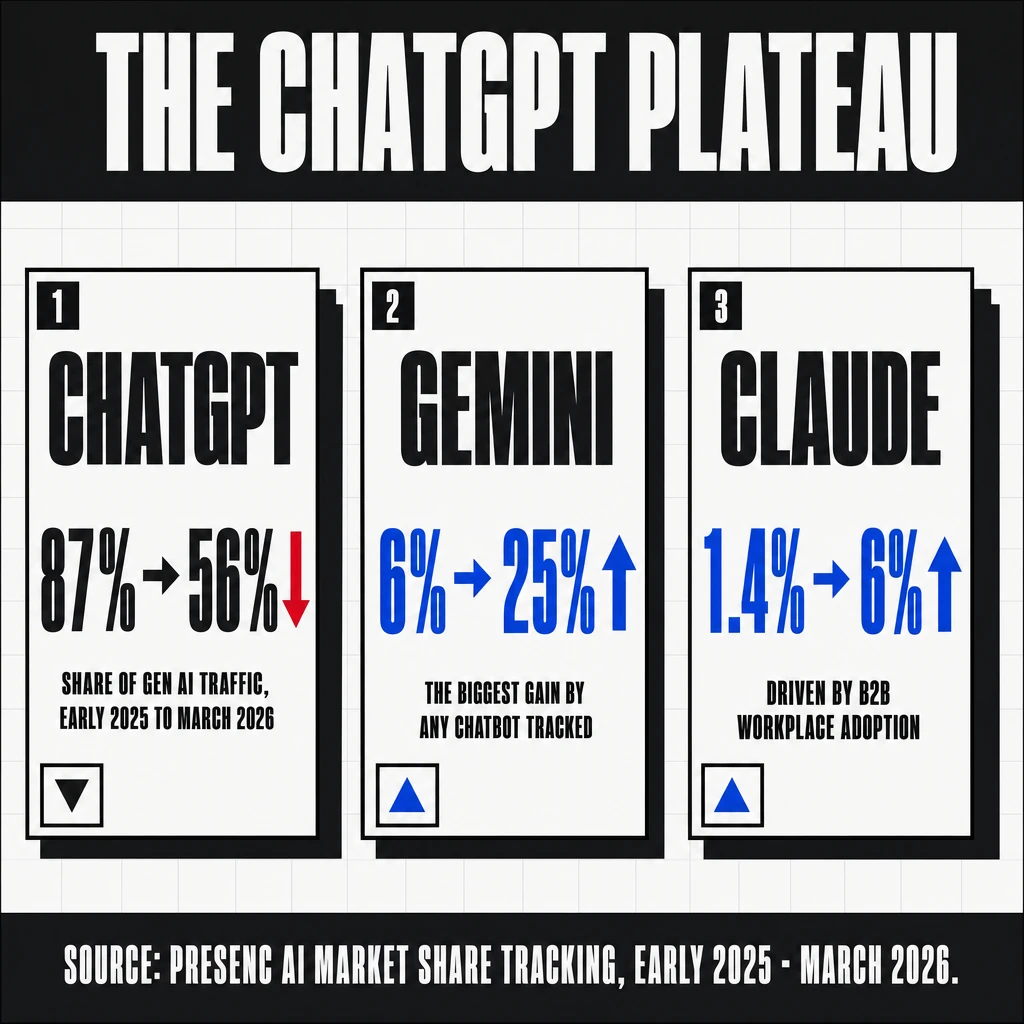
ChatGPT was 87% of generative AI web traffic in early 2025. By March 2026 it was 56.72% (Presenc AI, 2026).
That is a 30-point share loss in twelve months while the overall market grew. It happened quietly enough that most coverage missed the shape of it.
Gemini went from 6% to 25.46% over the same window, the largest share gain by any AI chatbot tracked (Presenc AI, 2026). Claude grew from 1.4% to 6.02%. The pattern is consistent across BrightEdge, Presenc AI, and First Page Sage market share reports.
OpenAI’s product behavior confirms the data. The company doubled its workforce from 4,500 to a target of 8,000 by end of 2026 (Creati, 2026), shifted Codex pricing to token-based on April 2, 2026, and Nick Turley publicly floated phasing out unlimited plans by comparing them to “unlimited electricity” (Fritz AI, 2026).
This is what a market leader pivoting to B2B looks like when the consumer growth curve gets harder.
Key Takeaways
- ChatGPT share of generative AI web traffic dropped from 87% (early 2025) to 56.72% (March 2026). The April number recovered slightly to 79.0% on a different measurement methodology, but the overall trend is clear (Presenc AI, ALM Corp, 2026).
- Gemini grew from 6% to 25.46% over the same period. Claude grew from 1.4% to 6.02%. Both gains came primarily from ChatGPT’s loss, not from market expansion alone.
- OpenAI is doubling its workforce to 8,000 by end of 2026 and explicitly prioritizing enterprise. The API business grew faster than ChatGPT consumer in 2025 (Creati, 2026).
- The unlimited ChatGPT plan is on its way out. Nick Turley compared it to “unlimited electricity” while signaling future pricing changes. Codex pricing already moved to token-based on April 2, 2026.
- Altman has softened the AGI marketing language. He now says “the AGI term has become hugely overloaded” and reframed 2026 as the year of the “AI Research Intern” instead of the inflection toward general intelligence.
- The bottom line: ChatGPT is still the market leader, but the assistant market is rapidly diversifying. Anyone optimizing for “AI search” as a monolithic channel is mis-modeling the audience.
The Market Share Numbers
Three independent data sources tell the same story with slightly different baselines.
Presenc AI tracks AI platform market share by web traffic. Their data shows ChatGPT at 87% in early 2025 falling to 56.72% by March 2026. Gemini rose from 6% to 25.46%. Claude rose from 1.4% to 6.02%.
BrightEdge measures consumer AI referral share. Their Q1 2026 report makes Gemini the number-two consumer AI referral source, “larger than every other ChatGPT rival combined” (GlobeNewswire, 2026).
ALM Corp tracks AI referral share with a different methodology. They show ChatGPT going from 89.2% to 81.4% in Q1 (a 7.8-point QoQ decline), then recovering to 79.0% in April. Gemini tripled from 4.3% to 11.6% in Q1, reaching 13.2% in April. Claude doubled from 1.1% to 2.3% in Q1, reaching 3.6% in April.
The absolute share numbers vary by methodology. The direction is consistent across all three.
| Platform | Early 2025 | March 2026 | Change |
|---|---|---|---|
| ChatGPT | 87.00% | 56.72% | -30.28 percentage points |
| Gemini | 6.00% | 25.46% | +19.46 percentage points |
| Claude | 1.40% | 6.02% | +4.62 percentage points |
Source: Presenc AI, as cited in the article. This dataset measures generative AI web traffic share, not total users or revenue.
The OpenAI Pivot Confirms the Data
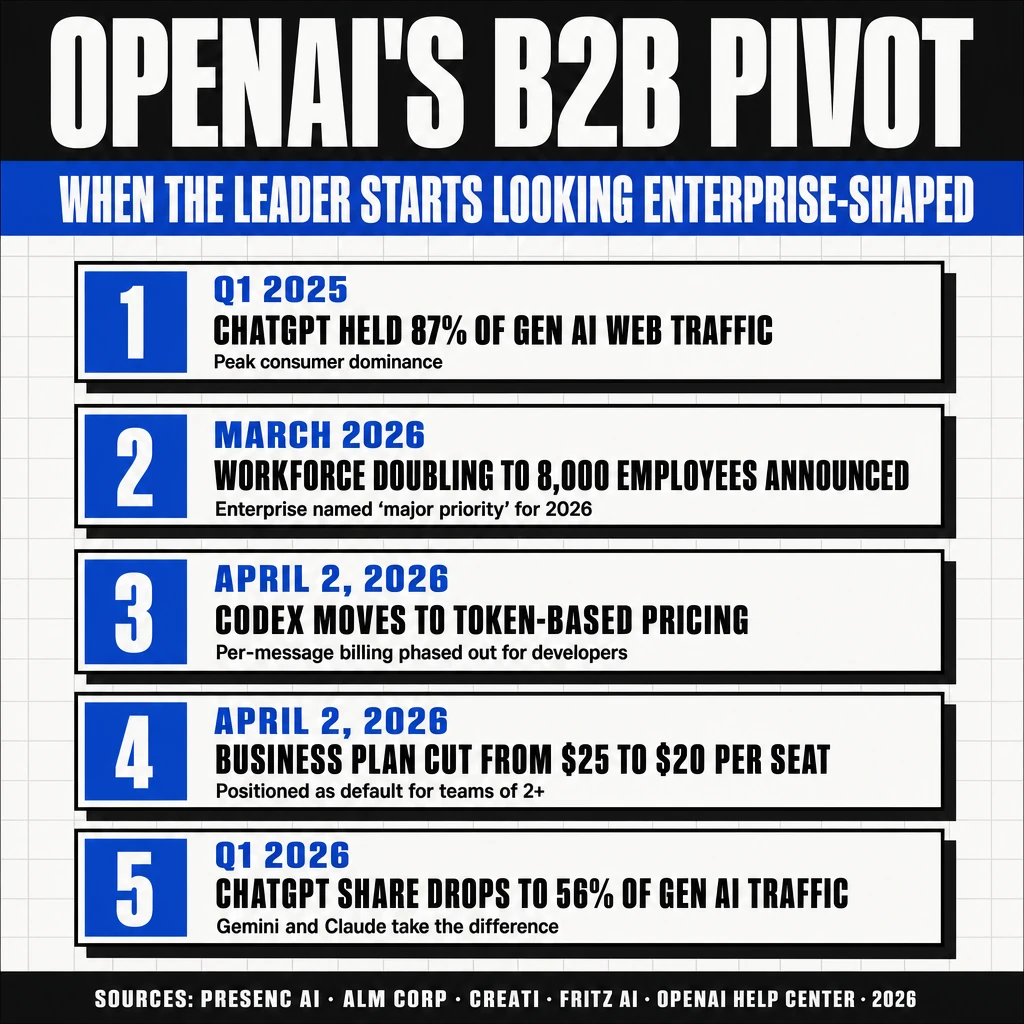
A company that owns 87% of a market does not double its workforce in twelve months unless the curve is harder than it was.
OpenAI announced in March 2026 it would expand from approximately 4,500 employees to 8,000 by year end (Creati, 2026). The framing was “commercialization, infrastructure development, and complex policy governance.” Enterprise was named a “major priority” for 2026.
The pricing changes followed the same direction.
- April 2, 2026: Codex pricing moved from per-message to API token usage (Fritz AI, 2026)
- April 2, 2026: ChatGPT Business price dropped from $25 to $20 per seat on annual billing, positioned as the default pick for teams of 2+
- New Codex-only seat type added to ChatGPT Business and Enterprise plans, with flexible token-based pricing
- Enterprise pricing settled at $40-75 per seat per month with a ~150-seat minimum, adding role-based access control, audit logs, and 24/7 SLA support
None of these moves target a consumer growing fast enough to be the priority. They target enterprise IT buyers who care about role-based access, audit logs, SLAs, and token-cost predictability.
Nick Turley said pricing will “significantly evolve” and floated phasing out unlimited plans. A company comfortable with its consumer growth does not threaten its own subscribers with that framing.
Why Gemini Is Winning Share
Gemini’s share gain looks structural, not stylistic.
Three advantages compounding at once:
- Browser distribution. Gemini is integrated into Chrome at the OS level on Android, in the search bar, and as a sidebar in Chrome desktop. ChatGPT requires a deliberate decision to open a separate tab.
- Workspace integration. Gmail, Docs, Sheets, Meet, and Drive surface Gemini features inline. The activation cost for a Google Workspace user to try Gemini is zero.
- Model quality reached competitive parity in 2025. Gemini 2.5 closed the gap on most benchmarks. Once parity was reached, distribution decided the rest.
The history rhyme is Bing in 2009 versus Google. Better technology cannot overcome distribution at scale. ChatGPT was the better product in 2023, kept the lead through 2024, and is now watching the distribution-first competitor compound. Gemini is the assistant whose growth I would extrapolate most confidently into 2027.
Why Claude Is Spiking
Claude’s growth has different shape from Gemini’s. Where Gemini grows on distribution, Claude grows on workplace adoption.
The 1.4% to 6.02% jump came mostly from B2B users (Presenc AI, 2026). Anthropic published enterprise customer counts and revenue growth in early 2026 showing a similar pattern: developer tools, software engineering automation, and high-stakes B2B workflows.
The Claude growth driver looks like coding agents and writing tasks at companies. The shift from “consumer chatbot” to “workplace tool” is happening fastest for Claude.
This connects to a broader pattern I covered separately: AI adoption is not evenly distributed across consumer and business audiences. The data has been pointing toward “AI as B2B tool” for over a year. The Claude growth curve is one of the cleanest expressions of that shift.
What This Means for Practitioners
Operational implications for SEO and content work in the next six months:
- Stop treating “AI search” as one channel. Optimizing only for ChatGPT citations is the equivalent of optimizing only for Yahoo in 2005. The market is diversifying fast enough that the right approach is per-assistant tracking.
- Track Gemini citation rate as the highest-priority new measurement. Gemini’s share gain is the biggest single move in the data, and its integration with Google Search means a Gemini citation is also a Google citation pathway.
- Audit your content for Claude-style usage if you serve B2B. Claude is disproportionately used in technical, research, and business workflows. If your audience is professional, Claude usage is higher than aggregate market share suggests.
- Plan for ChatGPT-only optimization to lose ROI. Not “ChatGPT is dying” (it is not), but “ChatGPT is one of several” is the operating model now.
I cover the practitioner-level approach to citation-rate measurement in my piece on what is actually new in AI-search optimization. The three-question vendor test in that piece applies cleanly to any “Gemini optimization” or “Claude optimization” pitch you encounter from this point forward.
FAQ
Sources & References
- Presenc AI. “AI Platform Market Share 2026.” 2026. presenc.ai
- ALM Corp. “Google Gemini vs ChatGPT Market Share 2026: Gemini Surges to 21.5% as ChatGPT Drops to 64%.” 2026. almcorp.com
- GlobeNewswire / BrightEdge. “BrightEdge Data: Gemini Becomes No. 2 Consumer AI Referral Source in Q1 2026.” May 20, 2026. globenewswire.com
- Creati. “OpenAI Plans to Nearly Double Workforce to 8,000 Employees by End of 2026.” March 22, 2026. creati.ai
- Fritz AI. “ChatGPT Pricing in 2026: Every Plan, Tier, and Hidden Cost Explained.” 2026. fritz.ai
- OpenAI. “Codex rate card.” OpenAI Help Center, April 2, 2026. help.openai.com
- OpenAI. “ChatGPT Rate Card (Business, Enterprise/Edu).” OpenAI Help Center, 2026. help.openai.com
- TechnologyChecker. “ChatGPT Statistics 2026 – 900M Users, $25B ARR.” May 2026. technologychecker.io
- Hunt, Jim. “AEO Is Just SEO With New Acronyms.” Gridlok, May 2026. gridlok.co
- Hunt, Jim. “The Data Disagrees With the ‘Google Is Dying’ Narrative.” Gridlok, May 2026. gridlok.co
See what ChatGPT is really searching
SubSeed captures the hidden Google queries ChatGPT runs behind every answer and enriches them with search volume, CPC, and keyword difficulty.
Related Posts


Read this post with an assistant
This is the whole prompt each button sends. Nothing hidden in it.
Read https://gridlok.co/blog/chatgpt-plateau-claude-gemini-rising/ and give me the main points in a few sentences.
Make Gridlok a Preferred Source on Google
See Gridlok surfaced more often in your Top Stories, AI Overviews, and AI Mode. One click, applied across Google Search.