Why Use Predictive Eye Tracking (And When Real Data Beats It)
Predictive eye tracking estimates where a person will look at a page, using a model trained on recorded gaze data, without recruiting a participant or waiting for a visitor. The fair question is why anyone would want an estimate when real measurement exists.
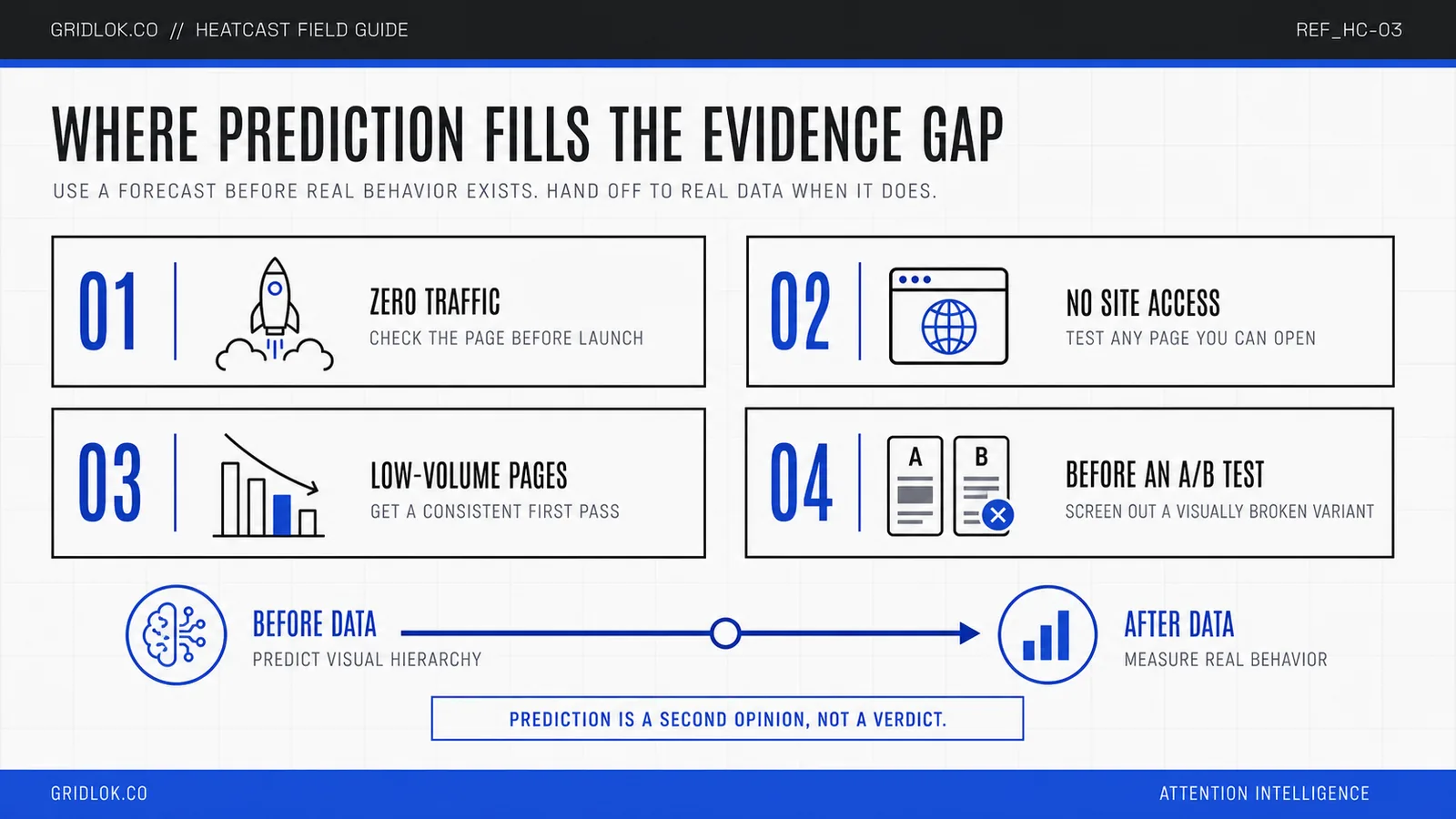
My answer is narrow. Measuring real attention needs four things at once: a page that already exists, traffic arriving at it, your tracking code installed on it, and enough weeks for the sample to mean anything. Take away any one of those and measurement is off the table. That describes most of the pages I actually need to make decisions about.
Key takeaways
- Predictive eye tracking works on a page with zero traffic, which moves the moment you can catch a hierarchy problem from weeks after launch to before it.
- It runs on any page you can load in a browser, including competitors and prospect sites, where installing a tracking script was never an option.
- The output is a hypothesis about visual hierarchy, good for spotting a buried headline or a call to action the eye never reaches.
- It answers a different question than recorded behavior, so where you have traffic and time, real data still wins.
What is predictive eye tracking?
Predictive eye tracking uses a saliency model to estimate where visual attention will concentrate on an image or a screen. The model was trained on datasets where researchers recorded real people’s gaze with eye-tracking hardware, so it has learned the relationship between what a screen contains and where eyes tend to go.
Feed it a page it has never seen and it produces a heatmap of predicted fixation density, plus in some tools a predicted order of looking. No camera, no panel of participants, no visitors required. The prediction is about people in general, not about the specific human sitting in front of the screen.
Why traffic-based heatmaps leave a gap
Click maps, scroll maps, and session recordings are genuinely good tools and I use them. They share one limit. Something has to happen before any of them can show you anything.
A brand new landing page has no clicks to map. A page getting forty visits a month will take most of a year to produce a scroll map you can trust. A competitor’s pricing page will never let you install a script on it. And a client who hasn’t signed yet isn’t going to hand over analytics access so you can win the pitch.
Those gaps aren’t edge cases for me. They cover the launch, the redesign, the competitive teardown, and the entire long tail of pages that matter individually but never reach statistical significance on their own.
Where predicted attention earns its place
Before a page has any visitors
This is the one I reach for most. A page goes live, real money starts pointing at it, and the first honest read on whether the hierarchy works arrives three weeks later in the conversion data. By then the traffic that hit the broken version is spent.
Running a prediction on the staging version costs a few seconds and catches the loud problems: a hero image that outcompetes the headline, a call to action sitting in a dead zone, a trust badge pulling more attention than the offer. None of that needs a visitor to become visible.
It catches things you stop seeing after the tenth look at your own layout. A page I read as leading with the offer was actually leading with a stock photo, and the prediction is what surfaced it.
On pages you don’t own
A prediction runs on anything you can load in a browser, which opens up the entire competitive set. You can look at how the three sites outranking your client structure their above-the-fold space, and what their layouts push the eye toward first.
For pitch work this is the difference between an opinion and an exhibit. Telling a prospect their phone number gets ignored is an argument. Showing them a predicted heatmap where their phone number sits in a cold corner while a rotating banner takes the first two fixations is a conversation starter that doesn’t depend on them believing me.
On the long tail that will never reach significance
Most sites have a handful of pages with real traffic and a few hundred with a trickle. Service area pages, blog posts, secondary product pages. Individually none of them will ever produce a usable behavioral heatmap, and collectively they’re often a large share of the site.
A prediction gives you a consistent read across all of them for the same cost per page, which is roughly zero. That turns a question you were never going to answer into a pass you can actually make.
Before you spend a test on the wrong variant
A/B tests are expensive in the currency that matters, which is time and traffic. If you have four candidate layouts and enough traffic to test one properly this quarter, the choice of which one to test is itself a decision worth informing.
Predicting attention across all four takes minutes and can knock out the variant where nothing reaches the button. The test still decides the winner. The prediction just keeps you from spending the test on a variant that was visually broken from the start. That instinct is the same one behind refusing to guess how your customers behave, applied one step earlier in the process.
What predicted attention doesn’t tell you
A prediction models bottom-up looking, the reflexive pull of contrast, edges, faces, and isolation. It doesn’t know your visitor’s goal, and goal changes everything. Someone hunting for a price scans a page differently than someone browsing on a lunch break, and the model has no access to which one just arrived.
It also predicts an aggregate, the shared pattern across many viewers, rather than what any individual will do. And it’s silent on whether your copy is any good. A prediction can tell you the headline gets seen first. Whether the headline is worth seeing is still your problem.
The one claim I want to be blunt about: this isn’t a ranking factor. Predicted attention is a design and conversion input. Anyone selling it as a way to move positions in search results is selling you something else.
Where this fits alongside SEO and AEO work
The connection is real, and it runs through structure rather than rankings. A page where a human eye finds the main point quickly is usually a page built with a clear hierarchy: one dominant heading, an answer near the top, sections that separate cleanly. Those are the same properties that make a page easy for a language model to parse and quote.
So I treat an attention prediction as a second opinion on hierarchy. When the heatmap shows attention scattered with no clear winner, that usually means the page has no visual answer to the question it’s supposedly about, which is the same failure that keeps it out of AI citations for service businesses. It’s one more angle on the argument that AEO is mostly SEO with new acronyms.
It’s a usability check that happens to line up with what machine readers reward. Useful, worth doing, and no substitute for the rest of the work.
How I actually use it
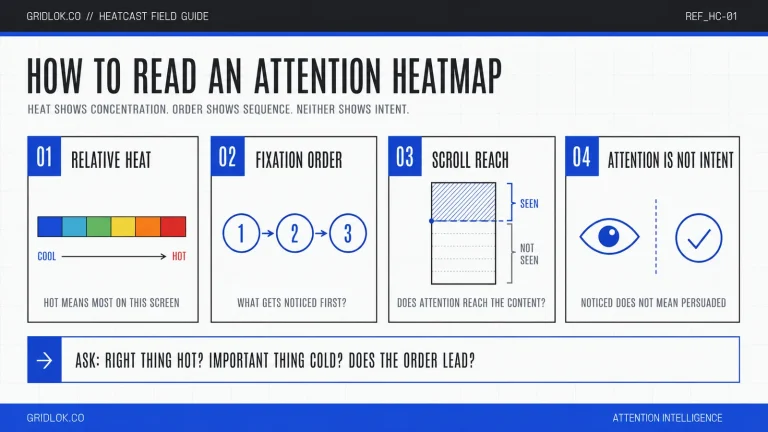
My routine is short. Before a page ships, I run a prediction on it and ask whether the first predicted fixation lands on the thing I most want noticed. If it doesn’t, I change the page and run it again. The rest of the questions I ask of a map are in how to read an attention heatmap.
After the page ships and traffic accumulates, I stop asking the prediction and start asking the analytics. The prediction was scaffolding for a decision I had to make before data existed. Once data exists, it’s the better witness.
That’s the whole workflow I built Heatcast around. It runs the model on your own machine, so the page you’re testing never leaves your device, which also means you can point it at a staging URL behind a login without shipping anything anywhere.
FAQ
Predictive eye tracking works in the places measurement can’t reach, which turns out to be most of the moments when the decision is still cheap to change. That’s the whole case for it.
Sources
- Hu and McGuinness, “FastSal: a Computationally Efficient Network for Visual Saliency Prediction” (2020), the efficient saliency model class these tools are built on. arxiv.org/abs/2008.11151
- Jiang et al., “UEyes: Understanding Visual Saliency across User Interface Types,” CHI 2023, on why interfaces need different calibration than natural images. github.com/YueJiang-nj/UEyes-CHI2023
- MIT/Tübingen Saliency Benchmark, on how saliency models are evaluated against held-out human eye-tracking data. saliency.tuebingen.ai
See what ChatGPT is really searching
SubSeed captures the hidden Google queries ChatGPT runs behind every answer and enriches them with search volume, CPC, and keyword difficulty.
Related Posts
Read this post with an assistant
This is the whole prompt each button sends. Nothing hidden in it.
Read https://gridlok.co/blog/why-use-predictive-eye-tracking/ and give me the main points in a few sentences.
Make Gridlok a Preferred Source on Google
See Gridlok surfaced more often in your Top Stories, AI Overviews, and AI Mode. One click, applied across Google Search.