Claude Mythos Leaked: What We Know About Anthropic’s Most Powerful AI Model
Key Takeaways
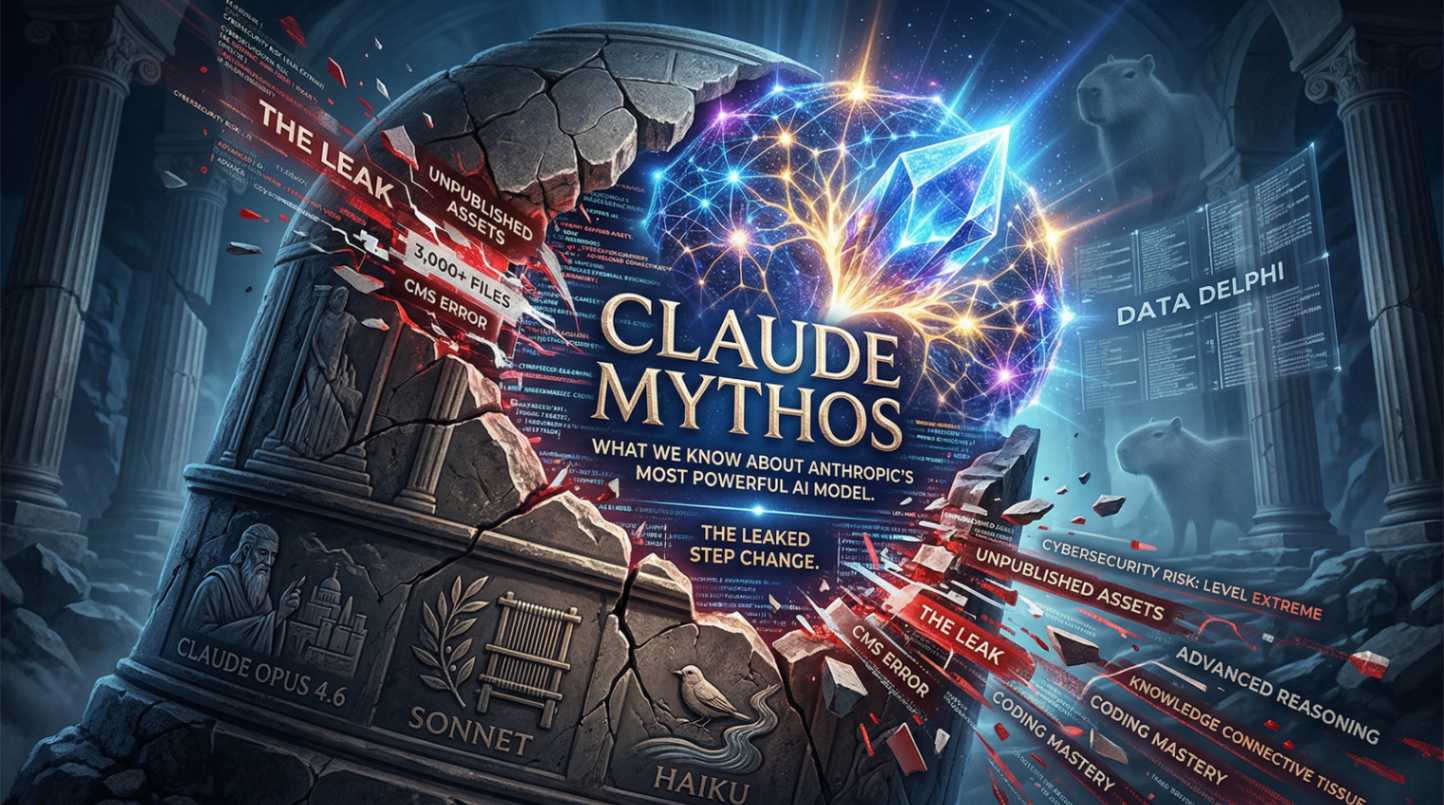
- Anthropic accidentally exposed details of Claude Mythos, an unreleased AI model it describes as “a step change” in capability and “the most capable we’ve built to date.”
- Mythos sits in a new tier called “Capybara,” positioned above the existing Opus models. It scores dramatically higher than Claude Opus 4.6 on coding, reasoning, and cybersecurity benchmarks.
- Anthropic’s own internal documents warn that Mythos poses “unprecedented cybersecurity risks” and could allow attackers to find and exploit vulnerabilities faster than defenders can patch them.
- The leak triggered a market selloff. The iShares Cybersecurity ETF dropped 4.5%. Individual stocks like CrowdStrike, Palo Alto Networks, and Zscaler each fell roughly 6%. Tenable lost 9%.
Claude Mythos Leaked Through a CMS Misconfiguration
Claude Mythos is an unreleased AI model from Anthropic that was never supposed to be public yet. On March 26, 2026, Fortune reported that a misconfigured content management system left roughly 3,000 unpublished assets sitting in a publicly searchable, unencrypted data store on Anthropic’s website.
Among those assets were draft blog posts describing a model called Claude Mythos, internal capability assessments, CEO event materials, images, and PDFs. Security researchers at LayerX Security and the University of Cambridge found the materials before Fortune contacted Anthropic.
Anthropic acknowledged the leak and attributed it to “human error” in their CMS configuration. A spokesperson confirmed the model exists and is being tested with early access customers.
The irony here is hard to ignore. Anthropic positions itself as the safety-first AI company. It built its brand on responsible development and careful deployment. And the existence of its most powerful and most dangerous model was exposed by a basic web infrastructure mistake.
What Is Claude Mythos and the Capybara Tier?
Anthropic’s current model lineup uses three tiers: Haiku (lightweight), Sonnet (balanced), and Opus (most capable). Mythos breaks that structure by introducing a fourth tier called Capybara, sitting above Opus.
From the leaked drafts: “‘Capybara’ is a new name for a new tier of model: larger and more intelligent than our Opus models, which were, until now, our most powerful.”
Capybara is the tier. Mythos is the specific model within it. Think of it the same way Opus 4.6 is a model within the Opus tier.
The name was chosen to “evoke the deep connective tissue that links together knowledge,” according to the draft posts. Anthropic was apparently deciding between the two names right up until the leak. An archived copy of the leaked drafts shows both a “v1 Mythos” and “v2 Capybara” version of the announcement with nearly identical content and strategic name swaps.
Anthropic’s spokesperson described Mythos as “a step change” in AI performance and “the most capable we’ve built to date.” That language is deliberate. They’re not calling it an incremental improvement. They’re signaling a generational jump.
Claude Mythos Capabilities Based on the Leaked Documents
The leaked materials describe six core capability areas where Mythos outperforms Claude Opus 4.6. No specific benchmark numbers were published, but the qualitative descriptions are consistent across all leaked documents.
Cybersecurity
This is the headline capability and the one driving most of the public reaction. The leaked docs describe Mythos as “currently far ahead of any other AI model in cyber capabilities.” That includes OpenAI’s GPT-5.3-Codex, which was the first model OpenAI classified as “high capability” for cybersecurity tasks under its Preparedness Framework.
Mythos can reportedly identify software vulnerabilities in production codebases at a scale and speed that no previous model could match.
Code Generation and Debugging
“Dramatically higher scores” on software coding tests compared to Opus 4.6. The leaked materials describe improved reliability in writing, debugging, and understanding complex code.
Academic Reasoning
Significantly improved performance on reasoning tasks that require multi-step logic and establishing connections between concepts.
Complex Multi-Step Reasoning
Beyond academic benchmarks, Mythos reportedly handles extended chains of reasoning with fewer compounding errors than current models.
Agentic Workflows
Improved consistency in autonomous task execution. If you’ve used Claude for multi-step agent workflows and hit reliability walls, this is the capability aimed at fixing that.
Proactive Vulnerability Discovery
A distinct capability from the general cybersecurity category. This is about the model actively scanning for and identifying security weaknesses, not just responding to prompts about known vulnerabilities.
Why Cybersecurity Stocks Tanked on the News
The market reaction was immediate and sharp. Cybersecurity stocks plunged within hours of the Fortune report going live.
The iShares Cybersecurity ETF (CIBR) dropped 4.5%. Individual stocks took bigger hits: CrowdStrike, Palo Alto Networks, and Zscaler each fell roughly 6%. SentinelOne dropped 6%. Okta and Netskope each lost more than 7%. Tenable, which specializes in vulnerability management, fell 9%.
Bitcoin also slid alongside software stocks, though the connection there is looser.
The logic behind the selloff is straightforward. If an AI model can find and exploit vulnerabilities faster than human security teams can patch them, the value proposition of traditional cybersecurity companies gets harder to defend. Investors priced in that risk within hours.
Whether that reaction is overblown depends on how you read Anthropic’s own internal assessment. Their leaked docs didn’t say Mythos might pose cybersecurity risks. They said it “presages an upcoming wave of models that can exploit vulnerabilities in ways that far outpace the efforts of defenders.”
That’s not hedging. That’s an AI company telling itself, in documents it never meant to publish, that this model could tip the balance between offense and defense in cybersecurity.
What This Means for AI Search and Content Strategy
If you’re in the SEO or content space, the Mythos leak matters beyond the cybersecurity headlines.
A model with dramatically better reasoning and agentic capabilities changes the calculus for AI-powered search citation. If Anthropic releases Mythos broadly, Claude-powered search products and API integrations will process and synthesize content at a higher level than anything currently available.
For content creators, that changes the game in a concrete way. Current models already show preference for content that provides original data, specific examples, and clear answers to specific questions when selecting what to cite in AI-generated responses.
A model with stronger reasoning can better evaluate whether a page is genuinely answering a question or just restating what ten other pages already say. It can spot when statistics are sourced versus fabricated, when examples are specific versus generic, and when a piece adds new information versus repackaging existing content.
If you’re building content to get cited by AI systems, that means surface-level keyword targeting and thin listicles become even less effective. The content that gets cited will be the content that provides something the model can’t synthesize on its own: proprietary data, real-world case studies, expert analysis with a stated methodology, or tested frameworks with documented results.
The agentic workflow improvements also signal where the industry is headed. AI agents that can autonomously execute multi-step tasks with fewer errors will reshape how businesses interact with search, content, and automation. AI search usage doubled in 2025. A model like Mythos accelerates that curve.
Release Timeline and Pricing
Anthropic is being deliberately slow with the Mythos rollout. The model is currently in early access testing with a limited number of customers, with initial access restricted to cybersecurity defense use cases.
The leaked drafts describe a phased plan: start with a “small number of early-access customers,” then expand to “more customers using the Claude API over the coming weeks.” The early access expansion would prioritize cybersecurity use cases specifically, giving defenders a head start before broader availability.
From the leaked documents: Mythos is “very expensive for us to serve, and will be very expensive for our customers to use.” No specific pricing was included, but positioning it above Opus suggests a significant premium.
No public release date has been confirmed. Some speculation ties a broader launch to Anthropic’s reported consideration of an IPO as early as Q4 2026, but that’s conjecture at this point.
The drafts also note that Mythos has been “tested on a very wide variety of safety and capability evaluations,” though no specific evaluation results were included in the leaked materials.
The rollout strategy makes sense given what the model can do. Releasing a tool that can find and exploit software vulnerabilities at unprecedented speed requires careful gating. Anthropic appears to be giving cybersecurity defenders a head start before making the model widely available.
The Bigger Picture for AI Development
Mythos represents the first time a major AI lab has publicly acknowledged (involuntarily, in this case) that one of its own models poses a specific, named category of risk that it considers unprecedented.
OpenAI has classified models under its Preparedness Framework before. Google DeepMind has its own safety evaluations. But neither has used language this direct about a specific model being a threat to cybersecurity at scale.
The fact that this assessment was internal, not intended for public consumption, makes it more credible. Companies tend to soften their language in public communications. What Anthropic wrote for itself was blunter than anything they’d put in a press release.
For anyone building on AI, whether that’s search optimization, content strategy, or product development, Mythos is a signal. The capability curve hasn’t just continued. It jumped. And the company that built it is worried about the implications.
If you’re building AI-first search strategies or thinking about how models like this will affect your business, now is the time to get your infrastructure in order. The models are getting smarter faster than most strategies account for.
Frequently Asked Questions
What is Claude Mythos?
Claude Mythos is an unreleased AI model from Anthropic that sits in a new tier called Capybara, above the existing Opus tier. It was revealed through an accidental data leak on March 26, 2026. Anthropic describes it as “a step change” in capabilities, with dramatically higher scores than Claude Opus 4.6 on coding, reasoning, and cybersecurity benchmarks.
How was Claude Mythos leaked?
A misconfiguration in Anthropic’s content management system left approximately 3,000 unpublished assets in a publicly searchable, unencrypted data store. Security researchers found draft blog posts, internal assessments, and other materials describing the model before Fortune broke the story.
When will Claude Mythos be available?
No public release date has been announced. The model is currently in early access testing with select customers, focused on cybersecurity defense use cases. Anthropic has described it as “very expensive to serve” and is taking a deliberately slow rollout approach. Get in touch if you want to discuss how upcoming model releases could affect your AI search strategy.
Why did cybersecurity stocks drop after the leak?
Anthropic’s internal documents warned that Mythos could “exploit vulnerabilities in ways that far outpace the efforts of defenders.” Investors interpreted this as a threat to the value proposition of traditional cybersecurity companies. The iShares Cybersecurity ETF fell 4.5%, with individual stocks like Tenable dropping as much as 9%.
See what ChatGPT is really searching
SubSeed captures the hidden Google queries ChatGPT runs behind every answer and enriches them with search volume, CPC, and keyword difficulty.
Related Posts


Read this post with an assistant
This is the whole prompt each button sends. Nothing hidden in it.
Read https://gridlok.co/blog/claude-mythos-leaked-what-we-know-about-anthropics-most-powerful-ai-model/ and give me the main points in a few sentences.
Make Gridlok a Preferred Source on Google
See Gridlok surfaced more often in your Top Stories, AI Overviews, and AI Mode. One click, applied across Google Search.