Navigational Search Is Collapsing: What Q2 2026 Data Means for AEO
The most important shift in the Q2 2026 search data is not AI. AI adoption actually dipped in June. The real story is that navigational searches collapsed across every major search engine, and they collapsed at the same time as informational and research queries climbed.
People stopped using search to get somewhere. They started using it to learn something. That single behavioral change reframes what optimizing for search even means in 2026.
The numbers come from Datos (a Semrush company) and its State of Search Q2 2026 report, built on clickstream data from tens of millions of desktop users across the US and Europe, April 2025 through June 2026.
Key takeaways
- Navigational search intent fell on every major engine year over year. On Google it dropped from 22.8 percent to 16.4 percent of searches.
- Informational and commercial-research queries rose across all five engines in both regions, while purchase-intent queries stayed under 2 percent.
- This is not a sign that Google is losing. Google’s user base grew and its search share rose. The job of a search changed, not the winner.
- If people search to research rather than to navigate, the page that gets chosen is the one built to be an answer, not the one hoping to be a destination.
What navigational search is, and why its decline matters
A navigational search is when someone already knows where they want to go and uses the search box to get there. Typing “facebook” into Google instead of the address bar. Searching a brand name to reach its homepage. The intent is a destination, not a question.
For years this was a large, stable slice of search. In Q2 2026 it fell off a cliff, and it fell everywhere at once.
In the US, navigational intent dropped year over year on every engine Datos tracks: Google from 22.8 percent to 16.4 percent, Yahoo from 37.3 percent to 22.2 percent, Bing from 32.2 percent to 21.3 percent, DuckDuckGo from 28.6 percent to 14.8 percent, and Baidu from 38.1 percent to 26.5 percent.
Europe told the same story. Bing navigational intent fell from 32.8 percent to 20.6 percent, DuckDuckGo from 31.2 percent to 18.3 percent, and Google and Yahoo settled at 20.6 percent and 24.0 percent.
When a pattern shows up on one engine, it can be a quirk of that product. When it shows up on all five, in two regions, it is a change in how people behave.
Where that intent went: research, not purchase
The searches did not disappear. They changed shape. Informational intent rose across all five engines in both regions, and commercial-research queries rose alongside it.
In Europe the informational jump was steep. Bing went from 52.3 percent to 60.9 percent of searches, and DuckDuckGo from 52.3 percent to 59.6 percent. People are asking these engines to explain things, not just to route them somewhere.
One number stayed flat and it is the one worth noticing: purchase intent. It held under 2.1 percent in the US and under 1.8 percent in Europe, unchanged year over year.
So the growth is in the middle of the funnel, not the bottom. People are researching more inside search itself, forming opinions before they ever reach a transaction. If your content only shows up at the moment of purchase, you are arriving after the decision has already taken shape.
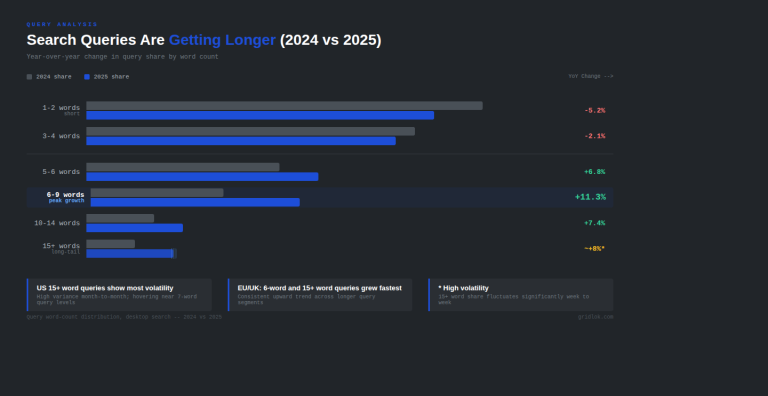
This lines up with a trend I wrote about last year. Queries keep getting longer, with mid-length six and seven word searches growing for a fourth straight quarter. Longer queries are research queries. You can see that pattern in what longer search queries mean for content strategy.
Why this is not the “Google is dying” story
It would be easy to file this under search decline. That reading is wrong, and the same report says so.
Google’s share of searchers rose from 87.87 percent to 90.21 percent over the year. Traditional search held its share of all desktop activity while AI tools, the supposed replacement, actually declined in June. Search is not shrinking. It is absorbing work that used to happen elsewhere.
Rand Fishkin, whose commentary runs through the Datos report, reads the intent shift as searchers learning that the top of a Google results page is now a reasonable substitute for ChatGPT or Claude. You ask, and the answer is right there. You never needed to navigate anywhere.
That is the honest version of the story. The engines are winning. What changed is the job a search result is expected to do. It used to be a signpost. Now it is an answer.
I have made this argument about the platform overall in why the data disagrees with the Google-is-dying narrative. The intent data is the behavioral proof underneath it.
What this changes about optimizing for search
If fewer people navigate and more people research, two long-held habits stop paying off.
The first is leaning on branded navigation. Ranking for your own name matters less when fewer people are searching their way to known destinations in the first place. That traffic was always going to arrive. The research traffic is the part that is now up for grabs.
The second is writing pages that only make sense once someone is already on your site. A research-intent searcher is comparing, learning, and deciding across a results page and, increasingly, inside an answer box. Your content has to do its work before the click, because there may not be a click.
What does pay off is being built to be the answer. Clear, extractable statements. Complete entities so a machine knows exactly what you are and what you cover. Structured data that spells out your facts instead of hoping they get inferred. This is the core of answer engine optimization, and the intent shift is the reason it stopped being optional. I broke down what is actually new versus repackaged in AEO is just SEO with new acronyms.
The deeper version of this shift is that the searcher is not always a person anymore. When an AI agent researches on someone’s behalf, every one of these behaviors gets more extreme: no navigation, pure extraction, no click. I covered that in information agents, when the searcher is software.
What to actually do about it
- Audit your top pages for research intent, not just transactional intent. If a page only answers “buy now,” add the “which one, and why” content that research-stage searchers need.
- Make your key facts extractable. Put the answer in the first sentence of a section, not three paragraphs down after the windup.
- Complete your entity. Make it unambiguous what your business is, what it covers, and how it relates to the category, in text and in structured data.
- Stop measuring success by branded-navigation traffic. That number is coasting on a behavior that is fading. Track whether you show up in research and answer surfaces instead.
FAQ
The headline writes itself as “AI is eating search.” The data says something quieter and more useful. People still search, more than ever, but they search to understand rather than to arrive. The businesses that win the next few years are the ones that show up as the answer during research, not the ones still optimizing to be a destination.
If you want to know whether AI tools are already citing you as that answer, the guide to getting cited by AI is the place to start.
Sources
- Datos (a Semrush company), State of Search Q2 2026: Behaviors, Trends, and Clicks Across the US & Europe. Desktop clickstream panel, April 2025 to June 2026.
- Rand Fishkin, SparkToro, commentary published within the Datos State of Search Q2 2026 report.
See what ChatGPT is really searching
SubSeed captures the hidden Google queries ChatGPT runs behind every answer and enriches them with search volume, CPC, and keyword difficulty.
Related Posts

Read this post with an assistant
This is the whole prompt each button sends. Nothing hidden in it.
Read https://gridlok.co/blog/navigational-search-decline/ and give me the main points in a few sentences.
Make Gridlok a Preferred Source on Google
See Gridlok surfaced more often in your Top Stories, AI Overviews, and AI Mode. One click, applied across Google Search.