AI Readiness: Is Your Business Ready for AI Agents?
AI readiness is the question every business is starting to ask in some form: when an AI agent goes looking on a customer’s behalf, can it find me, read me, and use me?
It is less about chasing the newest tool and more about whether the basics of your site and data hold up when software, not a person, is doing the reading. Most sites are not ready, and the gaps are fixable.
Here is what AI readiness actually covers, how to check where you stand, and what to fix first.
Key takeaways
- AI readiness is how well an AI agent can find, read, and act on your website and business data.
- It is not one thing. It spans access (can agents crawl and render you), data (are your facts machine-readable), content (can an agent trust it), and actions (can an agent do anything on your site).
- Most readiness work is unglamorous and familiar: clean markup, real text, accurate structured data, and fast pages.
- You can assess it. A short audit shows whether an AI can read your key pages and whether an agent can use them.
- The payoff is being the source an agent picks when it acts for your customer, instead of the one it skips.
What is AI readiness?
AI readiness is how prepared your website and data are for AI systems that read, summarize, and increasingly act on them, from AI Overviews and ChatGPT to the agents that book and buy on a person’s behalf.
A human visitor is forgiving. They decode a clever headline, wait for a slow page, and hunt for a price. An AI agent works from what it can parse. If it cannot read you cleanly, it moves to a source it can. AI readiness is closing that gap.
The four layers of AI readiness
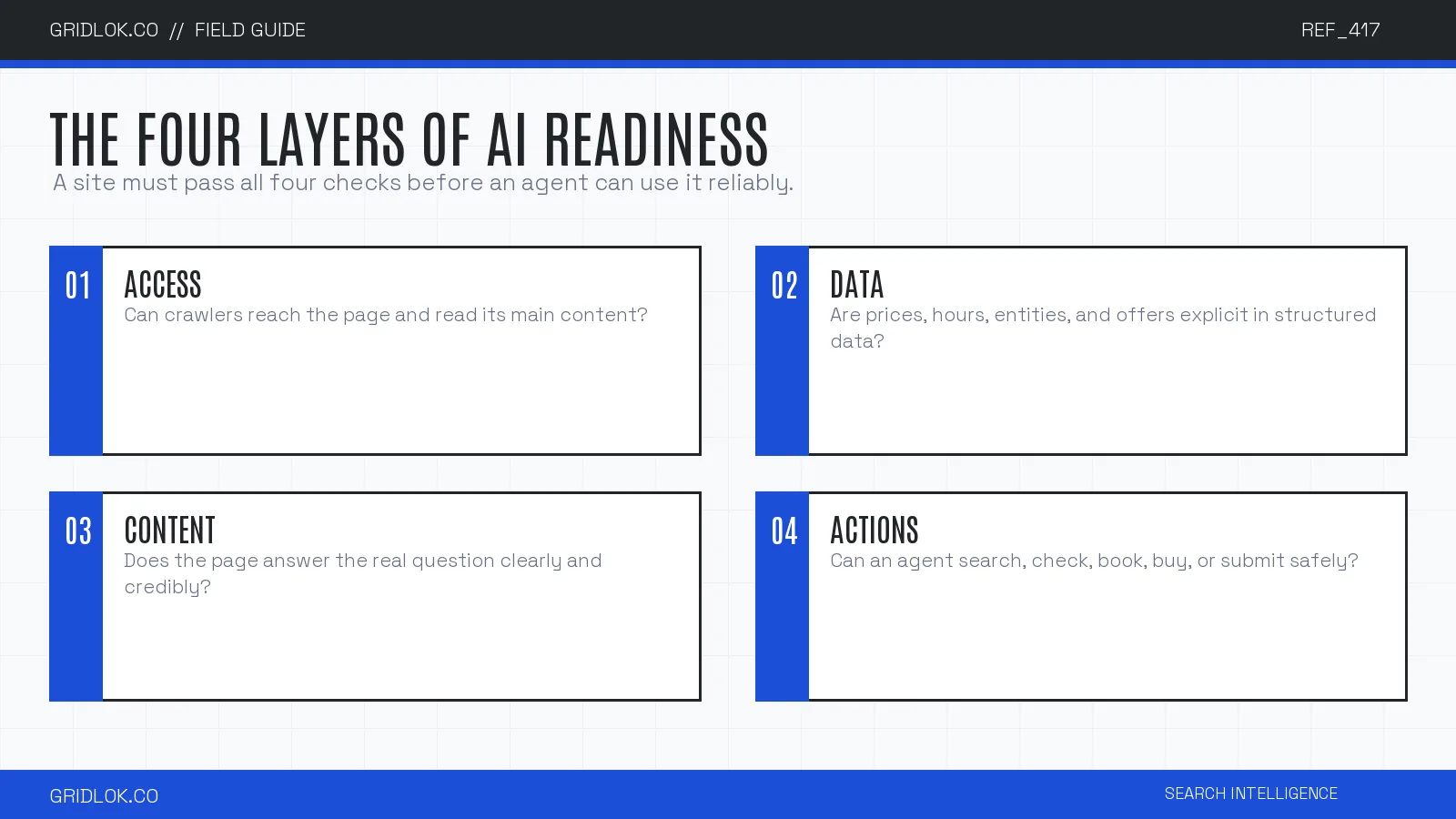
It helps to break readiness into layers, because most sites are strong on some and blank on others.
- Access: can AI crawlers reach your content, and does your page show its content without heavy scripting they may not run?
- Data: are your key facts, prices, hours, and specs in structured data an agent can read without guessing?
- Content: does your writing answer the real question clearly, so an agent can trust and use it?
- Actions: can an agent actually do something on your site, search, book, or ask, through something like WebMCP, or is every action locked in a human-only interface?
A site can rank fine for people and still fail three of these for agents. Readiness is making all four hold.
| Layer | Pass condition | Fast check | Common failure |
|---|---|---|---|
| Access | Crawler can fetch and render the core page | Inspect raw HTML and bot rules | Key content appears only after heavy scripting |
| Data | Important facts are explicit and current | Validate JSON-LD against the page | Schema is missing, stale, or contradictory |
| Content | The answer is clear, specific, and attributable | Ask an AI to summarize the page | Generic copy or facts buried below decoration |
| Actions | Agent can use a safe, defined interaction | Test search, lookup, or a read-only tool | Human-only interface with no callable contract |
A weak layer can block every layer after it. Start with access, then move toward safe actions.
How to assess your AI readiness
You do not have to guess where you stand. A quick assessment covers the basics:
- Pull up a key page and check whether its main content and facts appear in the raw HTML, not only after scripts run.
- Confirm your structured data is present and accurate (Organization, Product, FAQ, LocalBusiness as they apply).
- Read the page as an answer to a real question. Is the answer clear and near the top, or buried?
- Check that an AI can summarize it correctly. The AI Summary Preview shows you what an AI takes from a page.
- Run a full readiness check. The Agentic Readiness Check tests whether an agent can read and use your site, and where it breaks.
What to fix first
If you only do a few things, do these.
- Put your important facts in real text, not locked inside images.
- Add or tighten structured data so your facts are explicit.
- Make sure AI crawlers are allowed where you want to be found, and managed where you do not.
- Speed up your pages and clean up your markup.
None of it is exotic. It is the same hygiene that already helps you in search, done with agents in mind.
Go deeper on each layer
Each layer has its own playbook:
- AI crawlers: what they are and how to control them
- Structured data for AI: the machine-readable facts layer
- WebMCP: letting AI agents take actions on your site
- AI visibility: tracking whether AI mentions your brand
- The wider picture: Google I/O 2026: What Its AI Agents Actually Do
FAQ
AI readiness sounds like a big new project, but most of it is the quiet, durable work you already know, aimed at a new kind of reader.
Start by seeing where you stand. The Agentic Readiness Check shows you what an agent can and cannot do with your site today.
See what ChatGPT is really searching
SubSeed captures the hidden Google queries ChatGPT runs behind every answer and enriches them with search volume, CPC, and keyword difficulty.
Related Posts
Read this post with an assistant
This is the whole prompt each button sends. Nothing hidden in it.
Read https://gridlok.co/blog/ai-readiness/ and give me the main points in a few sentences.
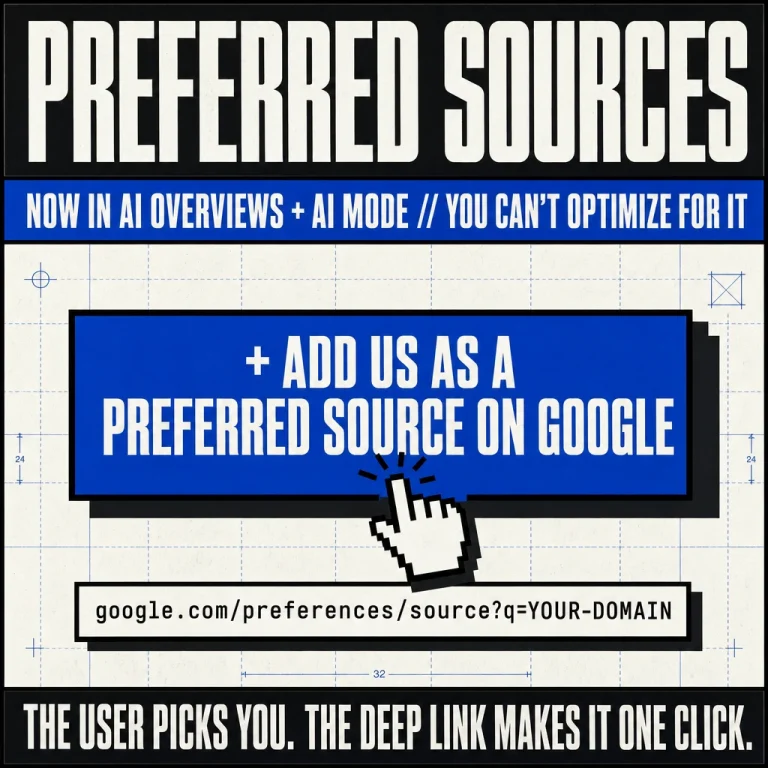
Make Gridlok a Preferred Source on Google
See Gridlok surfaced more often in your Top Stories, AI Overviews, and AI Mode. One click, applied across Google Search.