The Research Behind Predicted Attention: What FastSal and UEyes Actually Found
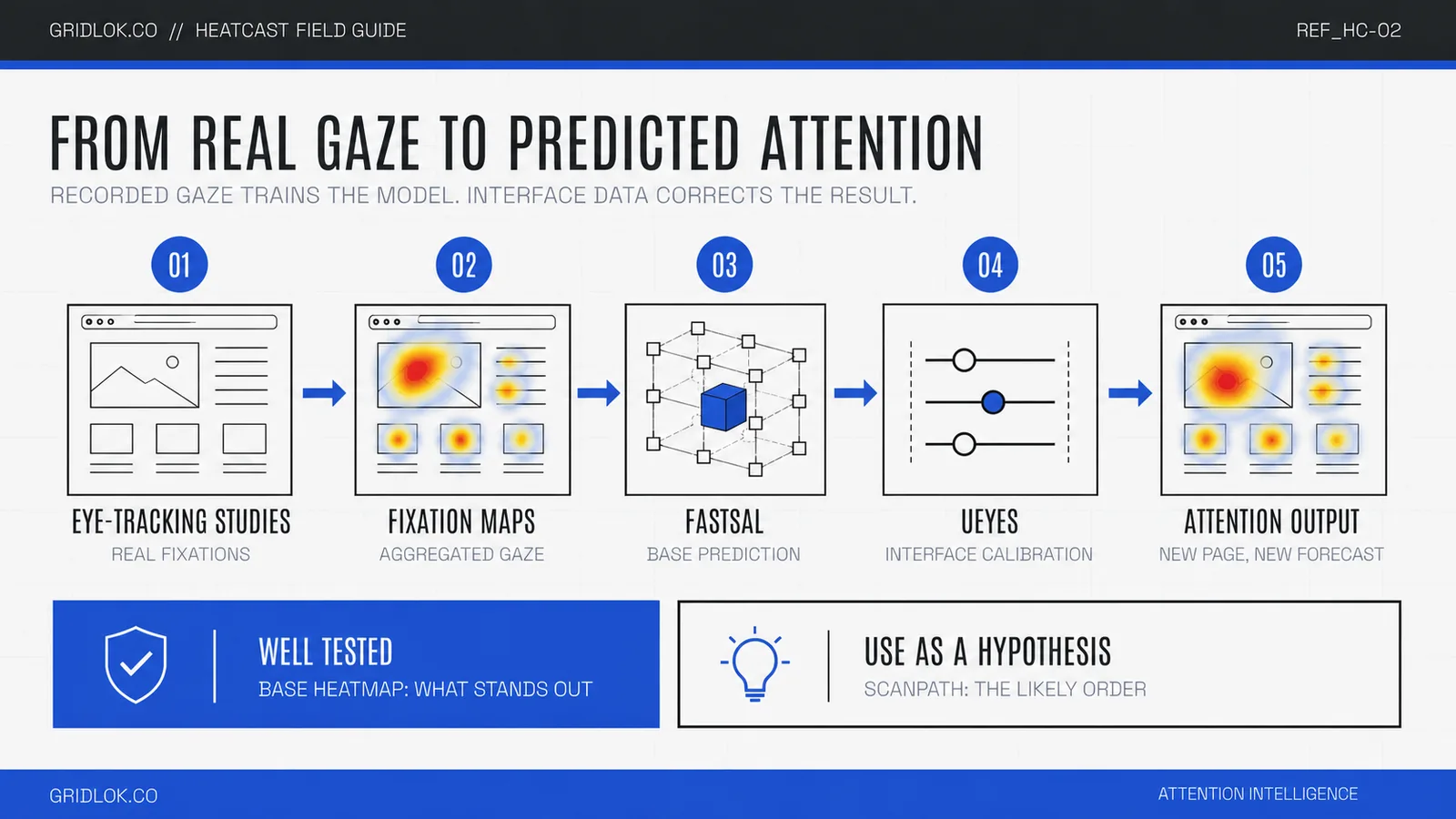
Every AI attention heatmap tool promises the same thing, that a model can guess where a human will look. Underneath that promise sits decades of eye-tracking research and one specific kind of model. Knowing what is in there tells you how much to trust the output.
This walks through what those studies found, including the parts that are solid and the parts that are still open.
Key takeaways
- Attention prediction rests on visual saliency, the study of which low-level features pull the eye. It has been measured with real eye tracking for decades.
- Saliency models like FastSal learn from datasets where people’s gaze was recorded, then predict where fixations concentrate on a new image.
- Interfaces aren’t photographs, so a model trained on natural images needs correcting. That’s what interface eye-tracking datasets like UEyes provide.
- The base heatmap is the well-tested part. The predicted order of looking and any face effects are grounded in research but harder to validate, and honest tools say so.
What actually pulls the eye
Visual saliency is the reason your eye jumps to some parts of a scene before others, without you deciding to. High contrast, sharp edges, motion, faces, and isolated elements all draw attention automatically. This is the bottom-up part of looking, the reflex that happens before intent kicks in.
Researchers have measured this for a long time using eye trackers, devices that record exactly where a person’s gaze lands and for how long. Show enough people the same image, aggregate where their eyes went, and you get a fixation map: a picture of where attention concentrated across many viewers.
That aggregated fixation map is what a saliency heatmap tries to reproduce. It describes the shared pattern across many viewers.
How a saliency model learns to predict
A saliency model is trained on those recorded fixation maps. You feed it thousands of images alongside the real attention data collected for each one, and it learns the relationship between what an image contains and where people looked.
Once trained, it can take an image it has never seen and estimate the fixation map: where attention would likely concentrate. That estimate is the base heatmap.
The model this class of tool commonly uses, FastSal, is built to do this efficiently enough to run on a normal machine rather than a research cluster. Its lineage traces to large saliency datasets like SALICON, and its usefulness comes from a specific test: it holds up on eye-tracking datasets it wasn’t trained on. A model that only performs on its own training data has memorized rather than generalized. Performing on held-out data is the evidence that it learned something real about human attention.
Interfaces aren’t photographs
Most saliency models were trained on natural images, photos of people, landscapes, objects. Web pages and app screens don’t behave like photos, and that gap is where a lot of these tools fall down.
On an interface, attention is pulled by text blocks, buttons, logos, and layout structure in ways a nature-photo model never learned. People also read interfaces, scanning in rough patterns rather than just being drawn to the brightest object. A model that treats your landing page like a photograph will get the emphasis wrong.
This is exactly what the UEyes study set out to fix. Published in 2023 at CHI, the leading academic conference on human-computer interaction, it recorded real eye-tracking data across different user interface types, web pages, mobile screens, posters, and desktop UIs, and showed that visual saliency genuinely differs by interface type and differs from natural images. That dataset lets a tool correct a general saliency model for how people actually read screens, rather than how they look at scenery.
When you see a prediction that accounts for your headline and your button rather than just your hero photo, this interface calibration is the reason.
What eye-tracking research established about pages
Decades of interface eye-tracking produced findings you have probably heard as folklore, now with data behind them.
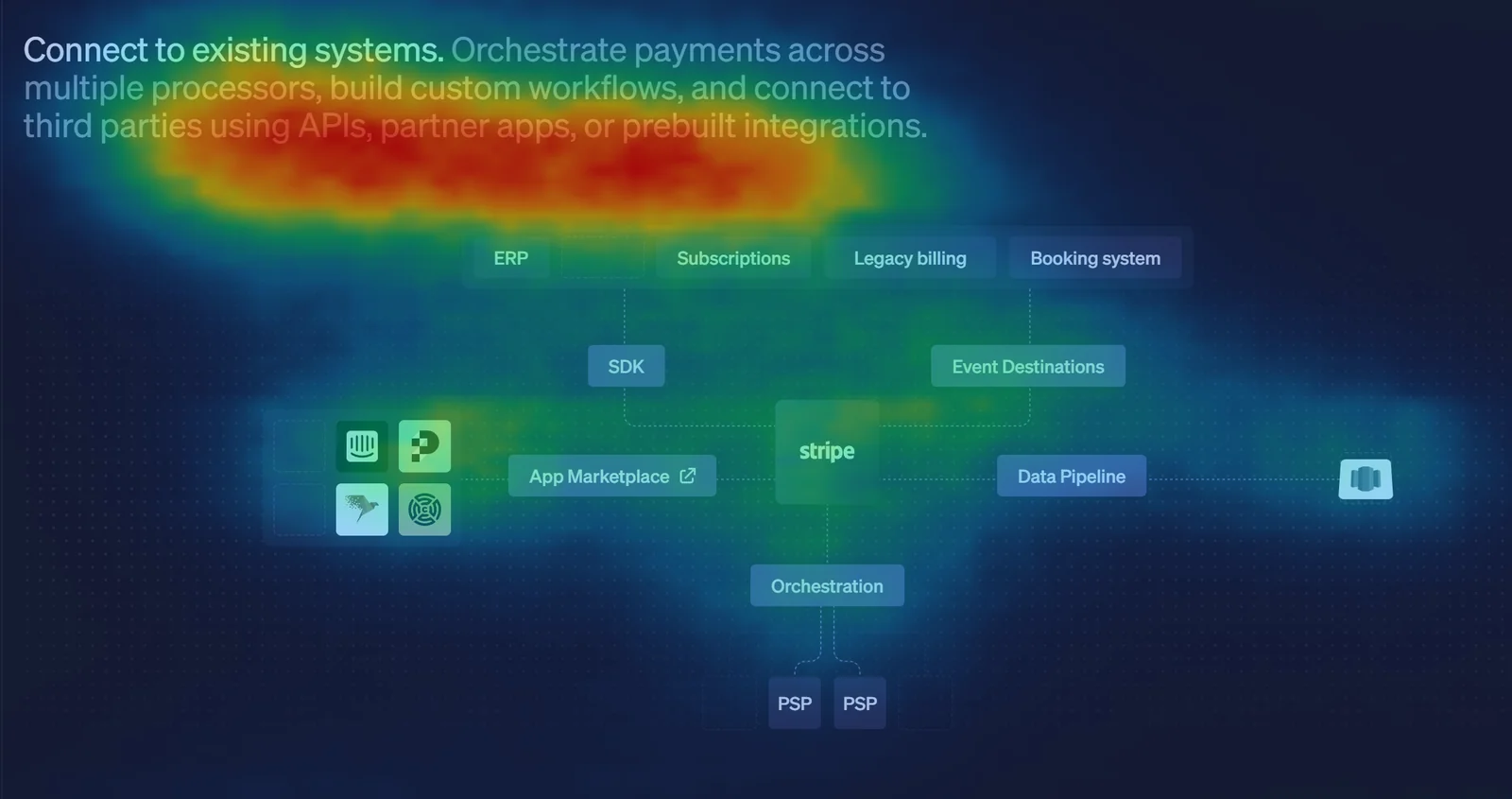
People scan rather than read, especially on first contact, moving through a page in rough patterns and fixating on elements that stand out. Faces reliably draw early attention, which is why a photo of a person changes where the eye goes. And elements that look like advertising get skipped, the effect popularly called banner blindness.
None of this is a rule you can apply blindly, and the specifics vary by layout and task. But the underlying point is stable: attention on a page is patterned and partly predictable, which is the whole premise that makes a saliency model worth building.
The face question, handled honestly
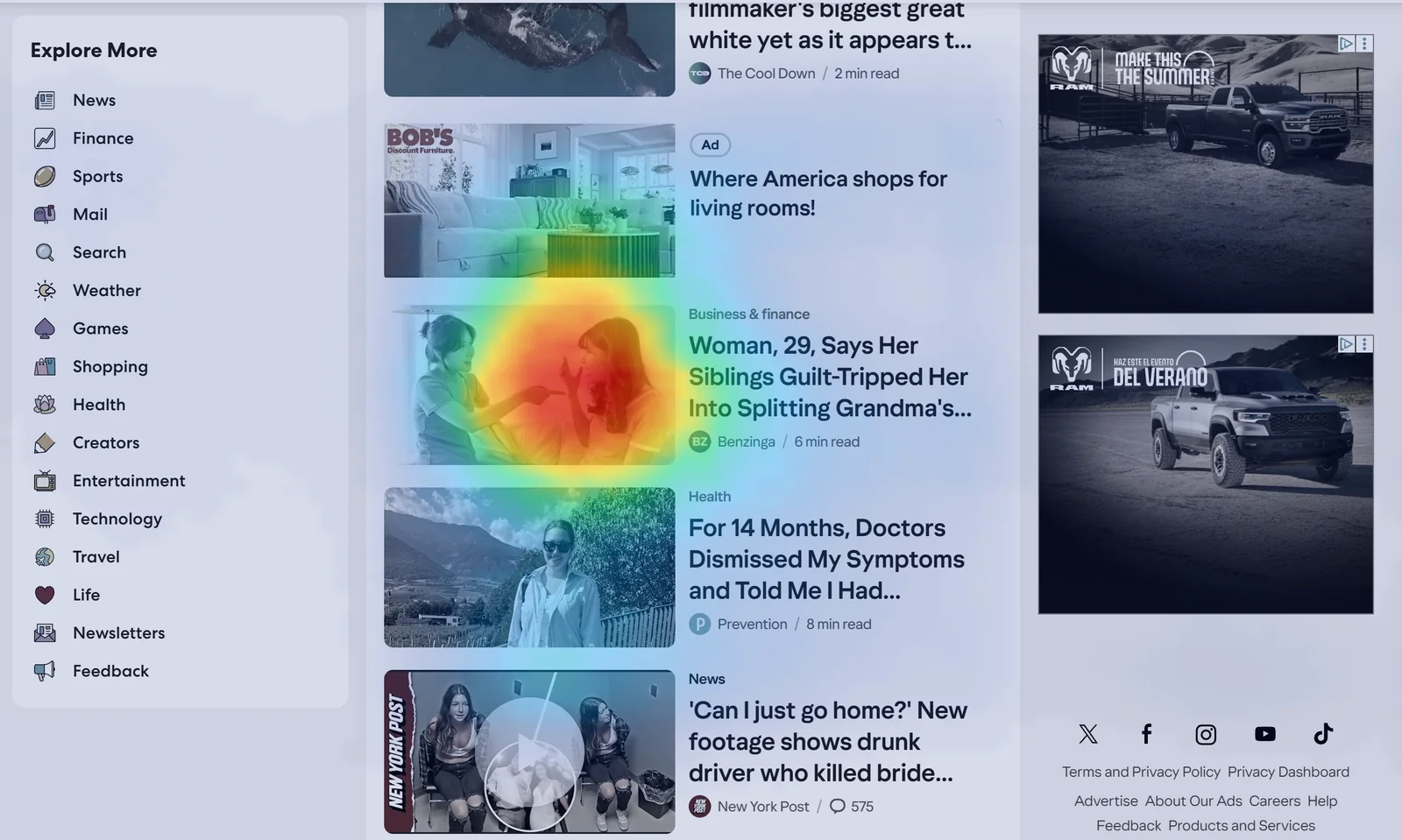
Faces are where these tools most often overreach. Research does show that a visible face can produce a brief early-attention effect. So a well-built tool may let a clearly visible face nudge attention toward an element the base model already supports.
The honest version of this is narrow. A face can adjust attention that’s already plausible. It should not invent a hotspot on its own. And detecting that a face is present is a completely different thing from claiming to read its emotion, age, or identity, none of which a responsible tool infers. The correct use is anonymous, on-device detection of whether a face is there, nothing more.
What is solid and what is still open
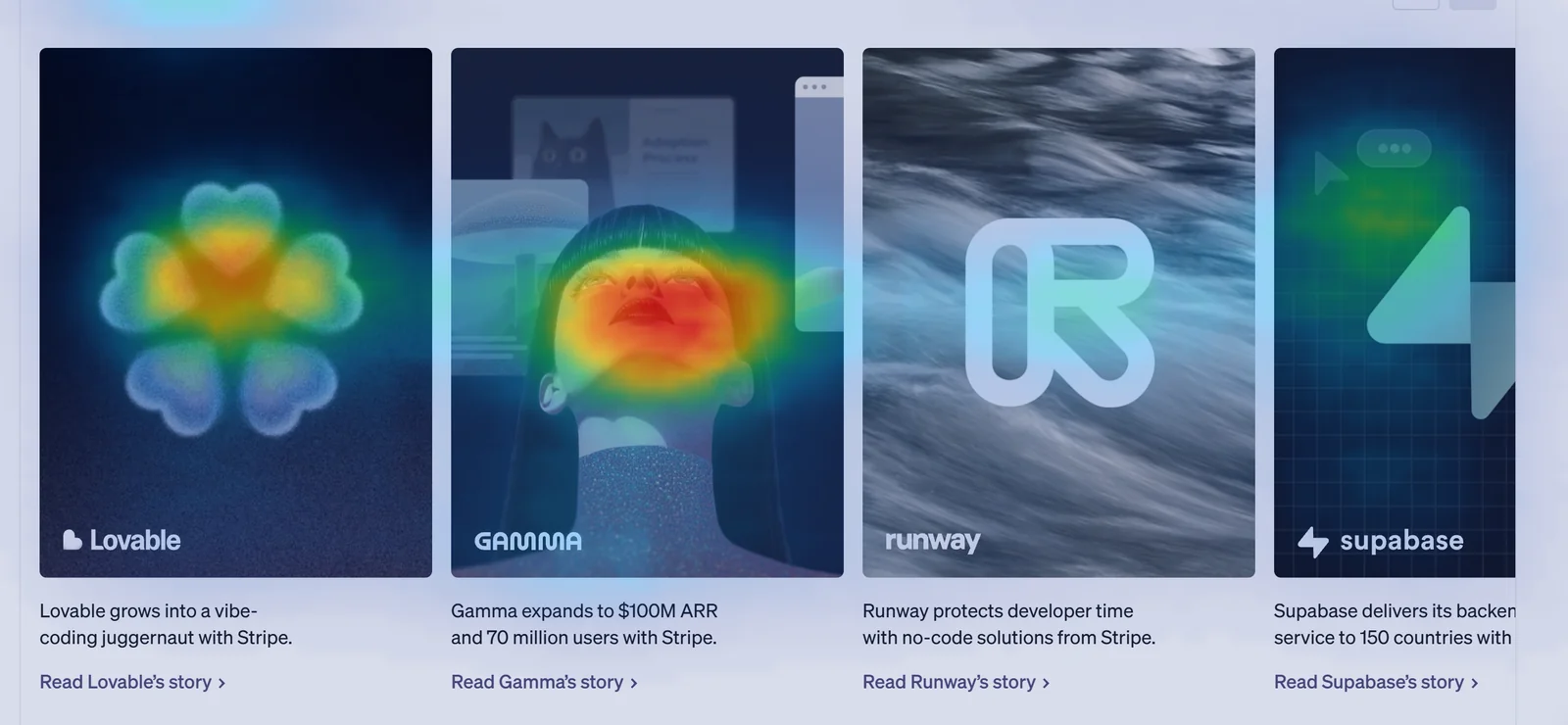
The base heatmap, where attention concentrates on a static image, is the well-tested piece. It has been measured against real eye-tracking data on images the model never trained on, and it generalizes. When a prediction says the eye goes here before it goes there, that claim has decades of method behind it.
The predicted order of looking, the scanpath that animates through a page, is on softer ground. It’s built from published research on how attention moves, inhibition of return, and reading patterns, but turning a static saliency field into a moving sequence involves modeling choices that are harder to validate against recorded gaze paths. It’s a reasonable forecast, not a measurement.
Two more limits matter here. A saliency map predicts aggregate fixation density, the shared pattern, not what any single visitor will do. And real gaze shifts with task and intent: someone hunting for a price looks differently than someone browsing, and a bottom-up saliency model doesn’t know the visitor’s goal.
What to trust and what to check
Knowing what is underneath changes how you should act on a prediction.
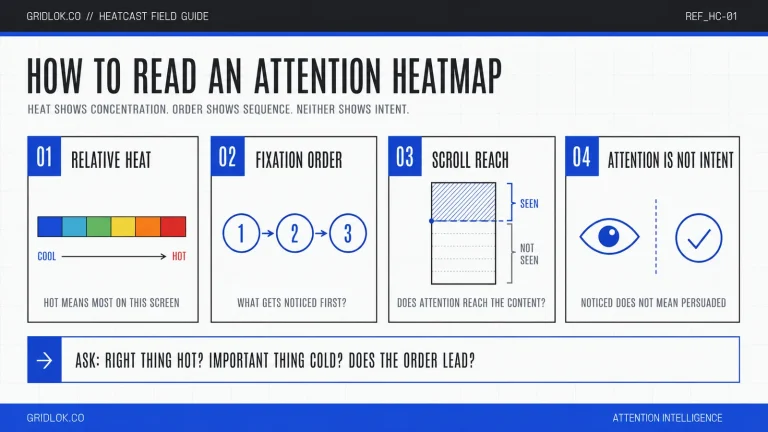
Trust the base heatmap to tell you what stands out and what gets ignored, because that’s the validated part. Use the scanpath as a hypothesis about order worth checking, not as proof. I walked through that reading in more detail in how to read an attention heatmap. Read the whole thing as a design question, then confirm anything that matters with analytics or a real test, the same instinct behind refusing to guess how your customers behave. That’s the discipline I built into the Heatcast tool, which runs this exact model stack on your own device.
There’s also a reason this sits close to the rest of what I write here. A page built so the eye finds the point fast is usually built so a machine can extract that point too, which is the throughline of AEO being mostly SEO with new acronyms and of getting cited by AI. Attention prediction is one more way to check whether your most important content is actually easy to find.
Predicted attention is science with known limits. A tool that names its limits is telling you where its output is strong, which is the part you actually need to know.
FAQ
Predicted attention is a saliency model, corrected for how people read interfaces, doing the one thing it was measured to do well. It shows where the eye is likely to land first. Read with its limits in mind, that’s genuinely useful.
If you want to see it applied to a real page, the Heatcast extension runs this model stack locally and produces a report you can read against the science above.
Sources
- Hu and McGuinness, “FastSal: a Computationally Efficient Network for Visual Saliency Prediction” (2020), the efficient saliency model. arxiv.org/abs/2008.11151
- Jiang et al., “UEyes: Understanding Visual Saliency across User Interface Types,” CHI 2023, the interface eye-tracking study behind the point that UI saliency differs from natural images. github.com/YueJiang-nj/UEyes-CHI2023
- SALICON, a large-scale saliency dataset built from crowd-collected attention data, on how saliency models are trained. salicon.net
- MIT/Tübingen Saliency Benchmark, on evaluating saliency models against held-out human eye-tracking data. saliency.tuebingen.ai
- Eye-tracking research on the early-attention effect of visible faces, the basis for the bounded face adjustment. pubmed.ncbi.nlm.nih.gov/21859204
See what ChatGPT is really searching
SubSeed captures the hidden Google queries ChatGPT runs behind every answer and enriches them with search volume, CPC, and keyword difficulty.
Related Posts


Read this post with an assistant
This is the whole prompt each button sends. Nothing hidden in it.
Read https://gridlok.co/blog/research-behind-attention-prediction/ and give me the main points in a few sentences.
Make Gridlok a Preferred Source on Google
See Gridlok surfaced more often in your Top Stories, AI Overviews, and AI Mode. One click, applied across Google Search.