AI Agents for Business: What They Actually Do in 2026
AI agents are the phrase of the year, and most of the explanations are either breathless or vague. Here is the plain version for someone running a business.
An AI agent is software that takes a goal and works through the steps to reach it, calling tools, reading data, and making decisions along the way, instead of waiting for you to prompt each move.
That is genuinely useful for some work and a waste of money for other work. The trick is knowing which is which.
Key takeaways
- An AI agent completes multi-step tasks on its own, using tools and data, rather than answering one prompt at a time.
- The agents that work are pointed at narrow, well-defined jobs where success is easy to check, not fuzzy, high-stakes ones.
- Most agent failures are not the model. They are the target: a process that was never clear, or systems the agent cannot read.
- Good starting points are repetitive, rule-based tasks with clean inputs, like sorting, drafting, monitoring, and routing.
- Before you automate anything, write down the process a human follows. If you cannot, the agent has nothing reliable to copy.
What is an AI agent?
An AI agent is software built on a language model that can take an action, not just produce text. You give it a goal, and it plans the steps, uses tools (a search, an API, your calendar), checks the result, and keeps going until the job is done or it needs you.
The difference from a chatbot is the doing. A chatbot answers. An agent acts, then checks its own work.
What AI agents actually do for a business
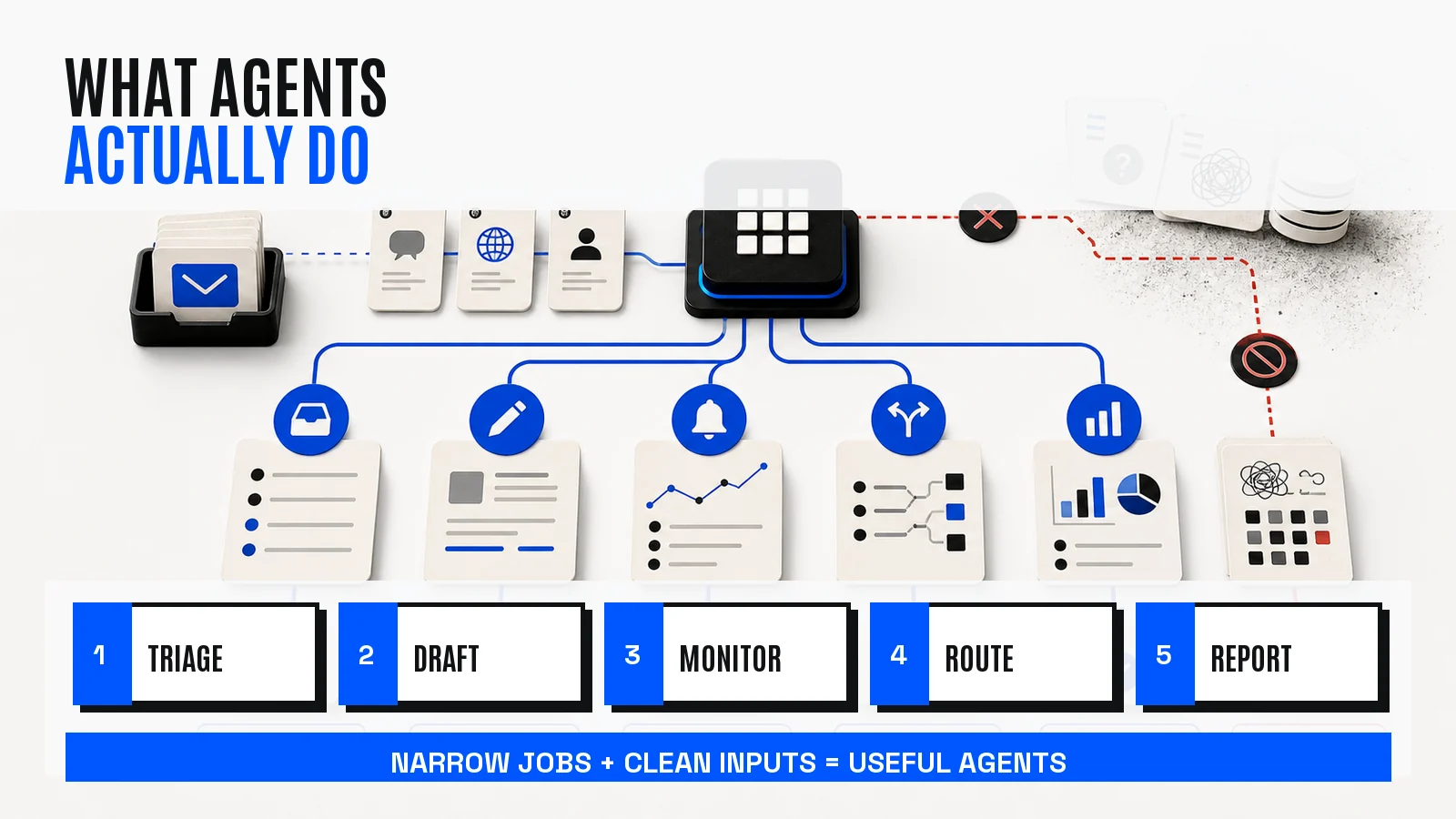
Strip away the demos and the useful jobs tend to look similar. They are repetitive, they have clear inputs, and you can tell quickly whether the agent got it right.
- Sorting and routing: triaging incoming email, tickets, or leads to the right place by rules you define.
- Drafting: first-pass replies, summaries, product descriptions, or reports that a person reviews.
- Monitoring: watching a price, a competitor, a metric, or a news topic and flagging changes.
- Research and gathering: pulling information from several sources into one structured place.
- Data cleanup: standardizing messy records, tagging, deduping, and filling gaps from a source.
Notice what these share. The work is bounded, the inputs are clean enough, and a wrong answer is cheap to catch.
Where AI agents fail, and why
The failures are predictable, and they are usually not the model’s fault.
Teams point agents at the exciting, judgment-heavy problems first, the ones with the least structure and the highest cost of being wrong. Those are the hardest jobs to automate, so they break.
The other common failure is the target. An agent is only as good as the process and the systems it works against. If the process lives in someone’s head, or the data it needs is locked in a layout built only for human eyes, the agent has nothing solid to stand on.
So before blaming the technology, look at whether the job was clear and whether the agent could actually read what it needed.
How to start without wasting money
- Pick one narrow, repetitive task with clean inputs and an easy way to check the result.
- Write down the exact steps a person takes today. If you cannot, fix the process before automating it.
- Keep a human in the loop at first. Let the agent draft or propose, and have a person approve.
- Measure it against the manual version. Faster and at least as accurate, or it is not worth it.
- Expand only once it is reliable. Add scope in small steps, not one big leap.
The bigger picture
The agents most businesses will meet first are not internal tools. They are the consumer agents acting for your customers, from AI shopping assistants and browser agents like Project Mariner to Google’s new always-on Gemini Spark. For the full picture, see Google I/O 2026: What Its AI Agents Actually Do.
When those agents start buying, the plumbing changes with them. Agentic commerce covers that shift, and agent payment protocols explain how software actually pays for things.
And if you want those agents to find and use your business, that is its own discipline: agentic SEO.
FAQ
AI agents are real and useful, but the value is narrower than the marketing. Point one at a clear, repetitive job, keep a person checking it, and grow from there.
And if you want the agents that act for your customers to actually find you, start with whether they can read your site. The Agentic Readiness Check shows you.
See what ChatGPT is really searching
SubSeed captures the hidden Google queries ChatGPT runs behind every answer and enriches them with search volume, CPC, and keyword difficulty.
Related Posts

Read this post with an assistant
This is the whole prompt each button sends. Nothing hidden in it.
Read https://gridlok.co/blog/ai-agents-for-business/ and give me the main points in a few sentences.
Make Gridlok a Preferred Source on Google
See Gridlok surfaced more often in your Top Stories, AI Overviews, and AI Mode. One click, applied across Google Search.